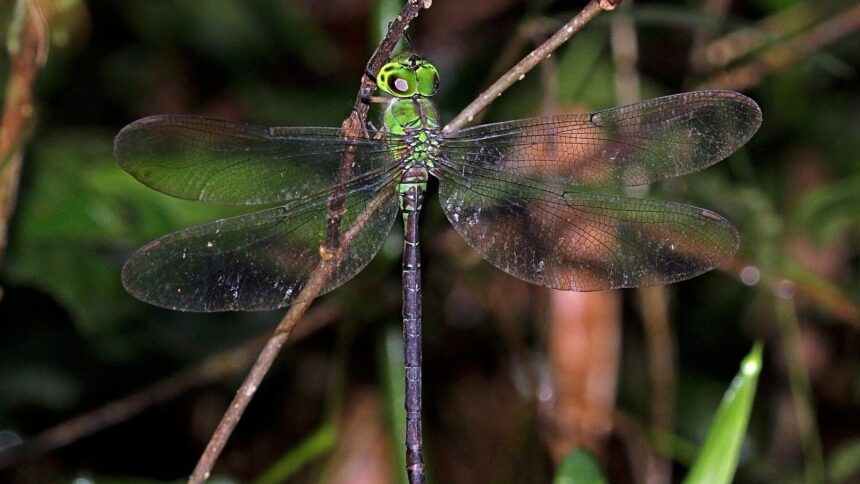
More than a century after it was first recorded in India, a rare dragonfly has made an unexpected comeback in Arunachal Pradesh.
The species, Gynacantha khasiaca, commonly known as the long-tailed duskhawker, was rediscovered in the Namdapha National Park and Tiger Reserve in Changlang district by a team of four citizen scientists. Although the dragonfly was spotted in October 2024, the finding was formally documented in a study published this month in the Journal of Threatened Taxa.
The sighting is significant because the species had not been recorded in India since 1914, when it was first described from the erstwhile Abor Hills. The new sighting location lies nearly 600 km east of where it was originally documented.
But beyond the rediscovery itself, the long-tailed duskhawker is a fascinating creature. Like other dragonflies, it is equipped with large compound eyes comprising thousands of tiny lenses, giving it an almost panoramic view of its surroundings. Dragonflies are among the most skilled fliers in the insect world, capable of hovering in place, changing direction suddenly, and even flying backwards.
A rare dragonfly species has been rediscovered in Arunachal Pradesh’s Changlang district, more than 110 years after it was first recorded in India. The species, Gynacantha khasiaca, commonly known as the long-tailed duskhawker, was spotted in the Namdapha National Park and Tiger…
— The Assam Tribune (@assamtribuneoff)
The newly spotted male dragonfly was observed on a cloudy October morning, rapidly patrolling the roadside and hovering while defending its territory, according to the researchers. Such territorial behaviour is common among dragonflies, which often guard specific patches of habitat from rivals.
Finding a species after more than 110 years is not just a matter of updating a checklist. Dragonflies are often considered indicators of environmental health because many species depend on clean water and relatively undisturbed habitats. about the condition of surrounding ecosystems.
The discovery also underscores the biodiversity value of Arunachal Pradesh. India is home to 504 known species of dragonflies and damselflies, with around 110 recorded from Arunachal Pradesh alone.
Researchers say the rediscovery highlights the importance of continued biodiversity surveys and habitat protection in regions such as Namdapha, one of India’s richest wildlife landscapes.
At a time when many species are making headlines for disappearing, the long-tailed duskhawker offers a rarer story of survival. Hidden away in the forests of Arunachal Pradesh, it appears to have quietly endured for generations before finally being spotted again!