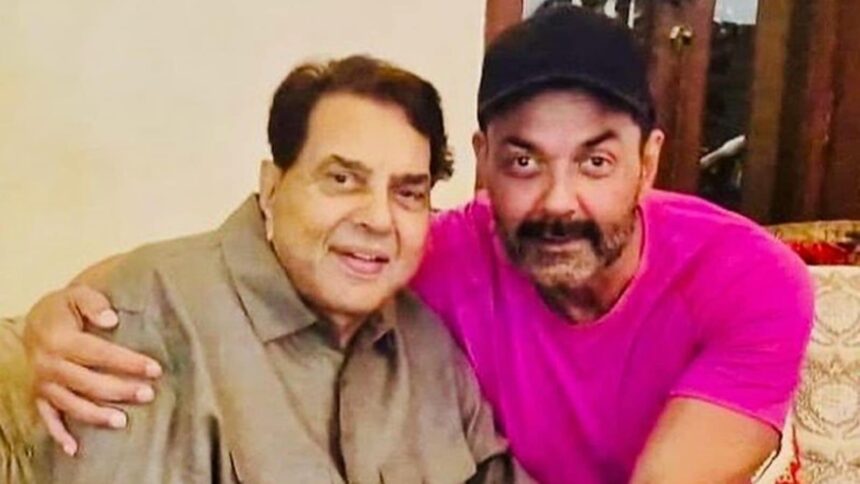
The death of a parent often reshapes a person’s understanding of love, memory, and loss. Legendary actor Dharmendra built a reputation over decades not only through his work on screen, but also through the warmth and simplicity people associated with him off-screen. When on November 24, 2025, just days before turning 90, tributes poured in from across the country. The veteran actor’s death was mourned not only by family and colleagues but also by countless fans who had followed his journey for generations. During an appearance on Shekhar Tonite, son Bobby Deol spoke emotionally about processing the loss and the immense affection people had for his father.
Reflecting on the outpouring of grief, Bobby said, “For me, my father was someone who was loved by the entire world. I always knew everybody loved him, but after his passing, the entire world expressed grief and pain just like his family. That’s who Papa was. Papa was special. Nobody can be like him.” When asked what he would remember most, Bobby struggled to reduce a lifetime of memories to one defining quality and said, “There can’t be one single thing about him. Everything about him is worth remembering. Everything about him was lovely. Even his anger was lovely.”
His words touch on something many people experience after losing a parent — the realisation that grief is not always about one memory or one moment, but about countless everyday moments that suddenly acquire greater emotional meaning.
Counselling psychologist Athul Raj tells indianexpress.com, “In grief work, people rarely begin with the big memories. What returns first are the ordinary things that once felt too familiar to even notice. That is because is built quietly over time. A parent’s presence becomes stitched into the rhythm of daily life, into routines, reactions, conversations, even the emotional atmosphere of a home.”
After the loss, Raj states that the mind becomes unusually sensitive to absence. People realise how much comfort was hidden inside everyday interactions they once took for granted. “In many Indian families, especially, love is often expressed indirectly through involvement, reminders, concern, discipline, and constant participation in each other’s lives. Those moments may not feel emotionally significant while they are happening, but after bereavement, they begin carrying enormous emotional weight because they represent continuity, safety, and care. Grief has a way of revealing how deeply loved we were in the most ordinary moments.”
One of the most emotionally disorienting parts of grief is realising that people begin missing even the things they once complained about. Raj says, “In therapy, grieving individuals often speak about wanting to hear a parent’s scolding voice one more time, or wishing they could sit through one more argument they once found exhausting. That shift happens because grief changes the emotional lens through which memory is experienced.”
When someone is alive, he mentions that the behaviour is processed in the immediacy of everyday emotion. But after death, the mind stops holding on to irritation in the same way. What remains is the person underneath the behaviour. A parent’s anger begins to feel connected to their concern, involvement, personality, emotional presence in the family.
“What Bobby Deol expressed feels deeply truthful because grief rarely remembers people in separate categories of good and bad. It remembers them whole. Even flaws become tender because they belonged to someone whose absence now feels impossible to accept,” concludes the expert.