



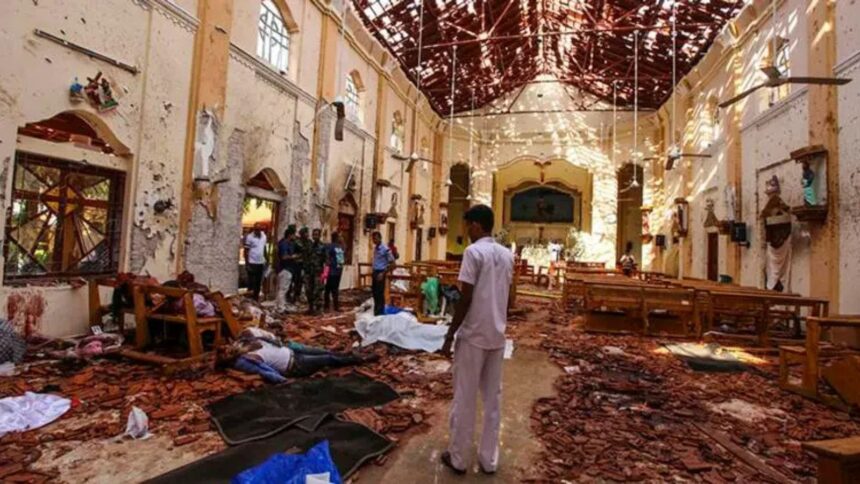
The former intelligence chief of Sri Lanka plotted the April , which killed 269, the country’s Minister of Public Security and Parliamentary Affairs said on Wednesday.
Sri Lankan police on February 25 had arrested the country’s former intelligence chief, Major General (Retd.) Suresh Sallay, in connection with the bombings. In the latest development in the investigation, the first official statement directly linking Sallay to the attacks was made by Sri Lanka’s Minister of Public Security and Parliamentary Affairs, Ananda Wijepala.
Wijepala said, “Current investigations have revealed that former Intelligence chief retired Major General Suresh Sallay had planned with full awareness about the Easter Sunday greedy attack.”
Sallay was arrested by the Criminal Investigation Department under the Prevention of Terrorism Act on suspicion of conspiracy, as well as aiding and abetting the perpetrators of the 2019 Easter Sunday bombings.
Quoting Ananda Wijepala, The Straits Times reported that investigations had revealed Sally met with the alleged orchestrators of the Easter Sunday bombings three weeks before the attacks to obtain information about the target locations.
Last week, Sallay was admitted to the National Hospital after launching a hunger strike to protest what he claimed was degrading treatment while in detention.
Suresh Sallay was appointed head of Sri Lanka’s State Intelligence Service in late 2018 by then President Gotabaya Rajapaksa.
Before his arrest, Sallay had repeatedly denied any involvement in, or connection to, the Easter Sunday bombings.
Channel 4, 2023 documentary linked several Sri Lankan government officials, including Sallay, to the 2019 Easter attacks and later renewed attention on allegations that were raised around him.
According to the documentary, Sallay was among the key figures allegedly involved in orchestrating the attacks.
The 2019 Easter bombings took place on April 21, 2019, targeting three churches and three luxury hotels across Sri Lanka.
The coordinated attacks struck locations in Colombo, Negombo, and Batticaloa during Easter Sunday services. The bombings were carried out through a series of suicide attacks linked to the Islamic State (ISIS).
A total of 269 people were killed and more than 500 others were injured. Investigations identified all eight suicide bombers as Sri Lankan nationals associated with the local Islamist militant group National Thowheeth Jama’ath (NTJ). Following the attacks, the Islamic State of Iraq and the Levant (ISIL) its propaganda outlet, Amaq News Agency. According to the Guardian, the group said the suicide bombers involved in the attacks were “Islamic State fighters”.

