



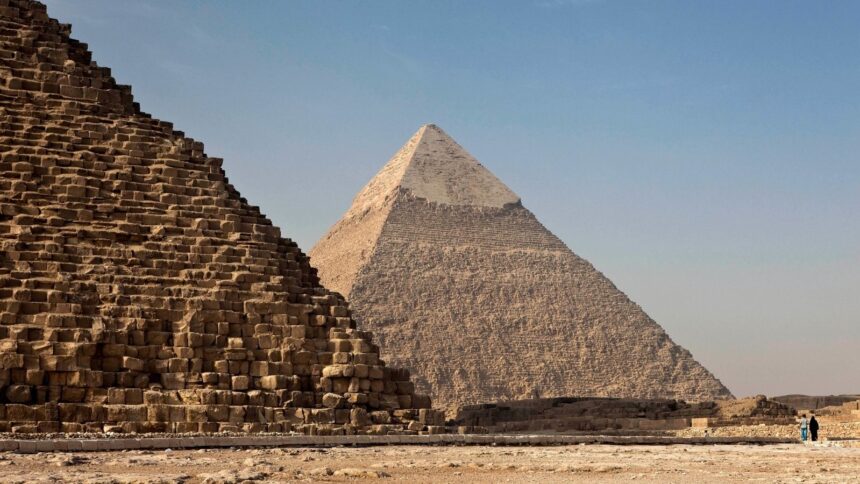
For centuries, historians and archaeologists have debated how the Ancient Egyptians managed to build the Great Pyramid of Giza without modern machinery. Now, new research suggests the solution may lie within the structure itself.
The Great Pyramid, built around 2,560 BCE as the tomb of Pharaoh Khufu, remains one of the most remarkable construction achievements in human history. Standing as the largest Egyptian pyramid ever built, it contains an estimated 2.3 million stone blocks, each weighing between 2.5 and 15 tonnes.
To complete such a massive monument within the roughly 27 years of Khufu’s reign, workers would have needed to position a stone block approximately every three minutes. How they achieved this feat has remained a mystery for decades.
Researcher Vicente Luis Rosell Roig believes he may have found the answer. In a new study published in the journal Nature, he presents mathematical evidence suggesting that the Egyptians used a network of four spiralling ramps built into the pyramid itself.
Previous theories have proposed that workers used large external ramps to haul stones upward. However, critics have long argued that such ramps would have required enormous amounts of building material and likely would have left behind more archaeological evidence.
Another popular theory suggested a single internal ramp spiralling upward through the pyramid. But according to Roig’s calculations, relying on one ramp alone would have taken nearly 50 years to complete the structure, far longer than the available timeframe.
Instead, the researcher proposes that four separate indented ramps spiralled around the pyramid simultaneously, beginning at different points near the base. This design would have enabled multiple teams of workers to transport stones simultaneously, significantly speeding up construction.
Once the pyramid’s main structure was completed, the ramps could have been filled in and concealed, leaving little visible evidence behind. Computer modelling showed that this approach could have enabled builders to finish the monument within the 27 years traditionally associated with Khufu’s reign.
Experts say the theory is intriguing. Dr Roland Enmarch, an Egyptologist at the University of Liverpool, described the idea as a plausible explanation but noted that more evidence is needed.
Future scans of the pyramid could help identify structural features that would be expected if the proposed ramps once existed. If confirmed, the theory could not only explain how the Great Pyramid was built but also offer new insights into the construction of other Egyptian pyramids.

