



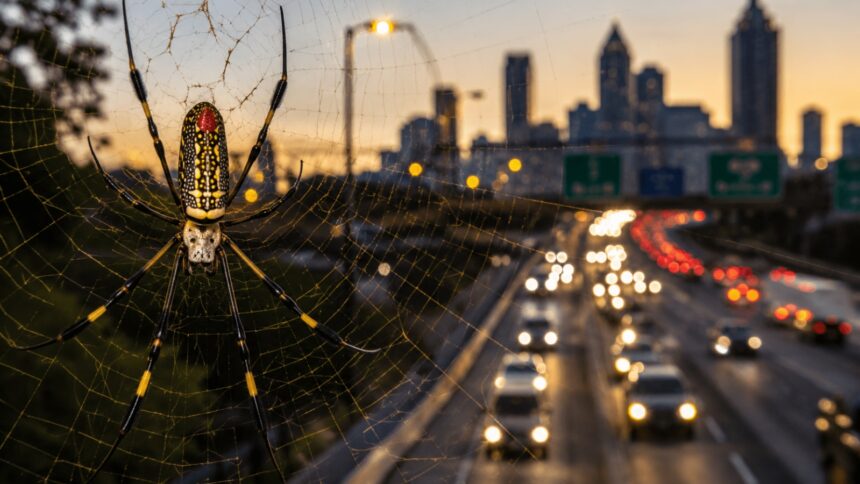
Most animals try to avoid noisy roads. But one giant spider appears to be doing the opposite. Joro spiders, an invasive species that arrived in the United States more than a decade ago, have become known for building their large, golden webs in some surprising places — from gas stations and parking lots to traffic lights and busy roads carrying thousands of vehicles each day.
So why would a spider choose to live amid constant traffic noise and vibrations? A new study published in Physiological Entomology suggests the answer may lie in the spiders’ surprisingly high tolerance for stress.
Researchers from the University of Georgia and Valdosta State University wanted to find out whether traffic noise actually bothers joro spiders (Trichonephila clavata) and their close relatives, golden silk spiders.
To investigate, they collected spiders from both noisy and quiet locations across Georgia. Back in the laboratory, the team exposed the arachnids to traffic-like sounds and measured their heartbeats using high-magnification cameras.
Like humans, spiders experience changes in heart rate when they are stressed. Although their hearts are shaped differently, spiders’ heart rates are surprisingly similar to ours, typically beating between 50 and 100 times per minute.
The researchers expected the spiders might show little reaction to traffic noise because they are often found living near roads. Instead, the spiders’ heart rates did increase when exposed to the sounds.
However, the response was relatively mild. “Yes, they’re getting stressed, but it was overall a pretty mild stress response,” behavioural ecologist Erin Grabarczyk told National Geographic.
That finding may help explain why joro spiders have adapted so successfully to . While traffic noise does appear to affect them, it may not bother them enough to drive them away.
Scientists say this ability to tolerate noisy, human-dominated habitats could be one reason the species has spread so quickly across parts of the United States. The study also raises broader questions about how animals experience modern environments.
Spiders rely heavily on vibrations to understand the world around them. They can pick up vibrations through their webs and the surfaces they sit on, while also detecting sound travelling through the air. In a sense, they may experience traffic noise in more ways than humans do.
Researchers have even found evidence that spiders living in noisy environments may build webs differently, potentially helping them cope with constant background noise.
While many questions remain unanswered, the findings offer a fascinating glimpse into how some animals adapt to life alongside humans — even in places most of us would consider far too noisy to call home.

