



At the WWDC 2026 keynote announcing new AI services, Senior VP Craig Federighi was critical of other companies’ pursuit of AI and made it clear that Apple is doing AI the way it sees as best going forward. “Some appear to be racing forward, seemingly pursuing AI for the sake of AI without clear regard for the people -all of us–that it’s ultimately meant to serve,” he said.
Federighi’s remarks reflect a clear stance on how wants to bring artificial intelligence to consumers, without fearmongering or making false assumptions about what AI is or is not. Unsurprisingly, Apple’s approach to AI has remained largely in line with the past three years since it first introduced its AI tools in 2024. The company is not framing AI as something that reduces the need for human labour, automates work, or makes workers interchangeable. Nor has it introduced tools that write code or described AI as “superhuman” technology.
It’s refreshing to see the world’s most powerful technology company refrain from making sweeping predictions about the impact of artificial intelligence, particularly at a time when concerns about hype, unethical practices, and the irresponsible deployment of AI are mounting. There is also a broader debate about whether AI is making humans less human by making them over-reliant on AI tools and, as a result, less creative.
To be clear, Apple is not pushing back against AI. In fact, quite the opposite: this year’s Worldwide Developers Conference was a showcase of the company’s AI ambitions. What sets Apple apart is how the company is simplifying AI and making it useful to ordinary people, much as it did with personal computing when it introduced the Macintosh. Apple’s approach is centered on bringing AI into everyday products such as the iPhone and Mac – not on futuristic narratives about humans losing control over intelligent machines. It’s harmless.
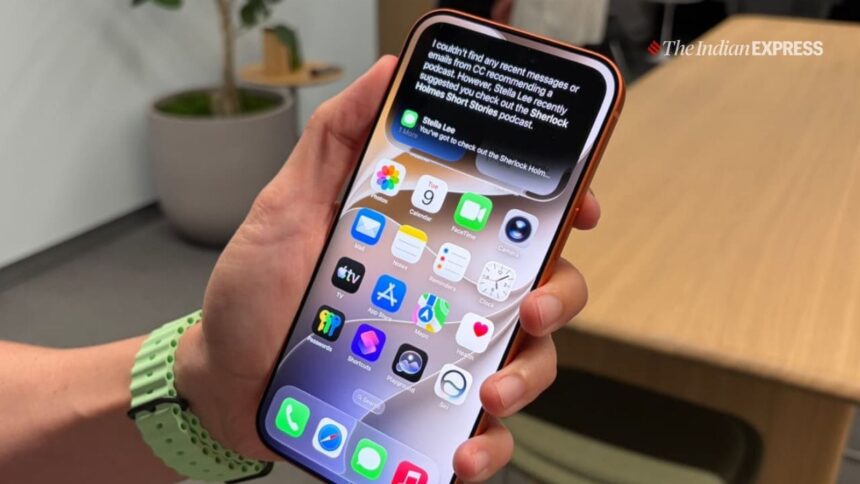
The new Siri, which Apple is calling “Siri AI,” will be available across Apple devices both as a standalone app and as a deeply integrated assistant embedded throughout the company’s ecosystem. It will be able to understand context, handle complex tasks, analyse what is on a user’s screen, and draw information from a user’s Apple devices to provide more relevant and accurate responses.
The use of AI gives Siri a much-needed second life after years of being plagued by speech-recognition errors and inconsistent performance. The experience had deteriorated to the point where many users relied on Siri primarily for simple tasks such as setting alarms, far removed from its original vision: a voice-activated assistant capable of interpreting natural language, conversing naturally, and performing a number of tasks as a secondary interface to the iPhone.
If AI can fix Siri and bring it on par with OpenAI’s ChatGPT and Google’s Gemini, then Apple should use artificial intelligence where there is scope to improve the user interface and the product. AI is not useless- an argument that doesn’t hold up, as critics like to believe.
Apple has done exactly that by redesigning Siri from the ground up and running on a new architecture. During multiple demos, Apple showed how Siri can hold a back-and-forth conversation, pull hotel information from an old email and take action across apps on your device without even touching the iPhone.
While Siri may have grabbed the headlines, and rightly so, Apple made small improvements throughout the software that powers its most popular products. Writing tools are built directly into the assistant. Safari can organise tabs automatically. Calendar can create events from a single sentence, while Shortcuts can assemble complex workflows from a single prompt. The Passwords app can now navigate websites on a user’s behalf to replace weak credentials, and photo-editing tools can reframe, extend, and clean up images with minimal effort.
It is fair to question why Apple chooses certain features for an AI makeover and brings them as part of Apple Intelligence. Yet the more important point is that Apple seems cautious about where AI can make a meaningful impact on consumers’ everyday lives. The company’s slow-and-steady approach can be debated, but it is also consistent with how Apple doesn’t like to rush in. Unlike many of its rivals, which race to ship new features as quickly as possible, Apple takes its own time, to refine the technology until it believes they are ready for mainstream users. Apple has already learnt a lesson by delaying updated Siri, a rare misstep in its history.
One question that keeps coming up is why Apple has not introduced an AI coding assistant similar to Anthropic’s Claude. But the more important question is: how would such a tool benefit the average consumer? Most people are still trying to figure out how AI fits into their everyday lives, and some are genuinely anxious about what they read and hear about the AI technology. A coding assistant, frankly, is of little consequence to most consumers.
That is the very message Apple tried to convey at its developer conference. The company is not asking consumers to live inside another chatbot, nor is it trying to turn every interaction into a prompt. What it is trying to do is make AI meaningful.
Sure, the new features that Apple has introduced may be “basic” and far from being “technical breakthroughs”, but if a tool removes friction from ordinary moments, it still convinces the idea that AI is not the bad technology it is sometimes made out to be.
Automatic password fixes, updated Clean Up and Spatial Reframing tools, and Safari’s page-monitoring capabilities are not really science fiction – and that is the point. AI does not need to be groundbreaking. If it can simplify everyday tasks, remove friction, and save people time, it delivers real value. That is more compelling than building AI around niche or technical use cases that have little to do with average consumers. Clearly, these AI tools actually can be pretty useful for some tasks, which is also what Apple is trying to convince users. Though other tech companies will continue to make overt promises that the AI tools will be able to replace a software engineer, a writer or generate a full-length movie from scratch, the reality is far different.
While everyone is talking about the new and improved Siri, the real structural shift is how Apple is joining the AI race on its own terms. Apple made it clear that Apple Intelligence and the Siri AI are built on third-generation foundation models, trained on its own data. Apple collaborated with Google to build the model family and refined four of the five models using outputs from Google frontier models. But the models themselves, the training data and the privacy structure are Apple’s own. That’s very Apple.
For many, even though there are some reservations about where Apple stands today in the AI race, Cupertino is still by large choosing not to jump onto the broader tech industry AI hype train around agentic AI. For instance, Apple executives called the consumer versions of AI agents early experiments. Though Apple is already preparing developers towards the AI Agentic store behind the scenes.
At WWDC, one thing was clear: Apple is uniquely positioned to bring personal AI experiences for its users while maintaining its strong commitment to privacy. Anthropic’s Claude and OpenAI’s ChatGPT may be popular, but they also collect user data, and many charge subscription fees for access to their most advanced models. Perhaps it is time to recalibrate Apple’s AI strategy on different terms – not by asking who got there first or who has the most powerful model, but by asking who is making AI more useful and human. If there is one company capable of bringing AI to the masses, it is Apple. No company other than Apple has more context about how its users interact with technology than almost any other company.

