



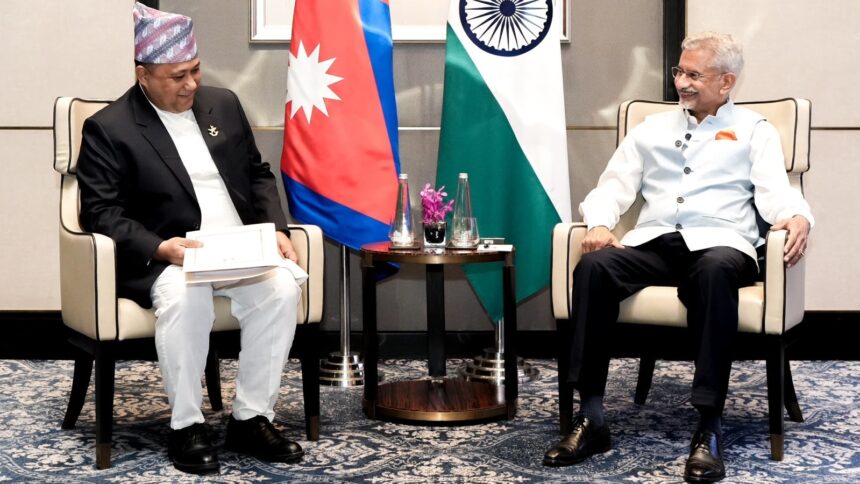
Nepal wants to resolve the border row with India through diplomacy as no problem is too large if both sides sit across with an “open heart”, Nepal Foreign Minister Shishir Khanal said in New Delhi on Sunday, talking to reporters just before concluding his two-day official visit to India.
Khanal said the new government in Kathmandu the “distorted, hyper-sensitive lens of 21st century geopolitics” and instead, wants to build a mutually beneficial relationship for overall prosperity of both nations. This came a day after Khanal held wide-ranging talks with External Affairs Minister S Jaishankar, which included discussions over the boundary issue.
Khanal’s remarks comes a week after Nepal Prime Minister Balendra Shah’s Speaking in the Nepal Parliament on May 31, Shah had stated that the border dispute with India is “not one-sided”. He claimed that after taking office, he discovered Nepal had also encroached on Indian territory in several places, just as India had done to Nepal.
Later that day, Nepal’s Foreign Ministry clarified that the cross-border encroachments were primarily technical issues related to the vaguely defined “no-man’s land” along already demarcated sections of the open border.
Playing down those remarks, Khanal said on Sunday that the priority of the new Nepal government is fast economic growth and it is with that lens that they want to upgrade ties with India, acknowledging at the same time that there are “outstanding issues, including border and boundary”.
“There are active mechanisms that exist between Nepal and India. Field survey team is actually on the border, working together. We agreed during discussions with Jaishankar to activate all these mechanisms to solve border issues,” he said.
No problem is too large and no boundary too complex when we sit down with an open heart, Khanal said, adding, “We look at India with an open heart, clear eyes, and with a single, transparent agenda: the economic transformation of Nepal.”
“Rather than engaging in hyper-nationalistic grandstanding, we are pursuing a calm, data-driven approach to resolve issues,” he said.
Shah had also suggested that the UK should help resolve the long-standing border dispute, as the current territorial boundaries were originally established during the British colonial era. The Ministry of External Affairs had rejected Shah’s call for third-party involvement.
On Sunday, Khanal clarified that Nepal has not sought the mediation of any third country for the resolution of its border dispute with India. “We need historical evidence, and we simply wanted to explore whether we could gain access to certain documents that may be available in libraries or archives in the UK. However, this does not mean that we have sought mediation. That is not what he [PM Shah] intended to convey,” he said.
“If you listened to what he said in Parliament, he stated very clearly and specifically that we want to resolve our border disputes through dialogue and diplomatic channels. This has been Nepal’s longstanding position, and it remains our position today,” Khanal said.
He also indicated that contrary to reports, PM Shah would be travelling to India at an opportune time, even as right now, his priority is to spend time in Nepal. “The PM is willing when he is required to travel. As a new government, the PM was keen on showing results on the domestic front. When the appropriate time comes, he will be ready to travel,” Khanal said.
He also underscored Nepal’s evolving political landscape, “I represent a completely new political reality in Nepal. Our rise is driven by an extraordinary and historic mandate from our citizens, centred on uncompromising good governance, strict meritocracy, and direct accountability.”
On how the new government views ties with India, Khanal said, “We’re not merely neighbours joined by political lines drawn on a map. We are the children of the same rivers, the same mountains, and the same ancient wisdom.”
“When we look across the border, we see a rising India. An India that has fundamentally and beautifully redefined itself on the global stage as a dynamic, fast-growing tech and economic powerhouse. We want to engage with this India of intense aspiration, cutting-edge technology, and relentless execution. In turn, we bring the energy of aspiring Nepal,” he said.
When asked about the Gen Z protests in Nepal and his views on youth protests in India a day earlier, Khanal said, “On the Gen Z question, there was a movement back in September, and the political transition that took place definitely has brought us into power. I would not want to comment on what’s happening in India. I’m happier to talk about Nepal and Nepal-India relations.”
Recently, Nepal had also objected to India and China’s plans to conduct the Kailash Mansarovar Yatra through the Lipulekh Pass, asserting that the route traverses its sovereign territory. On this, Khanal said, “Our concerns are with the renewal of the agreement between India and China through the Kalapani and Lipulekh areas, where we have said for a very long time that the land belongs to us, and without Nepal’s consent, the two countries by themselves cannot make those agreements. And we’ve made that very clearly known through our communication, including diplomatic notes to both countries.”

