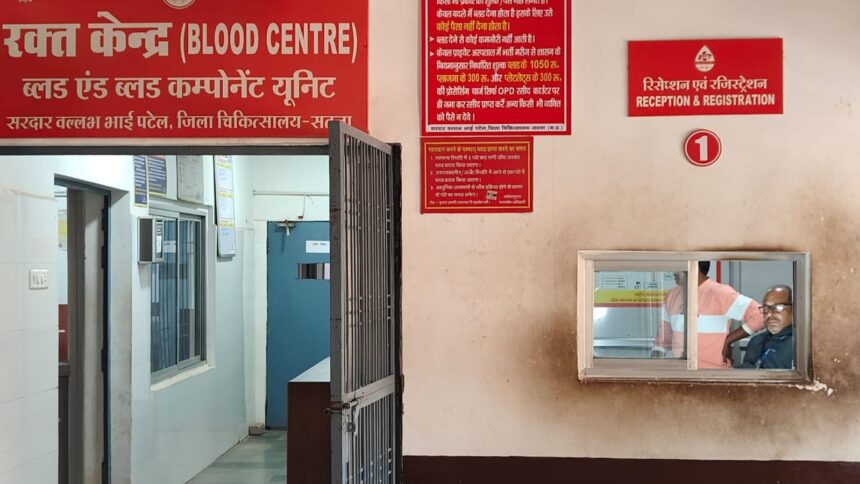
The inquiry committee constituted to investigate the in Satna has found that paid professional blood donors were allegedly operating unchecked within the premises of the district hospital, with authorities failing to curb the practice despite government norms promoting voluntary blood donation.
In beyond the blood bank itself, the committee observed that the hospital authorities “did not act against the use of paid professional blood donors despite the absence of adequate publicity regarding free blood donation services”. The findings were recently submitted to the state health department.
“Due to the absence of publicity and awareness regarding free blood, and due to the failure to impose a ban on obtaining blood donations from paid professional blood donors when patients in the hospital premises require blood — resulting in blood being donated in exchange for money — an FIR has been registered by the district administration over such problems,” the report said.
The committee said the district hospital administration also “failed to prevent the unrestricted movement of unauthorised and suspicious persons within the hospital premises, did not ensure security arrangements as required, failed to continuously inspect the Hemoglobinopathy Centre, ICTC, ART Centre and Blood Centre”.
The observations form part of the wider investigation into how five children suffering from thalassemia, who were dependent on regular blood transfusions at Satna’s Vallabhbhai Patel District Hospital, tested HIV positive. The case first came to light in December last year, though the children were diagnosed with HIV between March and April 2025. CHMO Dr Manoj Shukla and
Civil Surgeon Amar Singh did not respond to the allegations.
Earlier investigations by the Directorate of Public Health and Medical Education had found that proper records of blood donors were not maintained, donor questionnaires were incomplete and blood was allegedly collected without mandatory health screening or haemoglobin assessment.
Despite this, records purportedly showed all donors as having haemoglobin levels above the minimum eligibility threshold.
Investigators had also allegedly found that the blood donation room, which handled 40 to 50 donors daily, frequently witnessed the presence of unauthorised and suspicious persons. The counsellor post at the blood bank was vacant, resulting in the absence of mandatory donor counselling and screening procedures.
The probe further allegedly found deficiencies in testing blood for transfusion-transmissible infections. Between January 2024 and March 2025, 35 of the 204 blood units issued to the infected children were allegedly tested using rapid card methods instead of the more sensitive CLIA testing protocol prescribed for HIV screening. Officials attributed this to the non-availability of CLIA reagents.
The investigation examined Birla Blood Centre, a private facility whose licence had allegedly expired in August 2024, and allegedly found instances of expired blood units being issued, including one unit supplied to a girl suffering from thalassemia. The inquiry also allegedly found that donors who tested HIV-reactive were not referred to Integrated Counselling and Testing Centres as required under guidelines, and referral records were missing.
Serious gaps were also allegedly detected in the district’s HIV monitoring system. Of 14 transfusion-transmissible infection reactive donors identified by the district hospital blood bank between January 2024 and March 2025, only five could be traced through records at the antiretroviral therapy centre. No records were allegedly found for the remaining nine donors.
Civil surgeon Amar Singh told The Indian Express that the hospital administration “doesn’t tolerate paid blood donors”.
“We have taken action against this practice periodically. In fact, just this month, I investigated a case of paid donors and wrote to the SDM for further action,” he said.