



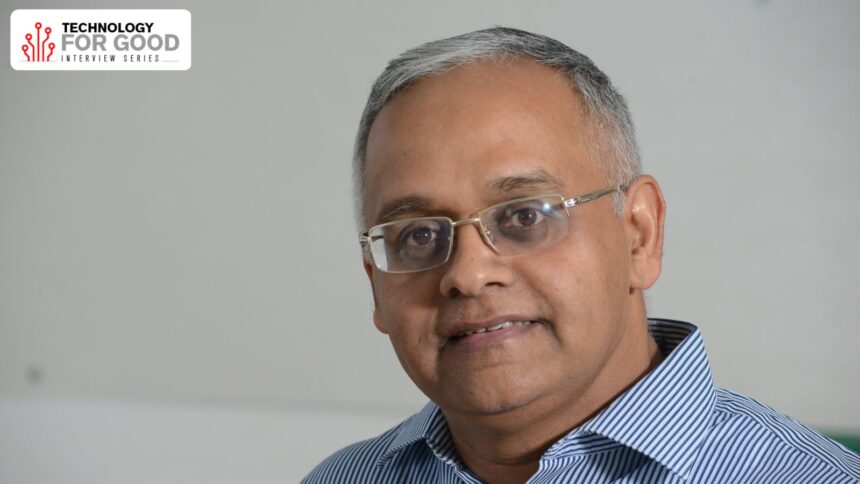
Shridhar Venkat is the CEO of the Akshaya Patra Foundation, which operates the world’s largest school meal programme run by a nonprofit.
With more than three decades of experience in working with multinationals, including Philips, ABB and Webex Communications (now CISCO), Shridhar has been with Akshaya Patra for 21 years, and has served as its CEO for the past 12 years.
An Eisenhower Fellow, Shridhar holds a bachelor’s degree in Electrical Engineering and a master’s in Marketing Management from NMIMS, . He is also an alumnus of the Advanced Management Program at The Wharton School.
Shridhar spoke to about his journey with the Akshaya Patra Foundation, its scale of operations and impact, the role of technology, and the challenges of delivering nutritious meals to millions of schoolchildren every day. Edited excerpts:
Venkatesh Kannaiah: Tell us about your journey towards Akshaya Patra.
Shridhar Venkat: I was involved with the Akshaya Patra Foundation as a volunteer, and had known its Chairman, Madhu Pandit Prabhu, before I joined the organisation.
Madhu Pandit Prabhu is an IIT Mumbai graduate and a techie at heart. While transitioning between various management jobs, he inspired me to join the foundation and do my best for society.
I was 36 at the time, serving as Vice President at WebEx.
Sometimes in life, you experience a calling. That’s exactly what happened to me. And now, 21 years later, not a single day at Akshaya Patra has been boring. Looking back, I could not have asked God for more than what I have received.
We have a dedicated team of volunteers and employees, the hunger warriors, as I call them. There are 9,500 of them serving tirelessly.
Venkatesh Kannaiah: Give us an overview of the scale of operations of Akshaya Patra and its impact.
Shridhar Venkat: On any given day, we handle about 500 tonnes of raw food material. We recently opened Akshaya Patra’s 81st kitchen.
We operate in 16 states and three Union Territories. Every day, 2.35 million children are fed across about 25,000 schools.
We also realised that many children come to school hungry and have to wait until lunchtime for a nutritious meal from Akshaya Patra.
So about a year ago, we launched a morning nutrition programme. Today, we serve about one million morning nutrition servings in addition to the 2.35 million midday meals we serve every day.
We are implementers of the PM POSHAN scheme, which was earlier known as the Mid-Day Meal Programme. We have signed an MoU with the government and implemented the programme on its behalf.
About 92% of the programme is catered through school-based kitchens, while about 8% is implemented by not-for-profits like Akshaya Patra that operate centralised kitchen models.
To show the scale of the issue that we are addressing, Akshaya Patra itself serves only about 2% of the total beneficiary base in India, and yet we are the world’s largest school meal programme run by a not-for-profit organisation.
We have not replaced the government; rather, we complement it. Of course, in the areas where we operate, the government does not run the programme directly. Instead, it provides us with cash subsidies and grain subsidies, which it would otherwise spend on operating the school meal programme itself. We have been implementing this programme for the last 25 years.
Venkatesh Kannaiah: How important is tech in your overall operations?
Shridhar Venkat: Let me tell you why we need technology before we get into how we are implementing it.
You see, if you want to solve a problem of this scale in a country like India, you have to solve it at scale. Otherwise, there are many ideas and pilots, but they remain as pilots.
Technology has helped us scale up.
From a kitchen operations perspective, when we started, we were feeding five schools and about 1,500 children in . Then we said we wanted to serve 20,000 children. The question was: how do you cook food for 30,000 or even 100,000 children within a few hours?
So we looked at how steam is generated in large-scale manufacturing facilities and asked ourselves: why can’t we use steam to cook rice?
That was one of the first uses of technology in Akshaya Patra. Akshaya Patra is also credited with creating India’s first centralised kitchen infrastructure in the not-for-profit sector. So the use of steam for cooking was one technological innovation.
The centralised structure and the vertical kitchen model, which uses gravity to move grains and ingredients, was another innovation.
Third, when we expanded into North India, we faced a different challenge. So the question became: how do you make 400,000 rotis in a few hours?
We approached a rural innovator in who had a papad-making machine that produced about 1,000 papads per hour. We asked him whether he could adapt the same process to create a machine capable of making 10,000 rotis per hour.
Within a week, he built the first version. We then collaborated further, improved the design, invested more resources, and eventually developed a machine capable of producing 40,000 rotis per hour. Today, we even have a prototype that can produce 60,000 rotis per hour.
Technology at Akshaya Patra is also about transparency and governance. One aspect is efficiency and effectiveness; the other is accountability.
For example, when an external auditor comes, they are given access to the entire ERP system of Akshaya Patra. ERP is pervasive across the organisation. All our kitchens are connected through it, and we have what you could call a central nervous system in Bengaluru, which is our headquarters. Every rupee that comes into the system from a donor is traceable within Akshaya Patra.
Venkatesh Kannaiah: Tell us about ways you have used tech to improve outcomes.
Shridhar Venkat: We talked earlier about roti-making machines. Those are examples from the operations side. Let us talk about automation.
One of the differentiators of Akshaya Patra was our mindset toward lateral hiring. If you look at our core team, many of them come from top tech and management backgrounds.
The first thing we focused on was automation to ensure routine tasks were automated.
We have automated key operational and finance processes at scale — from procurement approvals to invoice validation. This has reduced cycle times from days to hours and enabled the instant processing of nearly 12,000 invoices per month.
Our AI-led transformation has significantly improved productivity. Today, we are able to handle three to four times higher volumes without adding manpower.
We have implemented robotic process automation (RPA), and there are so many data points and complex reconciliation processes within Akshaya Patra. Tasks that earlier took 16 hours a day can now be completed in less than 30 minutes, with near 100% accuracy. So we embraced RPA, agentic AI, and related technologies much earlier than is typical in the not-for-profit sector.
If I save just one paisa in the cost of a meal at Akshaya Patra, we can feed 4,000 children for an entire year without raising any additional funds. Technology enables us to optimise at that level.
We also created a platform named Disha, which has enabled last-mile digitisation across Akshaya Patra. Another area is business intelligence dashboards, which support decision-making. For example, I can tell you the exact amount of funds raised till last night.
Similarly, we can track operational metrics across locations to support real-time decision-making.
Another initiative has been digital workflows. We have digitised more than 20 critical processes across operations, quality, HR, and finance. This has brought standardisation and eliminated many manual follow-ups.
What happens is that when we add a new kitchen, it may serve 5,000 or even 100,000 children. It has to integrate seamlessly with everything else we are doing. Technology enables seamless integration and allows us to scale efficiently.
Venkatesh Kannaiah: Tell us about a few tech problems you are still trying to solve.
Shridhar Venkat: I hope this interview reaches people who can help us solve some of these challenges. You see, we are serving ordinary schoolchildren. Many of them are children of migrant labourers. Many come from the bottom of the pyramid, and many come to school with aspirations. But attendance varies, enrollment varies, and circumstances keep changing.
In such a scenario, how do we bring analytics and accurate forecasting of daily meal demand across thousands of schools? If I forecast incorrectly, it leads to significant wastage. So this is a real problem we are trying to solve. How can we predict demand with near 100% accuracy? That is the first challenge.
The second challenge is geographical diversity. For example, our meals reach the jungles of Tripura, where we operate a kitchen in the heart of a forested region. How do we drive technology adoption in places like that? How do we ensure technology adoption across such a geographically diverse country? Even today, in many rural settings, the question remains: how do we enable digital adoption in the last mile?
The third challenge is data. We have built strong data platforms, but how do we ensure real-time and accurate data capture across multiple operational touchpoints? From kitchens to supply chains to finance, we operate at scale. People across locations may not all have the same capabilities or levels of training. How do we ensure accurate and consistent data capture across the organisation?
The fourth challenge is procurement.
If saving just one paisa can help feed 4,000 children for a year, procurement efficiency becomes extremely important. We purchase large quantities of raw materials across the country.
In a distributed, multi-location environment, how do we integrate and standardise vendors using technology? We are working with a leading technology platform on procurement, but this remains a significant challenge.
The fifth challenge is balancing automation with on-the-ground realities. You can automate many processes, but conditions on the ground are often very different. How do you navigate the gap between digital systems and real-world operations?
Unlike many industries, food service can only be automated up to a certain point. Ultimately, someone has to prepare the meal, deliver it, and a child has to eat it.
Venkatesh Kannaiah: Tell us about how you share your learnings and challenges with the larger tech community?
Shridhar Venkat: We do run programmes with various corporates around skill-based volunteering. They often have the flavour of hackathons, where participants work on challenges and propose solutions to us.
We actively take ideas from corporations through these skill-based volunteering initiatives. Of course, the challenges of a not-for-profit are very different from those of a for-profit.
For example, I have a 15-day runway for financial sustainability. A for-profit may have reserves that can sustain it for years. So our challenges are different. We operate on a shoestring .
The second point is long-term ROI in a mission-driven environment.
For example, technology investments in a large-scale social programme create extraordinary long-term value, but the return on investment is often realised over an extended period.
For an organisation serving millions of children, even small efficiency gains translate into significant impact. As I mentioned in the one-paisa example, the impact can be enormous. However, articulating the value of these investments and prioritising them requires a long-term perspective.
The third point relates to sharing our learnings and challenges.
For example, several IIMs, including IIM , have studied Akshaya Patra. IIM Bangalore alone has developed five case studies on our work. Harvard has produced two case studies and one Harvard Publishing case study on Akshaya Patra. So we openly share our learnings and experiences.
Another important aspect is aligning our mission with technology partnerships. We have an advisory board comprising several eminent professionals.
Venkatesh Kannaiah: Do you work with startups in your space?
Shridhar Venkat: At this point, we have not partnered extensively with startups. Partnering with startups requires a certain organisational design, so we typically do it on a case-by-case basis.
However, we have created the ALT Pledge, where entrepreneurs starting a company pledge a portion of their revenue to Akshaya Patra. That is one way in which we partner with the startup ecosystem.
Second, we collaborate with startups operating in the technology space, which can help us solve specific problems.
Venkatesh Kannaiah: We hear of innovations in vertical farming, hydroponics, and alternative/artificial proteins. Your thoughts?
Shridhar Venkat: As long as we are able to provide nutritious food to children and do not use anything that could harm their health, we are open to exploring all kinds of farming practices that can help achieve that goal.
We are not in favour of genetically modified crops. However, if a farmer is using vertical farming or other innovative methods that increase productivity, ensure good quality produce, and improve nutrition, without altering the DNA of the crop, we would be very happy to explore such options.
Akshaya Patra, by design, does not use any artificial or synthetic ingredients. At most, we may use jaggery, which is a natural ingredient.
We are currently talking to a startup incubated at IIT Mumbai. They are working on protein solutions, but these are not artificial proteins. They are derived from plants. We are exploring how we can enrich the protein content of meals served to children. But again, these are natural proteins with better extraction from legumes and other plant-based sources.
It is about going back to natural sources and making the process more efficient.
Venkatesh Kannaiah: How are you using AI in your operations?
Shridhar Venkat: We have automated several critical finance and operational processes, and we are seeing excellent results. In donor care, for example, volumes have increased significantly, but we have actually reduced the number of people required to handle them. In donor care, we have applied automation, AI, and agentic AI.
We are also trying to create Akshaya Patra’s own version of ChatGPT, where people across the organisation can query Akshaya Patra’s data. The idea is to democratise knowledge across the organisation.
We are exploring how AI can be used for auditing and risk management to identify patterns and potential issues much earlier.
I am also thinking about whether we can create kitchens that are highly technology-driven while requiring fewer people to operate. The goal would be to reduce operating costs while maintaining quality and scale. Those blueprints are currently being developed.
You should also keep in mind that we never lay off employees. Our use of AI is for raising efficiency and not for reducing employees.

