



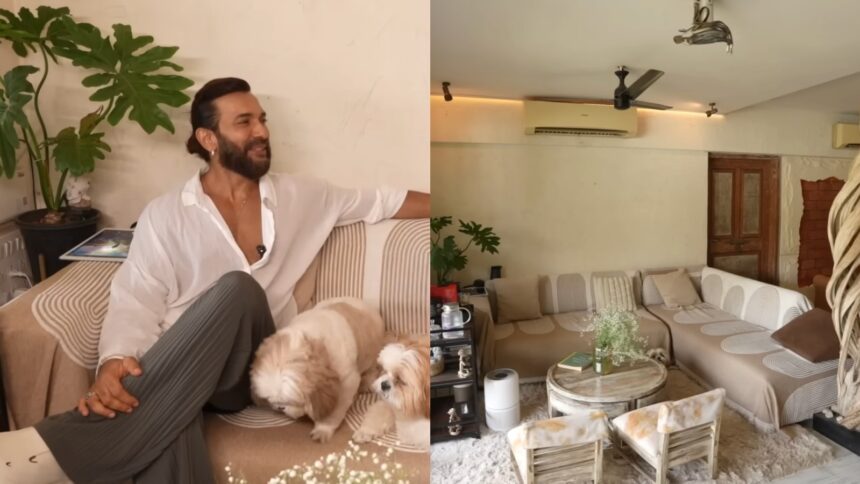
Celebrity choreographer and reality show judge Terence Lewis recently shared glimpses of his opulent house in Mumbai. The Ang Laga De choreographer welcomed filmmaker-choreographer Farah Khan to his abode, which opens with a luxurious yet elegant entrance door detailed with metallic accents. The guests, Farah and her cook Dilip, are welcomed by Terence’s dogs in the living area, with soft, earthy tones, making it perfect for relaxing and meditating.
The space further extends to plush seating in white and beige undertones, a dining area, a black piano, and an eye-catching bench created from tree roots. One of the standout decor items is a real tree trunk placed as a partition between the living space and dining area, adding character to the entire house.
Another piece that instantly grabs attention is an door sourced from Ishitta Arun from Jaipur. The decor piece features detailed carvings with vintage aesthetics. Horizontal metal bars fitted onto the structure hold candles, creating a softly lit corner that Terence says gives the area a church-like atmosphere.
The choreographer shared that Ishitta had helped conceptualise and design the interiors nearly 15 years ago. Attached to the living area is a spacious balcony filled with greenery and blooming bougainvillaea. The outdoor space also features an idol of Mother Mary.
Another highlight of the house is the bathroom. Reacting to the appeal, Farah joked that it looked like it belonged on the set of a Sanjay Leela Bhansali production. “Sanjay Leela Bhansali ka pura bathroom idhar laga hua hai (This looks like Sanjay Leela Bhansali’s bathroom),” the filmmaker says. Terence revealed that the design was inspired by the renowned Spanish artist Salvador Dalí.
The standout feature is a surreal, molten-style basin inspired by Dalí’s famous melting clocks. Instead of a conventional toilet seat, the bathroom features a throne-like commode. Terence explained to Farah that the throne could be lifted for practical use, though she chose to sit on it and pose for fun. A chandelier completes the theatrical aesthetic.
The tour continued into Terence’s study, featuring a cosy room with lime-washed walls, dark-toned seating, a television, and a blackboard where he had been mapping out ideas for beginning his YouTube journey.
Next up was the kitchen with warm interiors and yellow walls, and blue floral curtains. The space also grabbed attention for its striking chandelier assembled entirely from tea kettles.
Rahul Bansal, Partner, groupDCA, shared ways to meaningfully incorporate art and personal beliefs into modern interiors without making the space look crowded. He explained that the key is to identify zones for art, artefacts, wall installations, and other elements. “Once these zones are identified, the idea is to carefully curate what truly belongs there rather than filling every surface. The art should feel personally and culturally relevant to the homeowner, whether it connects to their beliefs, memories, or regional roots,” Bansal said.
“The next important part of the process is scale and placement. Well-chosen pieces need to be positioned thoughtfully and in the right proportions to create a meaningful and impactful spatial experience. When curated thoughtfully, these pieces can introduce warmth, identity, personality, and cultural relevance into a modern interior without making the space feel visually cluttered,” he added.

