
India has more cities among the world’s 50 most heat-vulnerable than any other country, with 14 cities featuring in an Oxford University study of 205 global cities. Nigeria and Pakistan, the next highest, have five and four cities respectively.
The study ranked cities not just on how hot they get, but on three factors: how many people are directly exposed to severe heat; how susceptible they are, with those in slums with poor ventilation and no reliable electricity or water at far greater risk; and how well a city can cope, where green cover and open spaces help, putting a city like , with its depleting tree cover, at a disadvantage.
The study, “Moving beyond exposure: a globally comparable framework for heat risk assessment in cities”, analysed living conditions across 205 cities with populations of more than one million. Heat risk in the study is assessed on three counts: hazard exposure, vulnerability, and coping capacity.
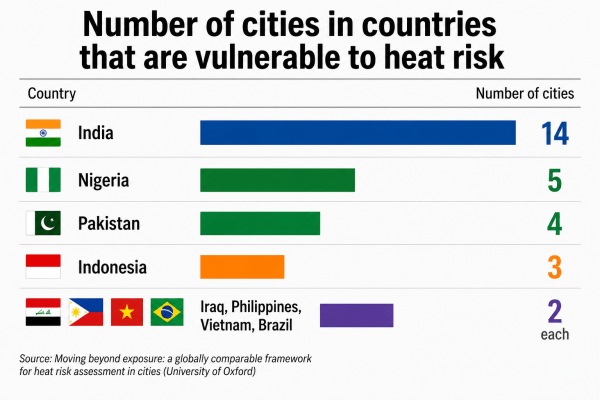
Among Indian states, Maharashtra has the maximum number of cities in the top 50 with three cities on the list: Nagpur (4th), (23rd) and Mumbai (46th). and Uttar Pradesh follow with two each, and Madurai for the former, and Kanpur and for the latter. The remaining eight Indian cities on the list come from eight different states: (Gujarat), Patna (Bihar), (Karnataka), (Madhya Pradesh), Jaipur (Rajasthan), (Telangana) and (West Bengal).
Among Indian cities, Ahmedabad ranks second globally, followed by Madurai (7th), Bhopal (15th) and Kanpur (20th).
The study’s findings come as several Indian cities, including Mumbai, Nagpur and Pune, have been under heatwave conditions and recurring orange alerts since March, driven by El Niño, which is a climatic phase triggered when trade winds weaken and push warm water toward the eastern Pacific, raising temperatures globally.
“Heat risk in cities is not solely determined by temperature extremes but by the combined effects of environmental conditions, including humidity, mean radiant temperature, wind speed, socio-demographic vulnerability and system-level capacity to cope,” the report stated.
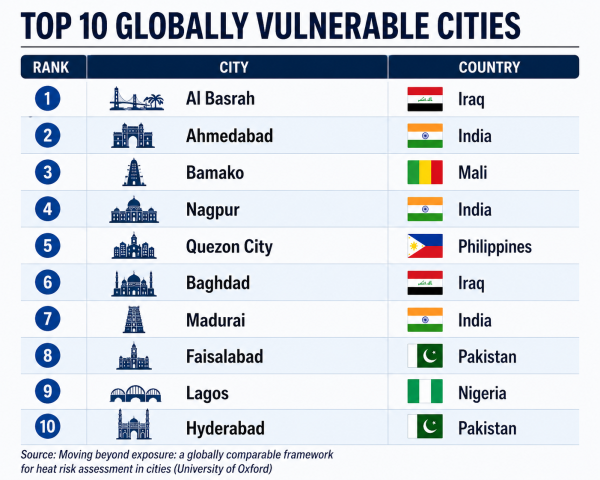
The risk index also factored in socio-economic conditions that increase susceptibility to heat-related illness, access to cooling infrastructure such as air conditioning, and ecological buffers such as tree cover.
Researchers cautioned against over-reliance on air conditioning. “Increased fossil fuel-based electricity demand, high global-warming-potential refrigerant gases and waste heat emissions can exacerbate urban warming over time,” the report noted.
Lead author Nethmi Jayaratne Kariyawasam, a DPhil researcher at the Oxford Smith School of Enterprise and the Environment, said the study highlights that heat risk emerges through multiple pathways, not just temperature exposure.
Radhika Khosla, Associate Professor at Oxford, said heat-risk planning must address vulnerability and coping capacity, not just exposure. “Air conditioning demand is increasing worldwide, but many cannot afford it. And if we over-rely on this energy-intensive form of cooling, we risk further global warming in a vicious cycle. Passive cooling and low-energy technologies such as fans and coolers should serve as the first line of adaptation,” she said.