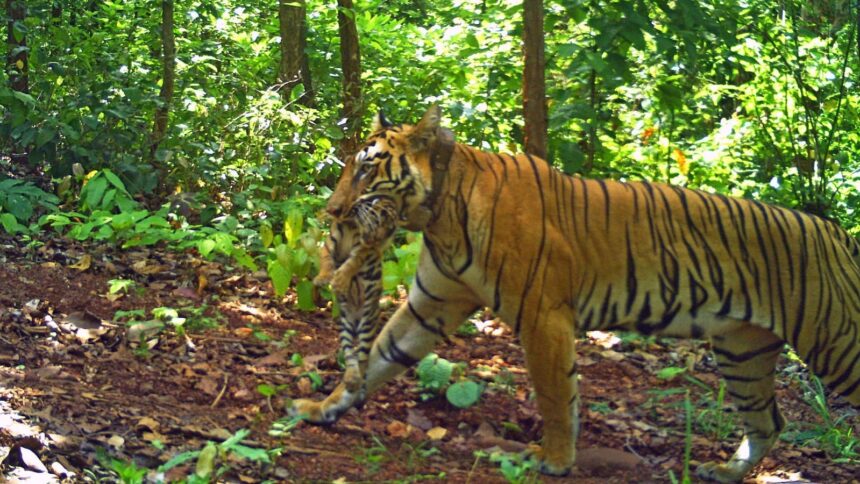
When the arrived in Odisha’s Similipal Tiger Reserve in late 2024, wildlife officials hoped it would help balance the gene pool at what is the only home in India of a rare tiger population.
Then, Zeenat vanished. Within days of being released into its new home, the three-year-old tigress slipped out of the reserve, crossed state boundaries, wandered through forests in Jharkhand and West Bengal, and triggered a frantic three-week operation that kept wildlife officials in three states on alert.
For months after its eventual recapture and return to Similipal, Zeenat remained under close watch, its every movement tracked through a radio collar as forest officials wondered whether the ambitious translocation experiment would ultimately succeed.
This week, they got some good news.
Camera traps installed deep inside the forests of Similipal have captured images of Zeenat carrying four cubs, offering what officials describe as a major milestone in Odisha’s efforts to strengthen the reserve’s tiger population.
“The cubs are believed to be around three to four weeks old and their movements are being continuously monitored,” Similipal Tiger Reserve Field Director Prakash Chand Gogineni told The Indian Express.
Diversifying gene pool
For conservationists, the significance of the photographs extends far beyond the birth of four cubs.
Zeenat was brought to Similipal from the Tadoba-Andhari Tiger Reserve in Maharashtra in November 2024 as part of a carefully planned effort to diversify the gene pool of tigers in the reserve.
Similipal, spread across northern Odisha, is home to the country’s only known population of pseudo-melanistic tigers — popularly called black tigers because of the unusually thick black stripes that merge across their coats. Scientists believe the trait became common because the tiger population remained geographically isolated for generations, resulting in extensive inbreeding.
While the striking appearance of Similipal’s tigers has drawn global attention, conservationists have long worried about the genetic consequences of such isolation.
Officials said Zeenat’s relocation was intended to introduce fresh genetic material into the population and reduce the prevalence of inbreeding-linked traits that could threaten the long-term survival of the reserve’s tigers.
“As Zeenat is from Tadoba, it does not carry the genetic trait commonly found among Similipal tigers. Its cubs are therefore expected to have a broader genetic base, which was the primary objective of the translocation programme,” Gogineni said.
Principal Chief Conservator of Forests (Wildlife) P K Jha said after Zeenat was released free into the wild in April 2025, it mated with a resident male but did not conceive. “The tigress moved freely inside Similipal and formed a territory in the core area. Once again, it mated with a resident male in January 2026,” said Jha.
He said the birth of the tigress’s cubs marks the achievement of the primary objective of the tiger translocation project, which was increasing the genetic diversity of Similipal tigers. Zeenat’s offspring with a male tiger from Similipal Tiger Reserve will have high genetic diversity and be helpful in securing the future of Similipal’s tiger population, Jha told The Indian Express.
Rocky start
The achievement comes after a turbulent beginning.
Soon after being released into a soft enclosure in Similipal’s northern division, Zeenat began an unexpected journey that took her nearly 300 kilometres across three states.
Its movements became a daily source of anxiety for forest officials as it moved through forest corridors, crossed human settlements and repeatedly evaded capture teams.
After 21 days on the move, Zeenat was finally tranquillised near Gosaindihi village in West Bengal’s Bankura district.
It was initially taken to ’s Alipore Zoo before being brought back to Similipal in accordance with guidelines issued by the National Tiger Conservation Authority (NTCA). Officials subsequently housed it in a larger enclosure before releasing it again into the wild under intensive monitoring.
Since then, its radio collar has provided forest officials with a near-continuous stream of information about its movements and adaptation to the Similipal landscape.
Now, with Zeenat successfully raising cubs in the wild, officials believe the tigress has finally made Similipal her home.
The birth of the cubs has also prompted discussions on whether the radio collar, fitted during the translocation project, should be removed.
Forest officials said any decision would be taken by a high-level committee comprising representatives of the Odisha government and the NTCA.
“For now, monitoring will continue for some more weeks,” said a senior forest department official. “A decision on removing the collar will be taken once the cubs begin moving independently.”
Odisha CM Mohan Charan Majhi called the development a “proud chapter” in Odisha’s wildlife conservation efforts. “This success not only signifies an increase in the tiger population in the state but also stands as an excellent testament to our administrative foresight in protecting biodiversity and creating a safe and robust habitat for wildlife,” Majhi wrote on X.