Written by Haobijam Chinglemba
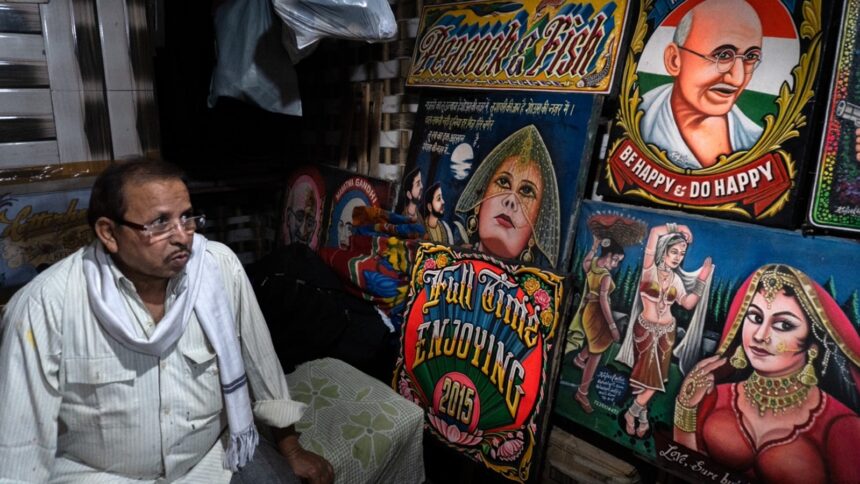
In a small pocket of , where the azaan from Jama Masjid echoes through crowded bazaars and narrow lanes, an alley preserves a fading chapter of India’s visual heritage. The craft of Bollywood-style hand-painted hoardings and film posters has largely yielded to the digital age. Yet one artist continues to keep the tradition alive, preserving an art form on the brink of disappearance.
Meet Kafeel Ahmed Ansari, better known as Painter Kafeel, a 70-year-old veteran artist who once hand-painted hoardings and posters for Bollywood re-runs such as Deewaar (1975), Pakeezah (1972), Mughal-e-Azam (1960), and Ram Aur Shyam (1967), among many others.
Born in the small town of Aonla in Bareilly district, Uttar Pradesh, Kafeel’s journey has been shaped by devotion to art.
His father, a shopkeeper, encouraged his artistic ambitions from an early age. Kafeel’s journey into painting began in school, where he learned calligraphy under his teacher, Niamatullah Ansari. In the evenings, he would spend hours watching local painter Shabir Raza Khan at work, observing his techniques and styles.
A turning point came in 1980, when Kafeel lost his father and the family business collapsed, leaving him without financial support. Carrying only Rs 1,000, he travelled nearly 268 kilometres from Bareilly to Delhi in search of work and opportunity.
After arriving in Delhi, he stayed with relatives in Jamnapar. Armed with brushes, paints, and a bicycle, he roamed the city looking for work. He later apprenticed under artist Faiz Siddiqui for 19 years, refining his craft. In 1999, Kafeel opened his own studio in Matia Mahal near Jama Masjid. Over time, his work gained recognition across the city, ranging from commercial signboards to cinema billboards.
However, the early 2000s brought sweeping changes. The rise of flex boards, digital inkjet printing, and digital photography transformed the advertising industry, gradually replacing hand-painted film hoardings across India.
Recalling the transition, Kafeel says, “Many of my colleagues died, and many left the city as their paintbrushes dried out after the film industry stopped hiring painters for hoarding boards and posters. All they knew was painting, which was replaced by technology. The inks of digital prints absorbed the artists’ lifeline during that time. I survived because, other than painting, I knew calligraphy.”
As digital printing gained dominance, Kafeel briefly experimented with digital art and accepted a few commissions. But the work brought him little satisfaction. Eventually, he returned to his roots: hand-painting.
When asked why Bollywood-style hand-painted art continues to attract admirers in the West, Kafeel pauses before answering: “In the West, computer-based artworks and paintings are saturated; people there want work that has depth and a tactile human touch. Another reason Bollywood-style painting is in demand is that it is different from the popular approach and mainstream artwork in the West. Buyers from the West consider the practicality of hand-painted work, as it lasts longer than digital printing. Outdoor paintings can last 50 years, while indoor works, if properly maintained, can last 100-200 years.”
Kafeel believes art should reflect equality and unity within society. For him, the bold colours in his paintings symbolise India’s diversity, while the striking three-dimensional lettering represents the depth of Indian culture. The aesthetics of Bollywood-style hand-painting still survives today — on trucks, old billboards, and clothes.
Yet Kafeel’s greatest wish remains unfulfilled: finding an apprentice who can carry forward the legacy of this art form.
For now, this small alley in Old Delhi continues to keep a distinctive visual tradition alive. Whether this heritage will survive another generation, however, remains uncertain.
– Haobijam Chinglemba is an intern with The Indian Express