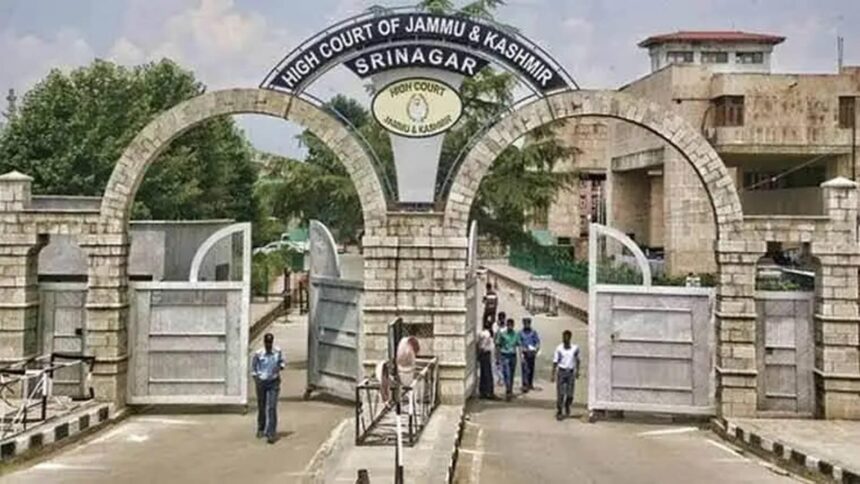
The Jammu & Kashmir and Ladakh High Court has held that the President or a Governor, acting on the aid and advice of the Council of Ministers, can remove an employee from government service without a departmental inquiry or an opportunity to be heard if the matter concerns the security of the state.
The judgment came in an appeal filed by the Jammu and Kashmir government against a single-judge order that had set aside the dismissal of a police constable accused of involvement in anti-national activities.
A Division Bench comprising Justices Sanjeev Kumar and Sanjay Parihar upheld the 2004 dismissal of Ghulam Mohammad Tantray, a constable in the Jammu and Kashmir Police, by the then Governor.
Tantray, who joined the police force in 1991, was arrested in 2004 by Srinagar’s Zadibal police for alleged offences under Section 120-B of the Ranbir Penal Code (which was applicable in J&K until 2019) and provisions of the Arms Act. Following his arrest, the government invoked Section 126(2)(c) of the erstwhile Constitution of Jammu and Kashmir — a provision corresponding to Article 311(2)(c) of the Constitution of India — to dismiss him without conducting a departmental inquiry.
A single-judge bench had quashed the dismissal, terming it “flawed” and “without reasons”, and observed that the government had not explained why it abandoned an ongoing departmental inquiry before invoking the constitutional provision.
Reversing that decision, the Division Bench said, “Firstly, the government has the right to regulate or determine the tenure of its employees at pleasure, notwithstanding anything in their contract to the contrary, provided that the mandatory provisions laid down in Article 311 have been observed,” it observed.
“Secondly, the government has no power to restrict or give up its prerogative of terminating the services of its employees at pleasure under any contract made with the employee, except to the extent recognised by clause (2) of Article 310 of the Constitution of India,” it added.
Article 311 of the Constitution deals with ‘dismissal, removal or reduction in rank of persons employed in civil capacities under the Union or a State’. Under Article 311(2), no civil servant can be “dismissed or removed or reduced in rank except after an inquiry in which he has been informed of the charges and given a reasonable opportunity of being heard in respect of those charges’’. Subsection (c) of the provision, however, says this clause shall not apply “where the President or the Governor, as the case may be, is satisfied that in the interest of the security of the State it is not expedient to hold such inquiry”.
Pointing out that the expression “security of the State” has a very high threshold, the Division Bench observed, “It generally concerns terrorism, espionage, militant links, activities threatening the sovereignty and integrity of the country, and grave anti-national conduct, etc.”
The satisfaction so reached by the President or the Governor must necessarily be a subjective satisfaction, which may be arrived at as a result of secret information received by the government about the brewing danger to the security of the state and like matters, the Bench observed, adding that there may be other factors which may be considered, weighed and balanced in order to reach the requisite satisfaction whether holding an inquiry would be expedient or not.
The court further added, “Though the judicial review of such satisfaction drawn by the President/Government on the aid and advice of the Council of Ministers is very limited and constricted, yet the constitutional Courts are not debarred from judicially reviewing such satisfaction if it is vitiated by mala fides, absence of relevant material, arbitrariness, and above all, if it does not generally concern the security of the State.”
Use of Article 311(2)(c) in J&K
The J&K Lieutenant Governor’s administration has dismissed 91 government employees since 2021 under Article 311(2)(c) of the Constitution.
Of these, seven employees have been dismissed for alleged militant links this year alone. Two Class-IV employees (one from the Education Department and one from the Rural Development Department) were terminated for alleged militant links and anti-national activities in April. The services of five others, including a school teacher and a police constable, were terminated in January this year.
Former chief minister and People’s Democratic Party president Mehbooba Mufti had earlier written to Chief Minister Omar Abdullah, seeking an immediate review of such terminations. Political parties from the Valley have criticised such dismissals as “arbitrary terminations” that aim to “disempower” Kashmiris.