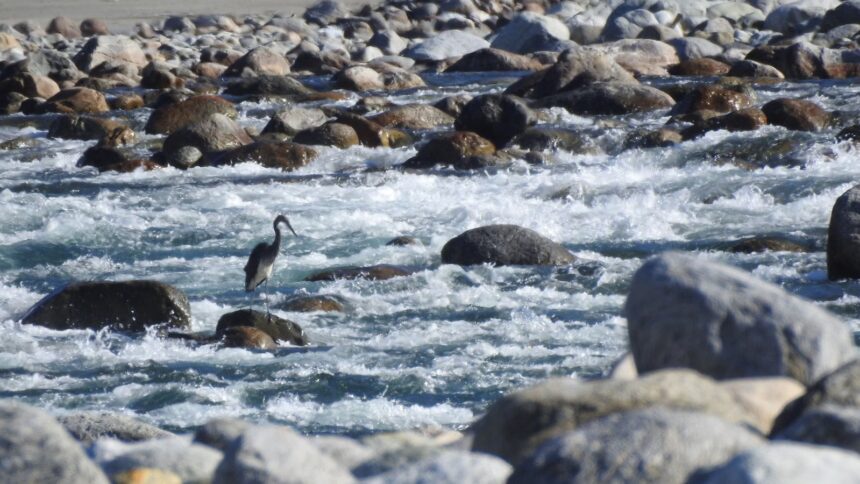
The Environment Ministry’s Forest Advisory Committee (FAC) has granted in-principle forest clearance to the 1,200 MW Kalai-II hydroelectric project, proposed on the Lohit River, which is one of the key habitats of the critically endangered White-Bellied Heron.
The nod paves the way for clearing 869 hectares of forest for the project, including the submergence of 638 hectares in the Anjaw and Namsai forest divisions, Arunachal Pradesh.
The THDC India Limited’s Rs 14,176.26 crore run-of-the-river project is proposed in Anjaw district bordering China, and will involve the construction of a 128.5 m concrete gravity dam and an underground powerhouse. Compensatory afforestation for the project in Madhya Pradesh, as Arunachal Pradesh is a “hilly and forested State with forest cover more than two-thirds of the geographical area”,
During , the state government’s nodal office informed the FAC that the heron species “is not spotted in the area proposed for diversion”.
The FAC, however, stated that since the bird species are reported in the landscape, the project’s wildlife management plan will be vetted or reviewed by the Wildlife Institute of India. This will be done to ensure “landscape-level ecological coherence and consistency with mitigation measures prescribed for downstream projects.”
Concerns over White-Bellied Heron
Prior to the FAC meeting on May 8, Soblam Malo, a project-affected person from Anjaw’s Chengung village, had written to them on reservations regarding the project. He pointed out that the bird has been sighted by wildlife researchers and local people in its riverine habitat along the length of the Lohit River, from upstream (Walong) to downstream (Parashuram Kund), including in the directly affected area of the Kalai II project, such as Chenguinty.
The FAC directed that the wildlife management plan should place special emphasis on the conservation of the White-Bellied Heron’s habitat, and that it be submitted along with a compliance report on the conditions laid down in the principal clearance.
Even as the FAC was informed that no heron was spotted in the area proposed for diversion, the Arunachal Pradesh Forest Department had officially recorded it in April 2021. It was also recorded in the Kamlang Tiger Reserve, downstream of the Kalai-II project area.
The state forest department had recorded in its 2021 sighting report that the Walong sighting at “1200 metres above mean sea level is probably the first record in the higher elevation areas in India. The nesting site is also spotted in the vicinity,” the then divisional forest officer Santosh Kumar Reddy V had noted.
Less than 60 birds are estimated to be present across its global range, according to the International Union for Conservation of Nature, which prepares a list assessing the health of species, including their extinction risks. The Lohit River is a crucial habitat for the bird, and researchers noted in the June 2023 edition of the Indian Birds journal that the bird’s numbers have declined due to habitat loss, hunting, and human disturbances.
The ministry’s regional office also acknowledged the project’s impact on wildlife habitats. “…the increased width of the submerged area will adversely affect the migration of wild animals from one bank to the other. As such, a necessary wildlife mitigation plan/biodiversity conservation plan should have been incorporated…in consultation with the chief wildlife warden of Arunachal Pradesh, such a mitigation/biodiversity conservation plan should be prepared,” it said.
The 870 hectares will be diverted for the hydropower project, which falls within a high-conservation value zone, as per the government’s GIS-based decision support system used to ascertain forest classification and canopy density. “Out of the total forest area proposed for diversion, 75 ha of land is classified as very dense forest, 169 ha as moderately 9 dense forest, 284 ha as open forest, 7 ha as Scrub, 168 ha as water, and 158 ha as non-forest land without tree cover,” as per official proposal documents.