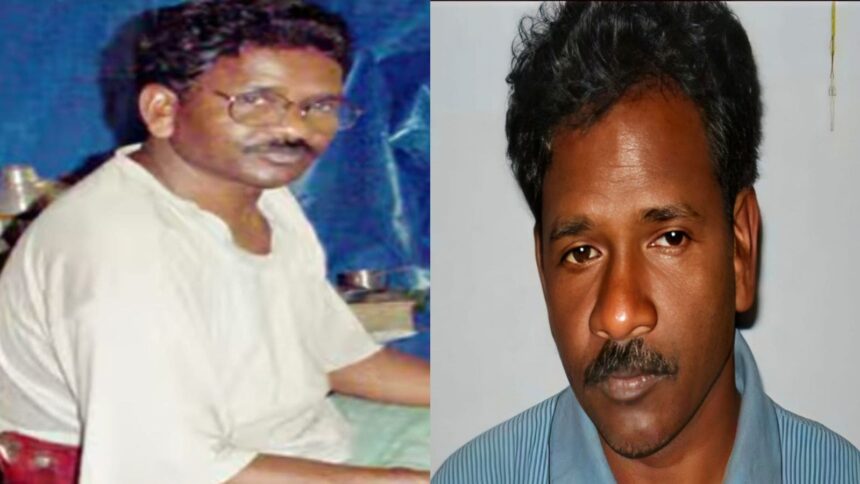
For years, Misir Besra – – was just a name. Although he was linked to at least two major attacks in 2003-04 that killed 55 security personnel, security forces had no idea what he looked like.
That changed with his arrest in September 2007, when he and another associate were stopped during a routine check that allegedly led to the recovery of cash, detonators and other explosives.
“He was around 5.4 feet tall and had curly-haired,” said one officer. “He had a heavy voice, but was calm and soft-spoken. He was the kind of person from whom you could extract more information over a cup of tea than through force. I told him, ‘If you speak like a criminal, you will be treated like one. But if you reveal your identity willingly, we’ll treat you with respect’. And he did.”
Last week, 27 Maoists, a majority of them from Besra’s cadre, surrendered in Jharkhand. The state’s largest Maoist surrender marked a significant blow to an insurgency already severely weakened in recent years by security forces’ push into former red corridors of Jharkhand and Chhattisgarh.
With a bounty of Rs 1 crore, the 66-year-old Besra is among the last remaining top commanders of the banned Communist Party of India (Maoist). Known variously as Bhaskar, Sunirmal, Pradhan Ji, and Sagar, Besra is stated to have over 150 cases against him.
The surrender is also believed to have triggered a power struggle within Jharkhand’s attenuated Maoist insurgency between Besra and another Maoist leader, Asim Mandal alias Akash alias Karthik, a Central Committee Member from West Bengal who also carries a bounty of Rs 1 crore. In communist cadres, the Politburo is the supreme inner-circle executive body, while the Central Committee (CC) is the larger national governing council that elects the Politburo.
“After the killing of (top Maoist leader and central committee member) Anal Da in January this year, only two major leaders are effectively left: Besra and Mandal, both of nearly equal standing. While some cadres are with Besra, others are with Mandal,” one officer said, adding that police continue to look for both.
Born into the Santhal Adivasi community in Madnadih village in Jharkhand’s Giridih district in the late 1960s, Besra completed his primary education in the village before moving to Dhanbad for further studies. According to his family, it was here that he was drawn towards Maoist ideology. He later enrolled for graduation and postgraduate degrees in political science in Dhanbad’s Rajganj. This was also a time of intense socio-political churning during the Jharkhand movement.
While still in his early 20s, Besra married Monasi Devi. They have a 37-year-old son, Siddharth, a daily wage labourer.
But family life couldn’t keep him, and in the late 1980s, Besra left home to join the Maoist Communist Centre, which later merged with the People’s War Group to become the Communist Party of India (Maoist). Some years after he left, his wife remarried.
“When I was around five, my father would come home two or three times. After that, I never really saw him again,” Siddharth said.
Soon after Jharkhand was carved out of erstwhile Bihar in 2000, Besra led a series of armed assaults and ambushes against security personnel. Chief among them were the 2003 and 2004 IED attacks in West Singhbhum’s Bitkilsoy and Baliba that killed 55 personnel. The attacks also led to his elevation to the Central Military Commission (CMC) and as head of the outfit’s Eastern Regional Bureau after the 2004 merger of the outlawed MCC and PWG.
“During that time, Besra also met top Maoist leader Muppala Laxmana Rao, alias Ganapathy, before the merger. He began expanding his influence across Jharkhand,” a senior Jharkhand Police officer told The Indian Express.
While being produced before a court in Bihar’s Lakhisarai district in June 2009 — nearly two years after his arrest — Besra staged one of the most high-profile jailbreaks of the time. As he was being escorted out of the court complex, around 30 armed Maoists stormed the premises on motorcycles, hurled bombs and opened fire on the police team, helping him escape.
The ambush left one policeman dead and several others injured. With Besra, who has evaded capture since, still at large, police have intensified searches.
“We are keeping security forces deployed and are using police camps to track him. We’re also appealing to families of the remaining Maoists to persuade cadres to surrender,” one officer said.
The last few months have seen sustained operations in the forests of Saranda, with a major January operation killing 15 Maoists, including CCM leader Anal Da. The operation involved personnel from the specialised counter-insurgency force CoBRA (Commando Battalion for Resolute Action), the Central Reserve Police Force, Jharkhand Jaguar and district police teams.
According to police, the encounter spooked the Maoist cadre, which has since scattered. Police believe fewer than 25 cadres remain, with the latest surrender further driving a wedge between the two Maoist factions.
When asked, IG (Ops) Narendra Singh told The Indian Express that police expect to capture both leaders soon, although he admitted it remains unclear where they are. “They are both believed to have abandoned Saranda but cannot evade capture for long. Jharkhand is almost free from Maoism,” he said.