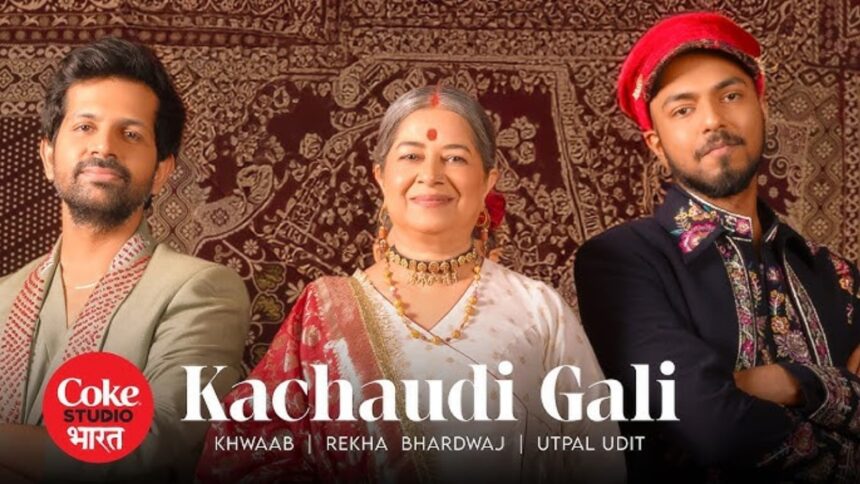
For the better part of its existence, the catalogue of Coke Studio Bharat has remained closer to mainstream artistes and indie music than to regional folk traditions. After struggling to find a firm footing with its previous editions, mainly because the digital-only show could only implement a patchwork of sounds and genres with numerous out-of-tune artistes rarely delivering music with gravitas, its latest release titled Kachaudi Gali, is a marked shift in approach, with a soundscape rooted in authentic folk. This time, the show has brought a melody from the bylanes of Banaras in the delicate cadence of Bhojpuri.
Sung by playback singer Rekha Bhardwaj, Utpal Udit, an indie folk singer from Bihar, and put together by Nishant Nagar, with the distinct Purabiya lilt in tow, Kachaudi Gali, from over a century ago, has attempted to resurrect a time and story that once was and a song that has survived for over a century through oral legacy. It opens with the line Sejia pe lote kala naag, Kachaudi Gali sooni kaila balamu (On the bed, a black serpent creeps slowly, Kachaudi Gali waits silent, missing your glow), which metaphorically speaks of a woman’s desire for her beloved who’s migrated to Mirzapur, a major industrial and trading hub back in the day, where
Varanasi’s Kachaudi Gali, which still survives, is a narrow lane tucked away in an area called Lahore Tola near Kashi Vishwanath Temple. The street got its name from the famed golden brown dough balls fried in large kadhais and was once a vibrant hub for freedom fighters, academics and artistes who would gather here to discuss politics and culture over tea and kachaudi. Also, unlike the usual innuendo-laden Bhojpuri music, the song manages to highlight the tradition of tender and eloquent folk within the Bhojpuri folk idiom.
Likely to have been written and composed in the 19th century, the kajri (a folk tradition sung in the monsoon) emerged from the ache of separation of a woman, possibly a courtesan from Banaras. The piece is also sometimes called Kajri Gauhar Jaan. But it was not written or sung by the famous Gauhar Jaan of Calcutta, the first Indian musician to record her voice commercially on the gramophone. As legend goes, this is the story of another Gauhar Jaan, one who lived in Dalmandi in Banaras. “It is believed that she used to go out in her palanquin in Kachaudi Gali and would pass by a man named Aslam, a patriot, near the chowk. There was no conversation but she was enamoured by him and fell deeply in love. One day, he disappeared. On asking around, she was told he had gone to Mirzapur to work, hence its mention in the song. Much later, she came to know that the British had deported him to Rangoon,” says -based Nirala Bidesia, an expert on Bhojpuri music and literature. He adds that the lines Hathwa mein hoti jo hamare katariya, baha dete gorvan ke khoon (If a blade had rested within my hand/ I would have shed the blood of the white man), come from that sense of wanting to avenge the injustice of her beloved being taken away to Rangoon. “Folk is an oral legacy; new lines and
Another story attached to the song is of it being a ‘Girmitiya geet’ (a song about the migration of the indentured labourers transported overseas). A lot of the migration was also to find some work for small wages. The song has also been associated with this phase.
Shehnai stalwart Ustad Bismillah Khan used to play this kajri in his concerts and would often say that he had heard it since he was a child in Banaras. His adopted daughter, Soma Ghosh, would perform this with him often. Folk singer Malini Awasthi has also sung the kajri and has mentioned the Gauhar Jaan story in her book Chandan Kiwad, in which she has tried to trace the stories behind the songs.
Folk music has remained one of the purest forms of storytelling, where melody, rhythm and lyrics are often used to document life. Using poetry and song as a narrative tool, the song moves further with the lines Aehi Mirzapur se udal jahajiya, Sayiyaan chal gayin Rangoon ho…(From this Mirzapur, a plane took flight, My beloved has gone away to Rangoon).
This is a reference to the continuous migration of thousands of men from Purvanchal, stretching across eastern Uttar Pradesh and parts of Bihar, which began during the Anglo-Burmese War of the 19th century. Thousands of ordinary citizens were forcefully sent by the Britishers to Rangoon or Burma (present-day Myanmar) as sepoys. From 1824 to 1937, Burma was under British rule. Even though the song uses the phrase ‘udal jahajwa’, these men were often sent aboard crowded steamships that would depart from what was once Calcutta. “Earlier it was chalal jahajwa. With changing times, chalal became udal,” says Bidesia.
Of the 40,000 troops, 15,000 perished due to malaria, dysentery and fighting amid terrain thick with jungles. While the war ended in 1885, the migration continued throughout the early 1900s as a result of British colonial policies, which administered Burma as a province of India. The war had brought in massive economic instability and Burma offered prospects for employment in port cities. These men worked in docks, rice mills and as manual labourers. Burma was also a transit point for the British system for Kaala Paani, the exile and imprisonment of Indian prisoners in the Cellular Jail in the Andamans.
“Even today, many people who came back from Burma, use Burma as their surname. It is interesting how the refreshed version of the song has brought age-old Bhojpuri folk and the historical context to the fore,” says Bidesia.