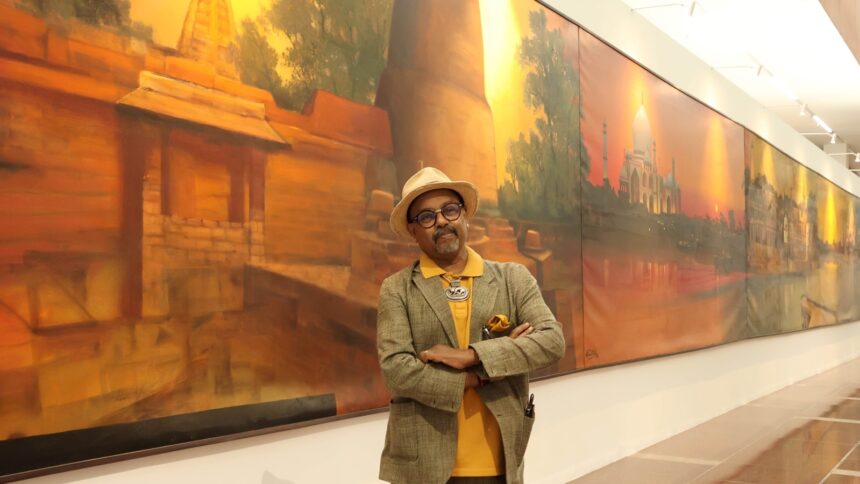
Recently back from the Venice Biennale, where his brass sculpture titled Equilibrium is being exhibited at Marinaressa Gardens along the Riva dei Sette Martiri, artist Paresh Maity was at the Noida International Airport on May 26, introducing his works at the venue to a select few. “It is important that an airport reflects the culture and spirit of the place,” he told The Indian Express.
Known for his large-scale public artworks and vibrant depictions of India’s cultural landscape, Maity has created two major works for the airport, which is reportedly expected to cater to nearly 12 million passengers annually during its first phase of operations. These include Jagriti (Awakening), an expansive 100 x 8 ft oil-on-canvas with six panels, and Mystic Abode, an immersive 12-and-a-half foot tall installation made of more than 8,000 brass bells. “These are works that represent India’s spiritual and cultural energy and heritage,” stated .
So Jagriti (Awakening) — on view after the security check — unfolds as a visual journey through some of North India’s most significant cultural and spiritual landmarks that are connected through the sacred rivers of Ganga, Yamuna, Saraswati and Saryu. If the first panel depicts the tranquil ghats of Varanasi, in another Maity paints the Sanchi Stupa of Sarnath in a recollection of Buddha’s first sermon after attaining enlightenment. The Taj Mahal in Agra stands on the banks of the river Yamuna, and next to it is Kusum Sarovar in Mathura-Vrindavan. The fifth panel is dedicated to Ayodhya, the birth place of lord Rama, and in the sixth panel he paints the spiritual congregation at the Mahakumbh that he also recently witnessed.
“This work is based on ‘Shadanga’ or the six limbs of art that refer to the classical framework for art according traditional Indian philosophy, including aspects such as form, proportion and expression,” says the artist who grew up in West Bengal’s Tamluk, situated on the banks of the Rupnarayan River. He adds, “The entire painting is also based on sunrise, which gives energy and awakening.”
If the canvas draws from India’s visual narratives, traditions and faith, Mystic Abode — in the boarding gates area — is inspired by acoustics and spiritual resonance of the bells. Conceived as an experiential installation and first exhibited in Switzerland in 2016-17, the work invites viewers to enter through its doors into a contemplative space. “In a world marked by war and unrest, I am trying to show that there is still a place for peace and harmony. Bells bring positive energy and create a meditative sensation. The installation also reflects a desire to be in a transformative space where one takes a pause and reflects within, tapping into our inner senses of vision, tactician and audition,” says the 2014 Padma Shri awardee.
One of India’s most recognised contemporary artists whose works are in museum collections the world over, Maity’s art can also be found at ’s Indira Gandhi International Airport. At Terminal 3 is his 850-foot-long mural Indian Odyssey that traces a visual journey through India’s landscapes, monuments and festivals, from Bengal and Assam to Rajasthan, Kerala and Kashmir, among others. At Terminal 1, on the other hand, his installations include Sound of Silence, a sculptural work that brings together thousands of brass and copper bells to create a human form, and Life’s Journey, a pair of fibreglass white elephants painted in myriad hues. “Art was always meant for the public, dating back to prehistoric times, and one of my aims as an artist is to reach people and create art that is accessible to all,” he notes.