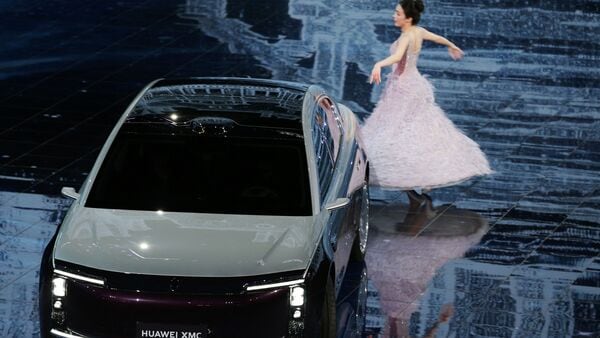
BEIJING—At an imposing 18 feet long, the Maextro S800 sedan gives off Rolls-Royce vibes with its two-tone color scheme and abundant soft leather.
But the Maextro isn’t the product of craftsmen in the English countryside. The battery-powered car is manufactured with the help of more than 1,000 robots in Hefei, China, and runs on technology from the country’s Huawei, best known as a maker of mass-market phones.
It is the pre-eminent symbol of Chinese automakers’ push to dominate the top end of the car market, after they seized the global lead in affordable electric vehicles. Chinese companies know they don’t have the heritage of a Mercedes or a Rolls-Royce. Their strategy is to stuff their vehicles with so much gadgetry that owners forget their dreams of European luxury.
The Maextro parks by itself and features a 40-inch screen with around 40 speakers for the entertainment of the VIPs stretching their legs in the back seat. With all those extras, the car costs the equivalent of about $173,000, and a version without the big screen can be had for as little as $104,000, half the price of a starter Mercedes-Maybach sedan and a quarter of what a basic Rolls-Royce costs in the U.S.
“This is a maxed-out car for a very affordable price,” said Thomas Luk, a strategy consultant and car expert previously with McKinsey who wasn’t involved in the Maextro’s development. The Maextro, he said, “is definitely challenging the Maybach and the 7-series BMW.”
While such comparisons might seem heretical, Chinese carmakers have shown an ability to surprise. As recently as 2020, they exported about a million vehicles worldwide. Last year, the figure topped seven million, adding to China’s lead as the No. 1 car exporter in the world.
The Maextro is currently sold only in China, but Huawei hopes to bring it overseas eventually. Huawei products are effectively banned in the U.S. under sanctions dating to the first Trump administration, so even if the U.S. eases its curbs on Chinese EVs, Americans aren’t likely to find a Maextro dealer anytime soon.
Huawei, a conglomerate that makes semiconductors, consumer electronics and much else, brings a smartphone-inspired business model to the car business. Its software runs the Maextro’s autonomous driving and entertainment systems. Hefei-based JAC Motors, which is partly owned by Volkswagen and is better known for bargain models, builds the car.
JAC’s role manufacturing the Maextro gets short shrift in the luxury car’s marketing, just as Apple doesn’t tell customers who manufactures its devices. Instead, Huawei’s name is front and center at showrooms where the Maextro is sold alongside $3,000 triple-folding smartphones and $4,000 diamond-encrusted smartwatches.
More than 17,000 Maextro cars have been delivered as of the end of April since the car was introduced a year ago, according to Huawei. Many buyers are entrepreneurs and executives, while some companies use the Maextro as a chauffeur-driven limo.
Huawei executive Richard Yu said in April that a new ultra-premium model would be introduced as soon as June, with a top price tag of nearly $300,000.
Recently, I took a ride in the Maextro through Beijing’s streets. To get in, I opened the door with a fist gesture detected by a camera in the front door—an idea that came from Huawei smartphones that allow users to take a screenshot with a similar gesture.
Inside, I closed the door with a wave of my hand and turned the window shade dark with a swipe of my finger. The back seat reclines nearly fully like a business-class airline seat and, as in most expensive Chinese cars these days, the seat gives a massage. The legroom, soft carpet and starry ceiling—a feature borrowed from Rolls-Royce—gave me that pampered feeling luxury carmakers strive for.
Out on the road, the car mostly drove itself. “You just sit here and watch,” said the Huawei sales manager who was behind the wheel but not steering it much. Huawei officials believe level-3 autonomous driving—in which drivers can take their eyes off the road in some scenarios—could get authorized for broad use in China as soon as next year.
I found the ride, while perfectly acceptable, didn’t offer the silky smoothness European buyers expect from a top-of-the-line luxury model. “We are learning and improving,” the sales manager said.
Back home in Singapore, I took a ride in a genuine Rolls-Royce and discovered some differences. Rolls-Royce Asia-Pacific spokeswoman Juliana Tan, who joined me for the ride, said the company chose not to include many of the Chinese-style tech features because its upper-crust customers consider the car a sanctuary and don’t want to spend their time fiddling with gadgets.
Tan said Rolls-Royce could customize virtually every feature of the car, down to the color of the umbrella tucked into the rear door. “That’s the biggest difference with Chinese cars: No matter how high-end they are, they’re still mass-produced,” she said.
Write to Peter Landers at Peter.Landers@wsj.com