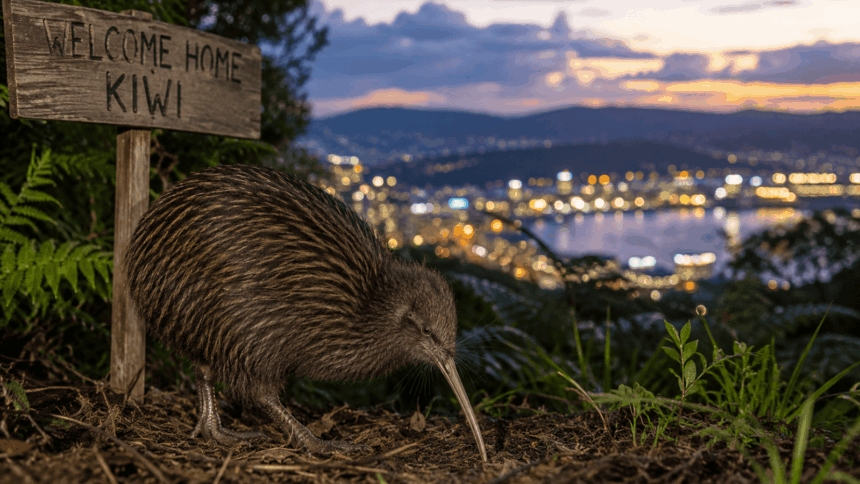
Imagine your country’s most recognisable symbol disappearing from your city for more than 100 years — and then finally returning home. That is exactly what is unfolding in Wellington, New Zealand, where the country’s beloved kiwi bird has made a remarkable comeback after vanishing from the capital’s hills over a century ago.
The shy, flightless bird — so central to New Zealand’s identity that locals themselves are nicknamed Kiwis — had disappeared from the region due to habitat loss and introduced predators such as stoats, rats, and feral cats.
Now, thanks to an ambitious citizen-led conservation effort, the iconic bird is reclaiming its old home.
In a major milestone, seven kiwi birds were recently released into Wellington’s wild landscape, including the 250th kiwi relocated under the Capital Kiwi Project.
The late-night release was deeply emotional. Under dim red torchlight, volunteers quietly carried crates containing the endangered birds across mist-covered farmland, then gently opened them one by one. Some onlookers reportedly teared up as a karakia (Māori prayer) was offered, while the birds cautiously stepped out, then quickly vanished into the darkness.
The kiwi is unlike most birds. Flightless and nocturnal, it has tiny underdeveloped wings, a whisker-like face, and a long, curved beak that gives it an unmistakable look.
It is also spiritually significant to many New Zealanders and so embedded in national identity that the country’s people are often informally called Kiwis.
Experts believe that around 12 million kiwi once roamed New Zealand before humans arrived. Today, only about 70,000 remain, with the population declining by roughly 2% every year.
Before being released, Wellington’s newest residents made an unusual stop:
There, schoolchildren and lawmakers got a rare up-close glimpse of the timid birds, many for the first time, as conservation workers cradled them like babies.
“They are a part of who we are and our sense of belonging here,” Paul Ward, founder of the Capital Kiwi Project, said.
This wasn’t simply a case of releasing birds and hoping for the best. Over the past decade, conservationists, landowners, local Māori communities, and volunteers have helped create a sprawling 24,000-hectare roaming zone where kiwi can safely live. More than 5,000 traps have been installed to control stoats — one of the biggest threats to kiwi chicks.
The result has been extraordinary: a 90% chick survival rate.
What makes this effort particularly unusual is that the goal isn’t to keep kiwi hidden away in remote fenced sanctuaries. Instead, Wellington is trying something bolder: bringing endangered wildlife back into a living, working city.
And it appears to be working. Kiwi have already been spotted by late-night mountain bikers and even captured wandering through neighbourhoods on backyard security cameras.
The effort also ties into New Zealand’s broader Predator Free 2050 mission, which aims to remove invasive mammalian predators threatening native wildlife. In a world where endangered species stories often end in decline, Wellington’s is offering something rarer: a comeback.