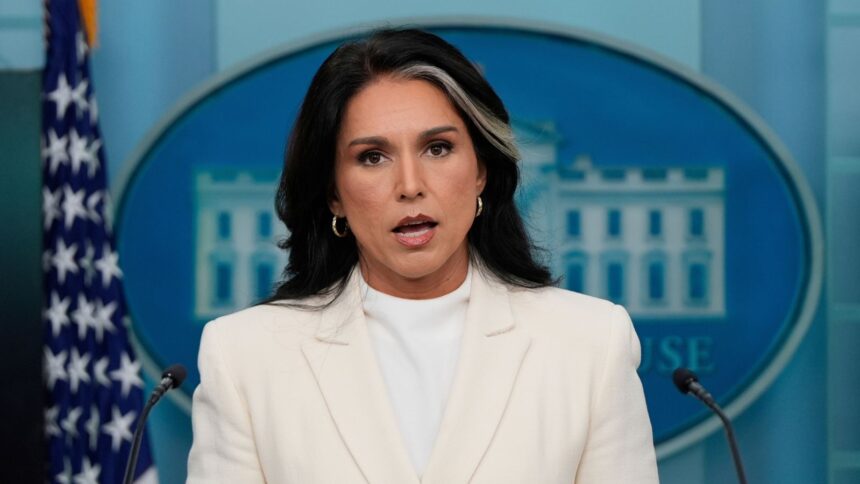
US National Intelligence Director Tulsi Gabbard has reportedly resigned on Friday in a major reshuffle in President Donald Trump’s administration.
According to Gabbard’s formal resignation letter, quoted by Fox News, the US national intelligence chief resigned to support her husband through his battle with “an extremely rare form of bone cancer.”
In the letter, Gabbard reportedly said she is “deeply grateful for the trust you placed in me and for the opportunity to lead the Office of the Director of National Intelligence for the last year and a half.”
Gabbard, who was sworn-in as National Intelligence Director in February last year, said “Unfortunately, I must submit my resignation, effective June 30, 2026. My husband, Abraham, has recently been diagnosed with an extremely rare form of bone cancer,” Fox News reported.
Gabbard, a loyal supporter of Trump during his 2024 presidential campaign, was confirmed as one of the most powerful figures in US intelligence-gathering weeks after he returned to the White House in 2025. But this year, she has largely been out of public view even as the US took military action against Iran, put pressure on Cuba, and notably removed Venezuela’s president.
Gabbard is the fourth Cabinet member to depart the Trump administration after Lori Chavez-DeRemer left her position as labor secretary in April. Homeland Security Secretary Kristi Noem and Attorney General Pam Bondi both left the administration earlier this year.
In her resignation letter, Gabbard said her husband, Abraham, “faces major challenges in the coming weeks and months.”
Trump said on social media that Tulsi Gabbard “rightfully, wants to be with him, bringing him back to good health as they currently fight a tough battle together. I have no doubt he will soon be better than ever.”
Gabbard, a former Democratic congresswoman from Hawaii and military veteran, has had a strained relationship with Trump over Iran policy. As a longtime anti-interventionist, she avoided endorsing the US-Israel strikes on Iran and sidestepped questions in a March congressional hearing about whether the administration anticipated the fallout. She also drew scrutiny from Democrats for perceived gaps between White House statements and intelligence assessments on Iran’s nuclear program.
Last year, Trump publicly rejected her congressional testimony that Iran was not pursuing a nuclear weapon, telling reporters: “I don’t care what she said. I think they were very close to having a weapon.” Trump has repeatedly cited Iran’s nuclear capability to justify the war.
Gabbard’s departure follows the exit of her top aide, former National Counterterrorism Center Director Joe Kent, two months ago. Kent resigned over the Iran war and urged Trump to “reverse course.” After his resignation, Gabbard publicly backed Trump’s decision, saying the president, as commander-in-chief, determines what constitutes an imminent threat.