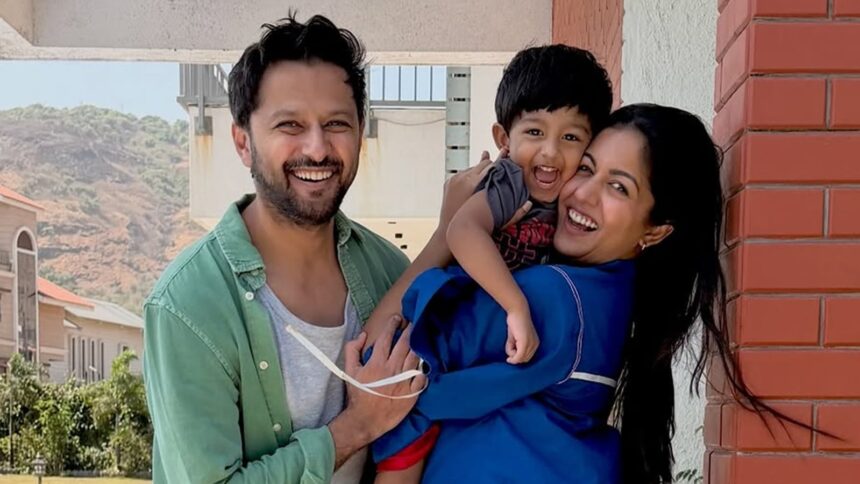
Screen time remains one of the most debated parenting topics today, especially as phones, tablets, and digital entertainment become increasingly woven into everyday family life. While many parents worry about the effects of screens on children’s attention span, behaviour, sleep, and development, the reality is often more complicated than simply saying yes or no. Actor couple Ishita Dutta and Vatsal Sheth recently opened up about this balancing act in an Instagram video, sharing their honest views on when and why they occasionally allow screen time for their son, Bayu.
During the conversation, Ishita asked Vatsal, “What is your opinion on ?” to which he replied, “I think it’s a complete no-no for me.” However, he quickly clarified that he does not judge parents who sometimes rely on screens. “Honestly, no, I don’t judge because there are situations,” he said, recalling moments when they used screens during difficult circumstances. “Remember, Ishita, when Vaayu was so sick, we gave him screen time.” Ishita also added, “With travelling, also remember we gave a little bit of screen time.”
Vatsal emphasised that, for him, “Screen time should be the last resort.” Explaining his concerns, he said, “Gadgets are so addictive. Kids, they are so small that they don’t realise that they become so cranky and so attached to it.” Ishita echoed these concerns, saying, “Of course, the negative implications, we have read a lot about it. Everyone knows the kind of cartoons that are available. They are so fast, not right for the brain at that age.” At the same time, she acknowledged that parenting is rarely perfect or rigid. “We don’t judge who gives screen time because we do too. But what is important is to understand when to give screen time and how much. Let’s not make it a habit. Try to use it as the last resort.” She also appreciated parents who manage without screens entirely, saying, “Those who are not giving any screen time at all and are managing, kudos to you.” Vatsal concluded the conversation simply: “Just be parents.”
Psychologist Rasshi Gurnani tells indianexpress.com, “Excessive screen time during early childhood can affect multiple areas of development because the brain is still in a highly sensitive neurodevelopmental stage. Young children learn through face-to-face interaction, sensory play, movement, observation, and emotional connection. When screens replace these experiences for long periods, it can interfere with language development, attention regulation, emotional processing, and social learning.”
She continues, “Research has linked excessive screen exposure with shorter attention span, impulsivity, irritability, sleep disturbances, and delayed executive functioning, which includes skills like self-control, focus, and emotional regulation. In many children, shows up as frustration intolerance, tantrums, restlessness, or difficulty calming themselves without external stimulation.”
According to Gurnani, healthy screen management works best when parents focus on regulation rather than restriction. Children respond better to predictable structure than to punishment or guilt-based parenting. One practical approach is creating “screen boundaries” instead of “screen bans” — for example, avoiding screens during meals, before bedtime, or during emotional meltdowns.
She adds that parents can also “use the concept of co-regulation by helping children transition away from screens gradually instead of abruptly removing devices, which often triggers emotional dysregulation.” Replacing screen time with emotionally engaging alternatives like storytelling, pretend play, outdoor movement, cooking together, music, or conversation is more effective than simply saying no.
“Another important psychological factor is modelling. Children internalise , so emotionally present parenting matters as much as the child’s screen use. In today’s technology-driven world, the goal should not be complete elimination, but building healthy digital habits alongside secure attachment, sleep hygiene, social interaction, and unstructured play,” concludes Gurnani.