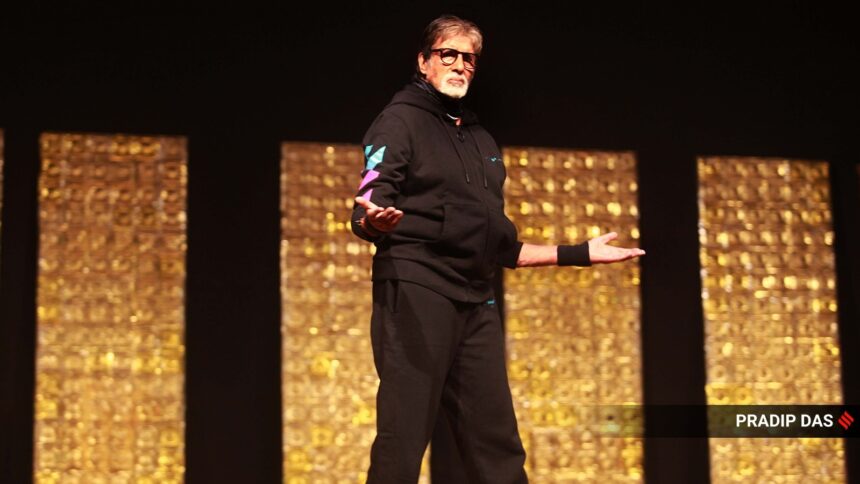
Veteran actor Amitabh Bachchan’s recent Instagram post about a centuries-old Vishnu temple in Iran has sparked curiosity about the deep historical and cultural ties between India and Iran.
Sharing a video of the temple located in Bandar Abbas, the actor wrote, “The Ancient Hindu Vishnu Temple in Bandar Abbas, Iran. Built in 1892 during the Qajar era, it was constructed for Hindu traders from India working in the city (sic).” The clip, accompanied by a Persian song, quickly drew attention online, with many users fascinated by the idea of a Hindu temple standing in an Iranian port city and what it reveals about centuries of trade, migration and shared .
The Bandar Abbas Vishnu Temple is believed to have been built by Indian Hindu merchants who had settled in the region during the 19th century, when maritime trade routes connected India closely with parts of the Persian Gulf. Bachchan’s post has now renewed public interest in how Indian traders once lived and worked in Iran, and how such historical structures continue to preserve traces of those connections even today.
While many people may see the temple simply as a striking historical monument, such places can offer valuable insights into migration patterns, multicultural coexistence, and how diaspora communities preserved their identity while adapting to foreign lands.
Former foreign secretary Shyam Saran tells indianexpress.com, “The Vishnu temple in Bandar Abbas is not the only testament to Indian traders, preachers and pilgrims leaving their mark on the littoral of the Indian Ocean, both east and west of the Indian peninsula. The South West monsoon took them to South East Asia and the east coast of China, while the North East monsoon took them to Persia, Arabia and the east coast of Africa. Merchants often had to spend several months waiting for the reverse winds to take them back to their native lands, and during this period, they mingled with local populations, sharing religious and cultural ideas even while engaging in trade.”
He adds that some Indians made these port cities their permanent home and built temples and monasteries to meet their religious and spiritual needs. “These structures are scattered across India’s extended neighbourhood. What is special about the in Bandar Abbas is its location in an Islamic country and the fact that it has been preserved as a historical and cultural symbol of the deep cultural affinities between the peoples of India and Iran over centuries. We are civilisational twins,” the expert says.
Indian merchant communities living abroad preserved their religious and cultural identity by constructing temples and monasteries in the port cities where they settled. Saran says that these institutions “catered to their spiritual and social needs while also becoming centres of cultural continuity and community bonding.”
He also points to several examples beyond the Bandar Abbas Vishnu temple. “There is the Srinathji temple in Bahrain, dating back to 1817, also established by Sindhi traders, and the even older Motishwar temple in Oman, founded by Gujarati merchants in 1507 and still in use today.”
Such temples, Saran notes, served not only as places of worship but also as spaces where migrant communities could maintain traditions, with both fellow Indians and local populations through cultural exchange.
According to Saran, monuments like the Vishnu temple in Bandar Abbas “illustrate how interconnected and deeply interwoven the Indian Ocean world has always been, with India at its centre.” This long history of movement, trade and exchange shaped India’s cosmopolitan temperament and fostered a civilisation that celebrated plurality and encounters with strangers.
He argues that this legacy leaves no room for narrow nationalism or sectarian exclusivity. Just as Indian seafarers and caravans were welcomed in distant lands, and mutually enriched through exchanges of ideas and cultures, the same spirit should prevail in today’s globalised world.
Saran adds that it was precisely these centuries of exchange across distant lands that contributed to India’s prosperity and brilliance as a civilisation. “This lesson of history must never be forgotten,” he says.