



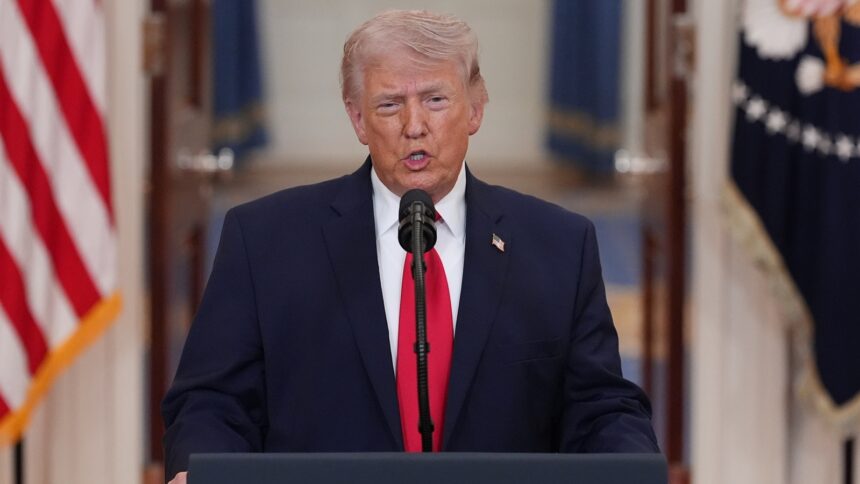
US President Donald Trump on Saturday announced that Abu-Bilal al-Minuki, second in command of ISIS globally, has been killed by American soldiers in a joint operation with the Nigerian forces. “Tonight, at my direction, brave American forces and the Armed Forces of Nigeria flawlessly executed a meticulously planned and very complex mission to eliminate the most active terrorist in the world from the battlefield. Abu-Bilal al-Minuki, second in command of ISIS globally, thought he could hide in Africa, but little did he know we had sources who kept us informed on what he was doing,” Trump posted on Truth Social.
ALSO READ |
“He will no longer terrorize the people of Africa, or help plan operations to target Americans. With his removal, ISIS’s global operation is greatly diminished. Thank you to the Government of Nigeria for your partnership on this operation,” Trump said in the post.
— Rapid Response 47 (@RapidResponse47)
Trump had earlier , alleging Christians in the country were being persecuted.
Abu-Bilal al-Minuki was born in the Borno state of Nigeria in 1982. He was designation Specially Designated Global Terrorists by the US on June 8, 2023, along with another ISIS leader Abdallah Makki Muslih al-Rufay’i of the Iraq-based ISIS.
According to Counter Extremism Project, Al-Minuki is believed to have occupied a regional command role within ISIS since the 2018 killing of Islamic State West Africa Province (ISWAP) chief Mamman Nur. He was seen as one of Nur’s principal rivals. al-Minuki later emerged as a key figure within ISWAP and has often been characterised as a hardline militant.
Regional scholars have also pointed to his strained ties with Boko Haram leader Abubakar Shekau. Sometime between March 2015 and early 2016, Shekau reportedly rejected an ISIS directive to deploy fighters to Libya, the CEP website states. Al-Minuki, who at the time served as ISWAP’s Lake Chad area commander, instead facilitated the deployment. The move is said to have further deepened tensions with Shekau, who opposed efforts to strengthen cooperation with ISIS.
It remains unclear when al-Minuki rose to become the senior leader of ISIS’s al-Furqan Office, one of the group’s most active and established regional networks. These regional offices are tasked with providing ISIS affiliates with operational direction and access to international funding.
The al-Furqan Office oversees activities in Nigeria and neighbouring countries, in addition to the Islamic State in the Greater Sahara (ISGS) network operating across the western Sahel.



