



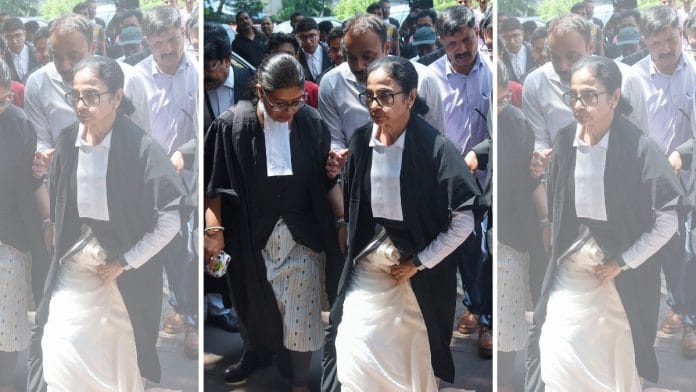
The whole thing was so perfectly Mamata that Bengal practically wrote the punchlines itself.
For years, Mamata treated visual politics like a full-contact sport. She and Narendra Modi have that (and much more) in common. She built an entire political identity around being visually unmistakable but she did it with unremarkable clothing.
The simple cotton sarees, durable rubber chappals, hair tied down and glasses — became her public uniform.
But with this almost stereotypical politician’s outfit, she wore brazen confidence on her sleeve. She claimed that she can speak in several languages, she (barely) paints, writes (supposed) poems, sings, dances, even jogs backwards. She — Mamata says so herself — can do it all. So of course, she can fight her own case, just like she did a few months ago when she presented arguments in the Supreme Court in the SIR case. She is the permanent street fighter, always ready for the next punch, even after a knockout.
But this ‘don’t care’ attitude comes curated for visual politics.
From her infamous image atop Jayaprakash Narayan’s car’s bonnet during the Emergency to her wheelchair campaign during the last election, Didi has always instinctively understood and used the camera well.
Her 26-day hunger strike during the Singur agitation was camera gold and soon catapulted her to power for three consecutive terms. She never took a salary once, she insists, during her 15-year tenure.
Never mind that she has an iPhone. Never mind that Calcutta slowly became a giant white-and-blue Trinamool mood board. Never mind the carefully cultivated personality cult. Mamata’s genius is making simplicity look rebellious.
This courtroom drama belongs to that same tradition except now the context has changed dramatically. Mamata is no longer Bengal’s chief minister.
Now, after her election defeat, she seems to be reinventing herself again. And for her first role, she has chosen to be a courtroom protagonist.
Because Didi without a fight has never really been Didi.
After a bruising electoral defeat, many politicians would retreat into carefully managed statements and symbolic appearances. Mamata instead showed that she was willing to walk into hostile territory alone.
This unpredictability is part of why she remains politically compelling long after voters have punished her government.
Her critics may see theatrics while supporters may see courage. Most Bengalis, at this point, recognise the performance instinctively.
And this may well be the next phase of her politics. Mamata as opposition mascot again — angry, visible, fighting and yelling, arguing in courtrooms, and surviving through sheer force of presence.
Mamata does not believe leaders should look distant from political drama. She believes they should stand in the middle of it, preferably while creating more of it.
Mamata Banerjee is not preparing to become a full-time litigator in her seventies. She is just showing everyone with this spectacle that Didi is still here, going it alone. Last woman standing.

