



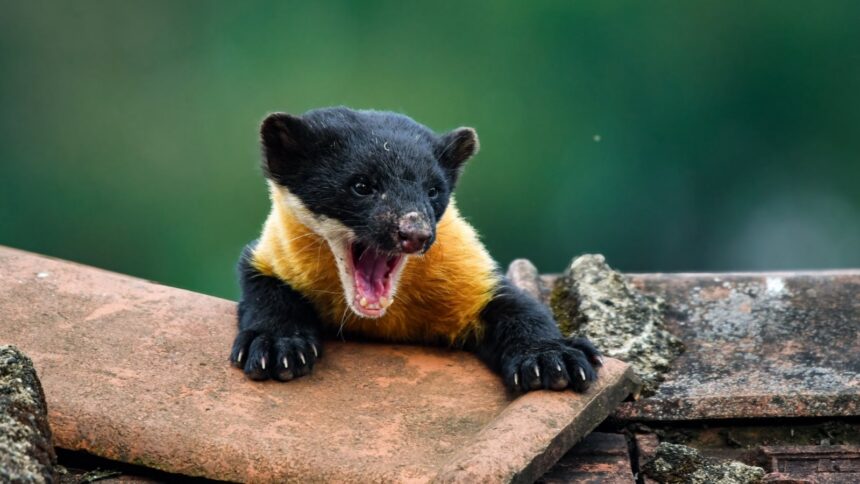
A tiny flash of golden-yellow and chocolate-brown fur recently captured the imagination of wildlife lovers online. The elusive Nilgiri Marten, one of India’s rarest mammals, was recently spotted in the Western Ghats.
Taking to X, IAS officer Supriya Sahu shared a post describing the Nilgiri Marten as “one of nature’s happiest little secrets.”
She wrote, “The Nilgiri Marten is one of nature’s happiest little secrets, with tiny feet, golden-yellow and chocolate fur, and playful agility leaping through the shola forests like a spark of joy. Found nowhere else on earth except the Western Ghats, this rare endemic beauty brings the spotlight on the precious and irreplaceable mountain ecosystems #wildwednesday #Nilgirimarten #endangered #wildlife incredible capture by R.Vidhya Vigashini #Endangeredspeciesday 15th May.”
The discovery of the endangered creature highlights underlying conservation-related concerns. According to wildlife photographer Indrajit Ghorpade, Founder of the Deccan Conservation Foundation, the Nilgiri Marten represents a much larger crisis unfolding
“There are hundreds of species that are rare, endangered, and threatened. The Nilgiri Marten is one of them,” says Ghorpade.
Found nowhere else in the world except the Western Ghats, the Nilgiri Marten is the only species of marten found in South India. Known for its elusive nature and energetic movements through dense forests, the species remains largely understudied due to its difficulty to spot in the wild.
Ghorpade explains that fewer than 1,000 Nilgiri Martens are believed to survive today. “They are victims of unsustainable development, habitat loss, and shrinking home ranges,” he says.
While charismatic species like tigers dominate conservation campaigns and policy conversations, Ghorpade argues that lesser-known animals often remain overlooked despite facing equally severe threats.
“Unfortunately, we are a tiger-centric country,” he says. “Most of the Western Ghats where the Marten and other species like the Leopard Cat survive are under tremendous pressure.”
He points out that species without widespread public recognition often struggle to attract funding, research attention, or dedicated conservation programs. As a result, many endangered animals continue
“The victims are the life forms that need these fragile ecosystems to survive. The Nilgiri Marten is a classic example,” he adds.
“Rare sightings are a blessing in disguise,” says Ghorpade. “They draw policymakers’ attention towards species that urgently need protection.” Because the animal inhabits forests that increasingly overlap with human-dominated landscapes, sightings also highlight the growing tension between development and biodiversity conservation.
According to Ghorpade, such encounters should not simply become viral social media moments. Instead, they should spark urgent conversations around habitat preservation before species vanish permanently.
“Before, like the Jerdon’s Courser (bird) and others, we lose them before the world discovers and witnesses these amazing creatures,” he warns.
The Western Ghats are recognised globally as one of the world’s most important biodiversity hotspots. However, these ecosystems are becoming increasingly degraded and fragmented.
“Ecosystems are shrinking, fragile, and degraded,” says Ghorpade. “The victims are the life forms that depend on them to survive.”
For species like the Nilgiri Marten, survival becomes even more challenging because of their naturally low population numbers and elusive breeding patterns. Ghorpade notes that the animals are often seen in pairs, making successful reproduction crucial for maintaining healthy populations.
“Living in pairs, procreation is crucial to survival and healthy numbers,” he explains. For Ghorpade, the solution remains straightforward, even if implementing it is far from simple.
“It’s a simple mantra I advocate, preserve habitats and protect wildlife,” he says.



