



Take a kancha aam (green mango), roast it over a flame until the skin blisters. Then remove the skin, extract the pulp, and puree it with a little ginger, salt, and sugar. Add this to a pan with water and boil until it reaches a thick, juice-like texture. Then cool it, bottle it, pour this concentrate into a glass, top with cold water, and thank the gods for what we in Bengal call aam porar shorbot. The hot Indian summer is upon us, and the one panacea for it is a tall, cold glass of sherbet. And in India, depending on which region you’re in, you can choose from mango to sugarcane to bel (wood apple). Now, to be clear, sharbat is not interchangeable with juice – sharbat always has some added flavouring, whether it is ginger, rock salt, sugar, or all of these. It is amped up juice.
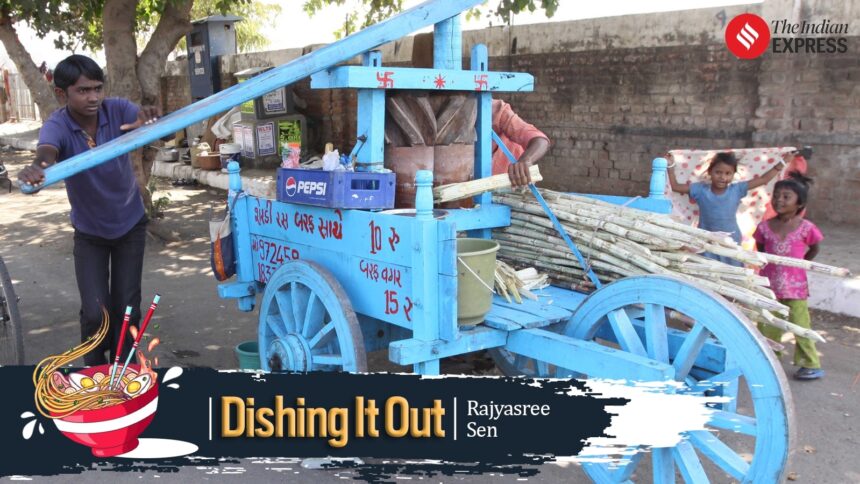
But was sherbet part and parcel of India? The natural sweet beverage of India was sugarcane juice, which was often flavoured with ginger. The history of sharbats in India is as fascinating and complex as some sharbats you might chance upon in the country. The word sharbat has Persian roots, a derivative of sharb. Sharbat in Arabic essentially means a light beverage. Not that sharbat was not made in India before. A sharbat, called panaka, was made in ancient India. In South India, especially in and Kerala, panakams are still consumed regularly.
In her book 50 Great Recipes – Sharbats, food historian Salma Yusuf Husain notes that Vedic literature and even the Arthashastra refer to drinks made with molasses. In southern India, tamarind and gooseberry are combined with elaichi (cardamom), ginger, and various citrus fruits. And in 200 BC, sharbats, as we know them, were made by hakims as medicinal drinks to heal the digestive and nervous systems. You could drink a blackberry and mulberry sharbat to cure your cough, and a pear sharbat to improve liver health. Sugarcane juice with certain spices was used to treat biliousness.
The advent of the Muslims in the second millennium AD saw the introduction of new types of sweet sharbats. These were coloured and flavoured with essences like rose, kevda (screwpine), and even herbs. And a drink called fuqqa, made with barley, was served during the Sultanate.
In fact, that abomination of a sharbat – according to me – Roohafza, might well have been inspired by the sharbat created by Mughal Empress Nur Jahan’s hakim. Nur Jahan supposedly smelt roses while walking in a garden, reminding her of the sharbats her mother used to make in Iran. This led her to ask one of her hakims to bottle the essence of roses.
The charm of the sharbat is that you can have multiple varieties and still never run out of options. In Uttarakhand, you can have buransh sharbat, made from rhododendron flowers and supposed to be good for the digestive system. Another sharbat, which is quite an oddity, is the bela (jasmine) sharbat, made with the smaller flowers available for barely a couple of months in summer.
My favourite sharbat is, of course, the one made from mangoes – both green and ripe. It’s really like taking a cold sip of a hot summer. Truly one of the best culinary creations coming out of India.
Next week, I’ll be writing about the Indian solution to eating light in the summer heat – from jhaal muri to bhel puri, dahi chaat, kakdi, and more.



