



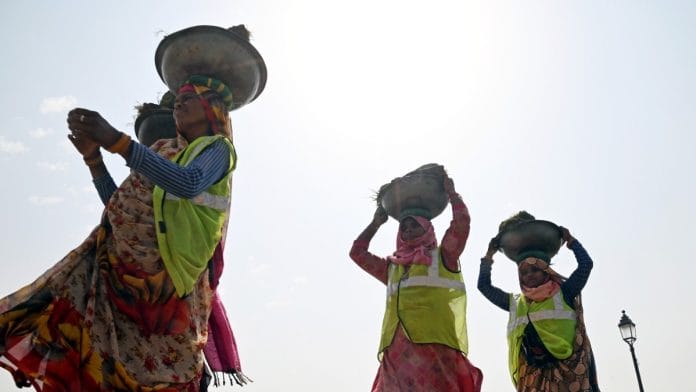
Consequently, more women are counted as part of the workforce, but not necessarily in roles that enhance their economic autonomy. Much of this work is performed alongside and constrained by ongoing care responsibilities.
This pattern is not unique to India, but its persistence is striking. As American economic historian and labour economist Claudia Goldin has , the idea of a U-shaped relationship between economic development and women’s work suggests that female labour force participation tends to decline and then rise with structural transformation. However, the upward shift is neither automatic nor inevitable; it depends critically on the reorganisation of work and the reduction of constraints such as unpaid care. Without this, economies can remain stuck in the lower- or middle-segment of the curve.
India’s trajectory suggests precisely such a stall.
This underscores a deeper reality: women’s participation in the labour market is influenced not only by job availability and qualifications, but also by the availability of time. For many women, time is already allocated to unpaid care work.
Consequently, women are disproportionately represented in flexible, home-based, or informal forms of employment that enable them to manage responsibilities. What is often perceived as “choice” frequently reflects underlying constraints. This distinction is significant: the labour market is not merely failing to include women; it is structured by this fundamental constraint. Unless this underlying constraint is addressed, increases in participation will remain limited in both quality and impact.
This issue also highlights a challenge of measurement. Conventional indicators of labour force participation capture whether women are working, but not the conditions under which they work or the unpaid labour that shapes those conditions. Consequently, the gender gap is both underestimated and misunderstood. It also involves time allocation, earnings quality, and access to economic opportunity.
Yet, care continues to be treated as a private responsibility rather than a matter of economic policy.
This is a critical oversight. Countries that have expanded women’s workforce participation have done so by investing in care systems, accessible childcare, eldercare services, and supportive labour market policies. As noted by the World Economic Forum, such investments not only enable women’s participation but also generate employment in their own right. A report by Primus Partners estimates that India’s care economy could unlock $300 billion in value and create over 60 million jobs by 2030.
In other words, care is not merely a social obligation; it is an economic infrastructure.
In India, the economic infrastructure of women’s care work remains fragmented. Public childcare provision is limited, especially in urban areas. Eldercare is almost entirely absent from policy priorities. Simultaneously, paid care workers, including domestic workers, ASHA workers, and Anganwadi workers, are undervalued and lack adequate protections.
The existing system relies heavily on women’s unpaid labour to function.
Addressing this issue requires a fundamental rethinking of care within economic policy. If care constitutes the primary constraint on women’s economic participation, it must be integrated as a core component of economic planning.
This process begins by expanding accessible, affordable care infrastructure, particularly childcare. It also necessitates the formalisation and professionalisation of care work, including fair wages, labour protections, and access to social security for care workers. Equally important is redistributing care within the household to promote more equitable sharing.
These interventions are not peripheral; they are central to enabling meaningful participation in the labour market. India’s economic ambitions must be evaluated in relation to the structural conditions that determine who can participate in the growth process.
An increase in female labour force participation driven by informal and low-quality work does not signal transformation; it reflects adaptation to persistent constraints.
Recognising, reducing, and redistributing care work is therefore not solely a matter of social policy; it constitutes an economic imperative. Until it is regarded as essential infrastructure rather than a private burden, India’s economic growth and social inclusion will remain fundamentally constrained.
Amir Ullah Khan is a Development Economist and teaches public policy at the Indian School of Business.
Anjana Divakar is a public policy researcher and Director at the Centre for Development Policy and Practice. Views are personal.
(Edited by Prashant Dixit)

