Walk through any Indian neighbourhood, garden, or market, and you are likely to come across plants so familiar that they feel unquestionably native to the country. But many species now deeply integrated into Indian landscapes and cuisine were actually introduced from other parts of the world through trade routes, colonial influence, and botanical exchange.
Here are five plants many people assume are native to India, but actually originated abroad.
It is difficult to imagine Indian cuisine without chillies today, but chilli peppers were not originally grown in India. They were brought from Central and South America by Portuguese traders in the 15th and 16th centuries. According to Britannica.com, “Chilli peppers are native to the Americas and are cultivated in warm climates around the world.”
Before chillies arrived, black pepper and long pepper were primarily used to add heat to food. Over time, chillies adapted exceptionally well to Indian climates and became a cornerstone of
Known for its bright pink, purple, orange, and white blooms, bougainvillaea is commonly seen climbing compound walls and decorating Indian streets. However, the plant is native to South America, especially Brazil, Peru, and Argentina.
It became popular in tropical and subtropical countries because of its drought tolerance and vibrant appearance. According to Britannica.com, “The combination of bract plus inconspicuous flower itself resembles a flower with conspicuous petals. B. peruviana, from Colombia to Peru, has rose to magenta bracts. B. × buttiana, a probable hybrid of B. glabra and B. peruviana, has given rise to varieties having lemon yellow (“Golden Glow”), orange (“Louis Wathen”), and crimson (“Mrs. Butt”) bracts. Bougainvillaeas are hardy in warm climates.”
Eucalyptus trees are widely planted across India for timber, paper production, and fast-growing greenery. Yet the species originated in Australia. According to Britannica.com, “eucalyptus, (genus Eucalyptus), large genus of more than 660 species of shrubs and tall trees of the myrtle family (Myrtaceae), native to Australia, includingTasmania, and nearby islands.”
Introduced during the colonial period, eucalyptus was favoured because it grows rapidly. However, environmentalists have often debated its ecological impact, arguing that some species consume large amounts of groundwater and
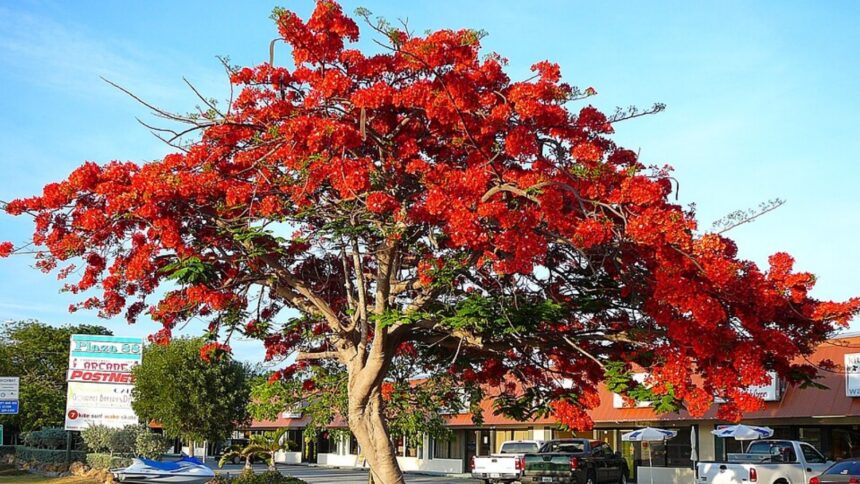
The gulmohar tree, famous for its fiery orange-red flowers during summer, is another species many mistake as Indian. In reality, it is native to Madagascar. According to researchgate.net, “The tree is native to Madagascar. It is now widespread in most subtropical and tropical areas of the world and has been widely planted more as a garden and avenue tree in both moist and dry regions of tropical India.”
Because of its dramatic canopy and ornamental appeal, gulmohar became a popular avenue tree in Indian cities and educational campuses.
Papaya is now commonly cultivated and consumed across India, but it originally came from Central America and southern Mexico. According to the National Horticulture Board, “Papaya cultivation had its origin in South Mexico and Costa Rica. Total annual world production is estimated at 6 million tonnes of fruits. India leads the world in papaya production with an annual output of about 3 million tonnes. Other leading producers are Brazil, Mexico, Nigeria, Indonesia, China, Peru, Thailand, and the Philippines.”
Introduced centuries ago through maritime trade, papaya adapted quickly to tropical climates and became valued for its nutritional content and digestive benefits.