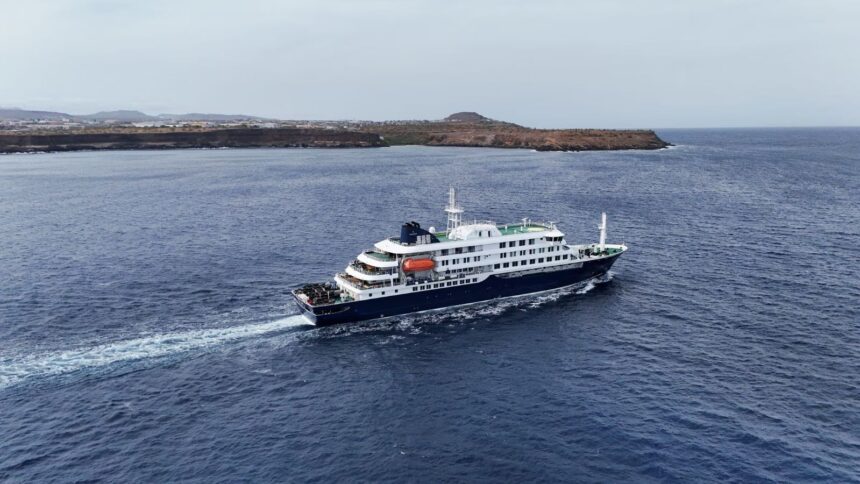
Passengers and some crew members disembarked from the . The vessel, carrying more than 140 people, arrived at the Spanish island of Tenerife, off the coast of West Africa, on Sunday.
There are currently people of . Spanish authorities in the Canary Islands will allow those coming off the ship to take only their essential items, cellphones, chargers, and documentation, AP reported.
The people will be ferried off in small boats, while the Dutch-flagged cruise ship will remain anchored off the coast. Some crew, as well as the body of a passenger who died on board, will remain on the ship, which will sail on to the Netherlands to undergo disinfection.
What’s the situation aboard the ship?
The World Health Organization (WHO), Spanish authorities, and cruise company Oceanwide Expeditions have said that nobody on board is currently showing symptoms of the virus. But those leaving will be checked for symptoms and will only be taken off the ship once evacuation flights are ready to fly them to their destinations. The average age of passengers on board the ship is 65 years.
The director of the WHO’s Department of Epidemic and Pandemic Management, Maria Van Kerkhove, said that authorities are aiming to complete the evacuation flights on Sunday and Monday. Both the US and the UK have agreed to send planes to evacuate their citizens. Americans are to be quarantined at a medical center in Nebraska.
All Spanish passengers will be transferred to a medical facility and quarantined. Oceanwide has listed 13 Spanish passengers and one Spanish crew member.
WHO Director-General Tedros Adhanom Ghebreyesus, along with Spain’s health and interior ministers, will supervise the evacuation. Authorities have said the passengers and crew members leaving the ship will have no contact with the local population.
Hantavirus is a zoonotic virus that spreads through contact with rodents, especially when exposed to their urine, droppings and saliva.
Most strains of this virus aren’t easily transmitted between humans, but the Andes virus (ANDV) detected on the cruise ship . This particular strain is primarily found in South America.
Symptoms usually appear between one and eight weeks after exposure. The disease can have a high case fatality ratio, reaching 40-50%, particularly among the elderly and those with co-morbidities, according to the UN health agency.
In this outbreak, a total of eight confirmed cases, including three deaths, have been detected so far, translating to a case fatality ratio of 38%.
According to the WHO, the infection can lead to hantavirus cardiopulmonary syndrome (HCPS), a rapidly progressive condition affecting the lungs and heart. It may also cause hemorrhagic fever with renal syndrome (HFRS), affecting the kidneys and blood vessels.
Words like quarantine making the rounds, visuals of health officials wearing PPEs surfacing, and alarming headlines have stirred up fears that the outbreak may be the onset of another pandemic like .
However, WHO officials have repeatedly stressed that this will not snowball into another pandemic.
While the disease has a higher recorded fatality rate, it does not spread as fast as Covid.
Reproductive number: This is the average number of people an infected person is likely to transmit the virus to.
A study by Dr Gustavo Palacios, a microbiologist at the Icahn School of Medicine at Mount Sinai in New York, cited by CNN, found that during a previous Andes virus outbreak in Argentina in 2018-19, the contagion had a reproductive number of 2.12. But the overall outbreak average was 1.19.
By comparison, Covid-19’s reproductive number was above 2 and possibly closer to 4.
The infectious window: This is the time window during which an infected person can spread the disease.
Studies have revealed that hantavirus transmission typically occurs only when a person is already visibly ill, and this window can last for roughly one to two days.
On the other hand, asymptomatic individuals transmitted Covid-19. Hence, the period during which the virus can spread from an infected individual was much longer.
Genetic stability: Another important factor to consider here is genetic stability. The rate at which a contagion mutates determines its ability to evade immunity, thereby influencing its transmissibility.
Genomic sequencing, comparing hantavirus samples from 1996 with samples collected recently, found relatively little genetic change over a three-decade period.
On the other hand, Covid-19 produced multiple variants within months, and the disease kept returning in waves driven by the spread of these new variants.
On May 2, the WHO was made aware of passengers with severe respiratory illness aboard the cruise ship when it was off the coast of Cabo Verde. At that time, 147 passengers and crew were onboard, and 34 passengers and crew had previously disembarked.
According to WHO records, the first case was of a male passenger who boarded the ship on April 1 after travelling for more than three months in Argentina, Chile, and Uruguay. He developed symptoms on April 6 and died on board five days later. Although no laboratory tests were conducted, he is considered a probable case.
The first confirmed case was of an adult female who was a close contact with the first case. She died on April 26 in a Johannesburg clinic, a few days after reporting gastrointestinal symptoms. She was confirmed with hantavirus infection by PCR testing on May 4, two days after the WHO was informed.
The third death also involved an adult female, who reported symptoms of fever and general malaise on April 28, and passed away from pneumonia on May 2. A post-mortem sample collected and sent to the Netherlands — along with two other evacuated patients — confirmed that she was infected with the Andes virus. The two evacuated patients are currently stable.
An adult male passenger who developed symptoms on April 24 was also evacuated. He remains in Ascension Island in South Africa, under intensive care after testing positive.
Two more cases involve adult male passengers: one, who had left the ship earlier, tested positive after returning to Switzerland; another, who disembarked in Tristan da Cunha, remains a probable case pending laboratory confirmation.
Authorities in Argentina, Cabo Verde, Chile, Germany, the Netherlands, South Africa, Spain, Switzerland, and the United Kingdom, along with the WHO and partner organisations, initiated coordinated response measures to contain the outbreak.
According to the WHO, one expert from the UN agency and one from the European Centre for Disease Prevention and Control (ECDC) are on board the ship to provide public health advice to the passengers.