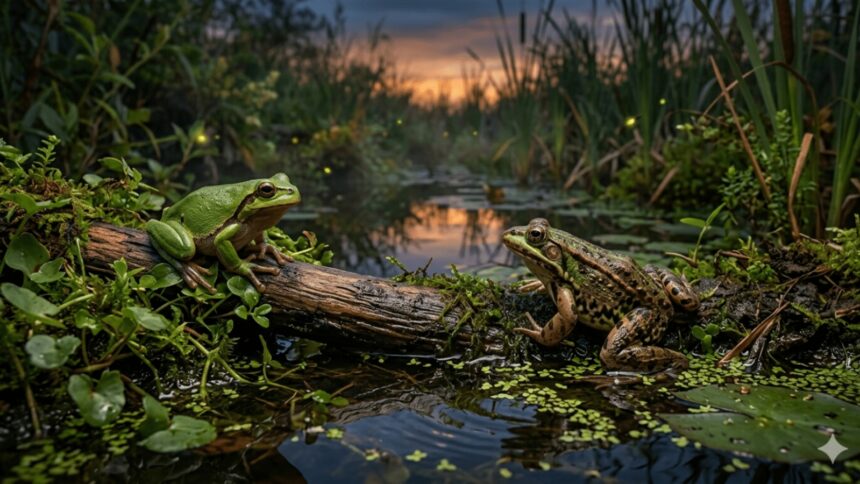
Frog calls are usually thought of as simple mating signals—loud croaks meant to attract a partner. But new research suggests they may be doing something more: acting like tiny, natural weather reports.
Scientists have found that the way male frogs call—how fast or slow, frequent or spaced out—changes depending on temperature. In colder conditions, their croaks are slower and less frequent. As the environment warms up, the calls become quicker and more energetic.
The study titled titled “Anuran call properties as reliable indicators of environmental suitability for reproduction” is published in the journal Frontiers in Ecology and the Environment.
Researchers believe female frogs may be “listening in” to these changes to decide whether it’s the right time and place to lay eggs.
For years, faster and more frequent frog calls were mainly linked to attractiveness—larger, fitter males tend to produce stronger, quicker croaks, making them more appealing to females.
This study adds another layer. also use these calls as environmental cues, especially in places with a short breeding window. In snow-fed or high-altitude habitats, water bodies may remain suitable for reproduction for only a few weeks.
By tuning into the pace of calls, females could be indirectly assessing water temperature—an important factor for egg survival. Warmer water improves the chances that eggs will develop properly, while colder conditions can be risky.
Frogs don’t have much time to reproduce. Once the snow melts and the water bodies open up, they must act quickly before conditions change again.
Males usually arrive at breeding sites first, giving them a better sense of water conditions. Females who arrive later may rely on these acoustic cues to decide when to enter.
There’s also a safety factor. Breeding sites can be highly competitive, and males can become aggressive. Arriving too early may expose females to intense competition and even risk of harm, making timing crucial.
The findings also tie into a larger concern—climate change. As seasonal patterns shift, the timing of snowmelt and warming waters is becoming less predictable. Frogs are already adjusting their behaviour in response.
If breeding begins earlier due to warmer conditions, it could create a mismatch between frogs and their food sources. Tadpoles may emerge before enough food is available, while adult frogs may become active before their prey appears.
Scientists say more research is needed to confirm how much females rely on these cues. For now, the idea is striking: what sounds like a chorus of mating calls may also be a subtle broadcast about the environment—one that helps frogs survive in a changing world.