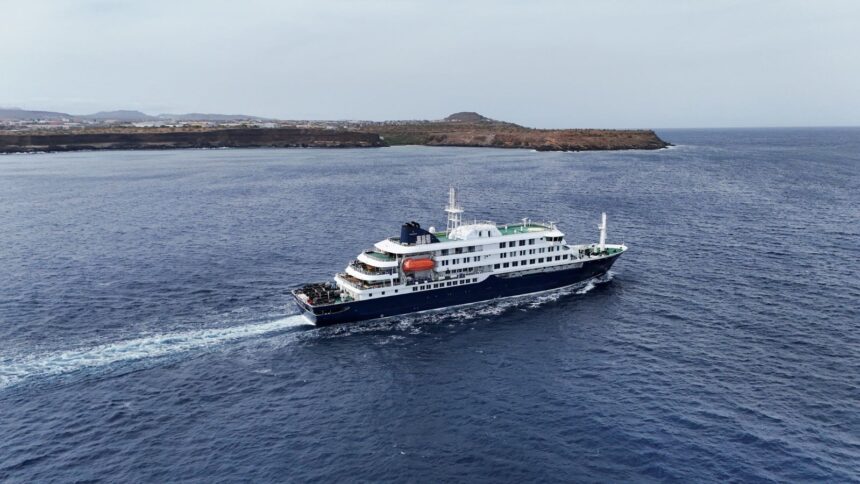
The World Health Organization (WHO) chief arrived in Spain Saturday to oversee the evacuation and safe disembarkation of more than 140 passengers and crew aboard the hantavirus-hit cruise ship MV Hondius, as countries across Europe and beyond scrambled to fly home their citizens amid fears over the rare outbreak.
According to Reuters, WHO Director-General Tedros Adhanom Ghebreyesus said he was travelling to Tenerife in Spain’s Canary Islands along with senior Spanish officials to supervise the operation after the Dutch-flagged vessel reported multiple infections and three deaths linked to hantavirus.
“WHO continues to actively monitor the situation, coordinate support and next steps and will keep Member States and the public updated accordingly. So far, the risk for the population of Canary Islands and globally remains low,” Tedros posted on X.
To the people of Tenerife,
My name is Tedros, and I serve as the Director-General of the , the agency responsible for global public health. It is not common for me to write directly to the people of a single community, but today I feel it is not only appropriate, it is…
— Tedros Adhanom Ghebreyesus (@DrTedros)
The MV Hondius is expected to dock in Tenerife early Sunday, where passengers will undergo screening before being transferred to isolated areas under strict health protocols, AP reported.
Reuters reported that Germany, France, Belgium, Ireland, and the Netherlands have confirmed they will send aircraft to evacuate their nationals from the ship. The European Union is also dispatching additional planes for remaining European citizens, while the United States and the United Kingdom are arranging contingency evacuation plans for their citizens.
Spanish authorities said passengers would only be allowed to disembark once their evacuation flights are ready.
AP reported that Spain has activated the EU civil protection mechanism to keep a specialised medical evacuation aircraft on standby in case any passenger
The head of Spain’s emergency services, Virginia Barcones, said passengers would be taken to a “completely isolated, cordoned-off area” after disembarkation, according to AP.
The outbreak aboard the Hondius has so far resulted in three deaths — a Dutch couple and a German national — while several others from Britain, the Netherlands, and Switzerland remain hospitalised in South Africa, Switzerland, and the Netherlands, Reuters reported.
The WHO said six of the eight suspected cases aboard the ship have been confirmed as hantavirus infections.
The outbreak has alarmed health officials because laboratory testing identified the strain as the Andes virus — t capable of limited human-to-human transmission through close and prolonged contact, according to Reuters.
Health authorities are now monitoring possible cases linked to passengers who had already disembarked before the outbreak was fully identified.
Reuters reported that a woman in Spain’s Alicante region developed symptoms consistent with hantavirus after sitting near an infected Dutch passenger on a flight from Johannesburg.
Another suspected case emerged on Tristan da Cunha, a remote British territory in the South Atlantic where the ship had stopped in April. British authorities said the suspected patient was a passenger aboard the Hondius.
The outbreak has triggered international contact tracing operations across four continents as authorities attempt to locate passengers and monitor possible exposures.
Despite concerns over international spread, WHO officials have repeatedly stressed that the overall public risk remains low.
“Based on the dynamics of this outbreak, based on how it is spreading and not spreading amongst the people on the ship, the people who have disembarked, as well, we continue to consider the risk as low for the general population,” WHO technical officer Anais Legand said during an online briefing, according to Reuters.
AP also reported that WHO spokesman Christian Lindmeier sought to calm fears after concerns surfaced about a flight attendant who briefly interacted with an infected passenger.
“The risk remains absolutely low,” Lindmeier said. “This is not a new COVID.”
Hantavirus is a rare but potentially deadly disease usually spread through exposure to infected rodent urine, droppings, or saliva.
People typically become infected after inhaling virus particles from contaminated dust in enclosed or poorly ventilated spaces.
Symptoms can appear between one and eight weeks after exposure and may initially resemble flu-like illness, including:
In severe cases, patients may develop respiratory failure and fluid buildup in the lungs.
According to Reuters, the WHO estimates fatality rates among infected people in the United States can reach up to 50%.
The Hondius outbreak is the first documented hantavirus outbreak linked to a cruise ship.
The ship had departed Argentina in March and travelled through Antarctica and the South Atlantic before authorities identified the outbreak.
By the time hantavirus was officially confirmed in a passenger on May 2, more than two dozen passengers from at least 12 countries had already left the vessel without contact tracing, according to AP and Reuters.
Health authorities across Europe, Africa, North America, and the South Atlantic are continuing surveillance and quarantine efforts as the ship approaches Tenerife.