



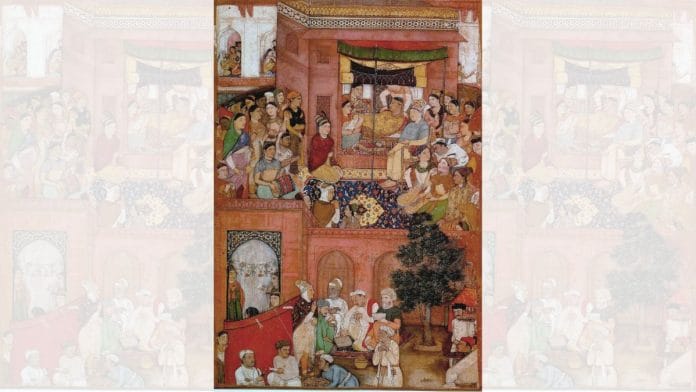
It made sense to create a model of kingship from materials that were ready at hand. So, while Akbar married into Rajput families, he also borrowed court etiquette and practices from them. For instance, an important part of the image of the emperor was the projection of him as a semi-divine figure, taking on the title zill-e-ilahi, or reflection of God. While the idea of divine sanction was not unknown within the Mughals’ Turko-Mongol heritage, Akbar sought to embody it in a distinctly Indian form. Thus, the practice of jharokha darshan was adopted, where the emperor would show himself daily to his subjects, framed in a window like a deity. Another practice adopted was that of tula daan, the ceremonial weighing of the emperor on his birthdays—both according to the lunar and solar calendars—against precious metals, rich cloths, grains, etc., that were then distributed in charity.
These cultural and political choices were an important part of Akbar’s policy of sulh-e-kul, perfect peace and harmony, an ideal that aimed at creating an inclusive state that dealt even handedly with its diverse subject population, and in particular, sought to forge ties with the non-Muslim part of that population. Marriages with Rajput princesses were, on the one hand, a part of that strategy, and in turn reinforced it, because these Rajput women did not simply become wives of emperors, but also the mothers of emperors such as Jahangir and Shahjahan. Their important place within the royal household was bound to strongly influence the essential culture of the Mughal family.
Signs of this very specific syncretic culture can be seen in the many accounts of the later Mughals that still survive, such as palace diaries, newspapers, and memoirs of those who had been part of the court and household. Festivals such as Holi, Dussehra and Diwali were celebrated at court with formal durbars, as were festivals like Eid and Nowruz. There were also special practices such as the emperor bathing in the water of seven wells on Holi, and the sacrifice of buffaloes at the gates of the fort on the occasion of Diwali—a distinctly Rajput custom.
Equally significant are the celebrations that took place within the confines of the royal family’s residential area, particularly the mahal, where the women of the family lived. Not only were all these religious festivals celebrated, but even some non-religious occasions were celebrated with a mix of Rajput and Indian Muslim traditions. For instance, the anniversary of the emperor’s accession to the throne involved a ratjaga, an all-night celebration on the eve of the anniversary. During this, an important part of the observances was a Rajasthani custom. The chief consort would pour seven double-fistfuls of dal into a pan, to which more dal was added and then soaked. At midnight, this would be ground, and the queen would make seven badas or fritters with her hands, which the emperor then transferred with a spoon into hot oil to fry.
These descriptions of the palace give us a greater insight into the culture of the Mughals beyond performative aspects of court ritual and etiquette. These were not designed to include subjects and courtiers of diverse backgrounds. Instead, they were an integral part of the beliefs and practices of the Mughal royal family itself; a family whose Chaghtai, Rajput and other roots came together to support and nourish a single tree. The Mughals would have been Indian even if they had not married Indian women, simply because they chose to make India their permanent home, but these marriages made them Indian in very specific ways.
To see Mughals as aliens in India is to forget history. It is also an extremely patriarchal lens that completely invisibilises women. By looking only at the male lineage of the Mughals, it willfully blinds us to the indisputable fact that women were active agents, not just vessels for the procreation of heirs. Akbar’s Rajput wife was not only respected for being the emperor Jahangir’s mother. She was an influential and wealthy woman, one of whose properties was the ship Rahimi, the largest Indian ship sailing to the Red Sea at the time. It is time we acknowledge her lineage and her role as a formative influence on the Mughal family.
(Edited by Theres Sudeep)

