



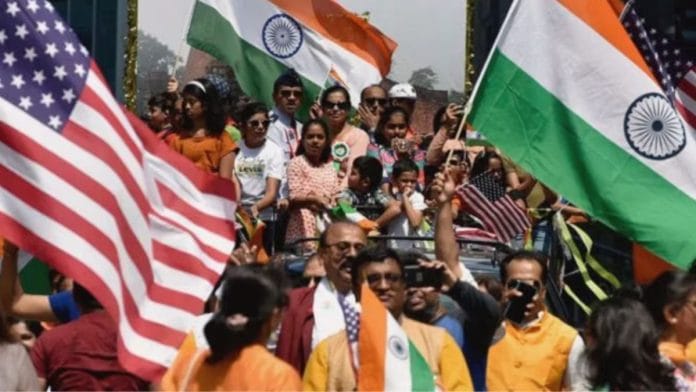
For quite some time now, he has consistently asserted that employment opportunities for Americans are diminishing due to the presence of foreigners. He has repeatedly argued that companies utilise H-1B visa provisions to import cheap labour from abroad, thereby displacing American workers. Consequently, he has tightened H-1B visa regulations and initiated rigorous scrutiny of foreign workers.
The vast majority of Indians working in the US, primarily in the software and technology sectors, do so through the H-1B visa program, a mechanism through which both American and Indian companies employ Indian nationals.
Interestingly, Trump has previously been an admirer of the Indian people and the leadership. In the past, he has consistently stated that India is a great friend and a strategic partner. At events such as ‘Howdy Modi,’ he heaped praises on Indian-Americans, describing them as incredible and noting their immense contribution to the American economy.
However, he recently used derogatory language regarding the Indian people and India on his social media platform, ‘Truth Social’. India’s Ministry of External Affairs countered his remarks as uninformed, inappropriate and in poor taste. This statement by Trump, on the Truth Social platform, was part of a broader, highly controversial commentary on the US by radio host Michael Savage.
Nevertheless, following this incident, the US administration clarified that Trump regards India as a great nation and considers its leadership to be a close friend. Before this, Trump had also caused diplomatic friction by imposing heavy tariffs on nearly all of the US’s trading partners, including India, though the US Supreme Court has since ruled to overturn the majority of those tariffs.
In the current context, Vembu’s appeal to Indians to return home and contribute to their country’s technological advancement holds particular significance for two key contexts. First, the shifting geopolitical landscape—specifically the statements and actions of the US administration, and Trump in particular—has cast a shadow of uncertainty over the future of Indians residing in the US.
Second, India is not only poised for technological advancement but is also witnessing a steady expansion of its potential in this domain. There was a time when India lagged significantly in terms of technology. During that era, graduates from our premier educational institutions, such as the IITs, AIIMS, as well as management experts, scientists, and professionals, were unable to secure work opportunities commensurate with their talents due to adverse conditions in India.
Consequently, our brightest young minds turned their gaze toward foreign shores. These young individuals subsequently played a pivotal role in the nation-building and development of those host countries. People of Indian origin only 1.5 per cent of the US population. Of these, two-thirds are immigrants, while one-third are native-born.
However, a remarkable fact is that—owing to their diligence, education, and capabilities—they earn several times more than the average American and contribute 6 per cent to the US national revenue. The US government derives $300 billion in revenue from people of Indian origin. Compared to various other demographic groups, the Indian-origin community represents the highest-earning segment of the population.
Indians maintain a strong presence in America’s most lucrative sectors, such as technology, healthcare, and finance. They possess exceptionally high levels of education and professional expertise. Furthermore, they play a pivotal role in entrepreneurship and business ownership. Indeed, the Chief Executive Officers (CEOs) of numerous major corporations are of Indian origin. The amount of money people of Indian origin contribute in taxes far exceeds the benefits they receive in return through social security and other government welfare programs.
However, some people in India have not received Vembu’s appeal very positively, and they are criticising him. At the same time, however, many are supporting him. It is evident that for people of Indian origin who have been living in the US, for one or more generations, packing up their belongings and returning to India is no easy task—even if they love India and believe in its growth story.
Many believe that the environment, infrastructure, standard of living, and opportunities for employment and business are far superior in the US compared to India. Some have even moved to the US specifically for their children’s education. Consequently, Vembu’s appeal may have only a very limited impact on their decision to remain in the US, but this appeal will definitely shake up their minds.
Nevertheless, many who left India in pursuit of better education and, subsequently, a good job are now facing adverse treatment from the US administration, particularly regarding visa-related uncertainties, rejections, and other restrictions. Many see opportunities in India—driven by its thriving start-up ecosystem and business prospects, as well as the country’s progress in innovation, technological advancement, and rapidly improving infrastructure. Many harbour a sense of patriotism toward their motherland; they have begun to contemplate a return—and, indeed, some are already making their way back to India.
Furthermore, many are already maintaining strong ties with India, contributing to technological development, investing in businesses and start-ups, and preserving their close connections with the country. It appears that while this transformation may not occur overnight, sooner or later, people of Indian origin, including Green Card holders, US passport holders, and Indian passport-holding NRIs, may find themselves drawn back toward India.
The reasons behind this could include a sense of patriotism, better opportunities for development, robust infrastructure, and ease of living. However, we must understand that this is a highly opportune moment for ‘brain gain’, opposed to ‘brain drain’ scenarios of the past.
(Edited by Saptak Datta)

