



Another city was added to the above-cited list in 2014. Mayor Patrice Vergriete, who holds a doctorate in urban planning, announced that , a city in France with a population of , would provide free bus services. The initiative was “100% free bus, 7 days a week”. The objectives were to improve mobility in the city, reduce reliance on private vehicles, and and air pollution. However, the plan was preceded by nearly four years of preparation before its rollout.
The programme was communicated to the public through the media and on the streets. This was followed by surveys and extensive dialogue with residents, leading to revisions and simplification of timetables to better align with commuting patterns. Vehicle quality improved, bus stop locations were modified, and the fleet size increased. In 2015, the city piloted the programme by introducing free weekend travel. The full free bus service was rolled out in 2018. Throughout the process, a total investment of was made, with a contribution of from the European Union’s .
The results of the endeavour were highly encouraging. There was a rise in bus ridership. About of bus users had permanently given up their cars, and parking lot use declined by . A found that half of new bus riders were taking bus journeys they previously made by car. People travelled to the city centre, and significantly. The initiative had little impact on , which was mainly a leisure activity for residents. The initiative also catalysed a positive shift away from the of private car ownership, especially among young people.
While Dunkirk’s experience has been replicated in , debate persists over the model’s viability in major cities worldwide—including New York City, where Zohran Mamdani campaigned on a for all residents.
In Dunkirk, free bus rides cost (3.4 percent) of the city’s total budget of . However, in New York, transportation is the , accounting for an average of of household spending. Estimates for a free bus service in New York City put the cost at , or about of the Metropolitan Transportation Authority’s (MTA) total revenue. This does not account for the likelihood that free rides will boost demand, thereby increasing bus trips, which stood at 415 million in 2022. Increased travel demand will require an expansion of the city’s bus fleet. While US$ 652 million in revenue loss is a small portion of the city budget, the resulting deficit is likely to affect other services. This shortfall, however, could be offset by raising fares on other public transport modes or by increasing general taxes.
This scenario brings us to the debate over freebies——and their desirability. Western countries have practised in various forms for a long time. In India, this is a , raising concerns in certain quarters, especially about the growing use of such measures. Critics have cautioned that such measures may create disincentives to work and discourage labour force participation. Besides, they can place significant pressure on a country’s economy by diverting capital to unproductive expenditures and crowding out resources development and infrastructure upgrades. The Economic Survey 2025–26 reported that had risen to become a central pillar of national welfare policy and amounted to in FY 26.
Economists and policy analysts, however, have argued that the distribution of certain commodities, such as , could be classified as essential. Other goods have been labelled as ’, which yield significant public benefits, especially in health and education-related areas, such as mid-day meals. However, the inclusion of cash transfers or goods such as TV sets is often seen as less justifiable. Money that is directly transferred to an individual may lack clearly defined public objectives beyond individual benefit and may, in some cases, influence political preferences. This may lead to greater consumption, but the public authority has limited control over how the money is spent. Despite these criticisms, several social commentators such measures.
While a universal definition of ‘freebies’ remains difficult, one possible approach is to consider a cap on such expenditures as a share of city and national budgets. Such a cap would be relatively easy to monitor and could help prioritise expenditures that deliver greater public value.
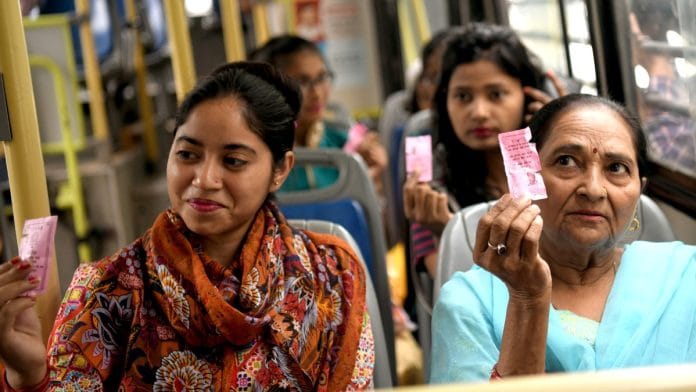
In the suggested gradation, free bus service emerges as one of the most desirable interventions on account of the several public benefits it generates. It promotes public transport and discourages private car use. It reduces traffic congestion and air pollution, and contributes positively to the urban environment. It can also release parking space due to reduced demand. Walking to and from bus stops contributes to public health. These benefits are complemented by its inclusionary nature, particularly for lower-income groups. Given its global popularity, free bus transport can be considered a significant public good.
The Dunkirk experiment demonstrates how free bus transport, when carefully designed and supported by complementary investments, can yield significant mobility, environmental, and social gains. For Indian cities, grappling with congestion, pollution, and unequal access, such initiatives hold promise as targeted, inclusion-oriented interventions rather than broad-based welfare measures. The key lies in embedding them within a broader framework of transport planning, fiscal prudence, and institutional accountability. Free bus services should not be viewed in isolation, but as part of a larger effort to shift commuters away from private vehicles, strengthen public transport systems, and improve urban livability. As Indian cities continue to expand, the challenge will be to strike a balance between equity and efficiency, while ensuring that such schemes remain financially sustainable and deliver tangible public value.

