



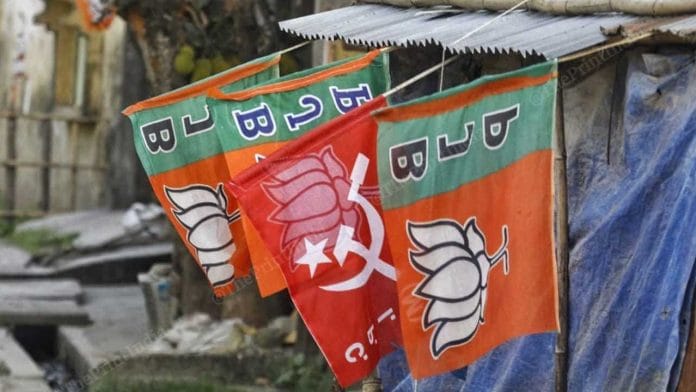
Politics and ideology run deep in Bengal: from local sports clubs to Durga Puja committees, the social sphere of Bengali society is organised around party politics, which further fragmented Dalit constituencies. However, this overarching party-based society did little to alleviate caste disparity. Dalits remained downtrodden; untouchability and caste-based violence were rife, and entry into temples was prohibited — the most recent example being the denial of Dalit entry into the 300-year-old Girdheshwar Temple in East Bardhaman district in 2025.
Party politics invisiblised their struggle, while all efforts went into sustaining the hegemonic notion — peddled by the Bhadralok, who are primarily upper-caste and upper-class — that Bengal is “caste-less” and therefore better than other states. But this has been nothing more than sweeping the crucial question of caste, first under the red carpet and then the blue.
Dalits in Bengal are dispersed across the state and comprise several sub-castes and communities. The Namo Shudra and Matua communities are spread across southern Bengal, especially in North 24 Parganas and Nadia. The Rajbanshis, another Dalit group, hold sway in north Bengal, especially in Jalpaiguri, Cooch Behar and Darjeeling. Other Scheduled Caste communities — Bagdi, Bauri, Mochi and Chamar — have a significant presence in Jangal Mahal, Midnapur and semi-urban constituencies across the state. Their aspirations are as diverse as their identities.
Identity, among other things, remains one of the major struggles these communities face. The Matua and Namo Shudra communities trace their origins to undivided Bengal, and their primary concern to this day is citizenship and refugee status. The Rajbanshis of north Bengal have a long-standing demand for a separate state. Other Dalit communities are largely agrarian, with common concerns around education, employment and equality, issues that have largely gathered dust since Independence.
Many reports, despite the much-proclaimed caste-less character of the state, suggest that segregation in classrooms and at drinking wells, as well as caste- and gender-based violence, are as ubiquitous as the urban legend of Bengal being a caste-less society.
The BJP has not only given voice to these communities but also listened to their long-standing demands. Recognising the caste realities of a society as diverse as Bengal’s, and engaging with its communities’ demands, has been one of the key takeaways in this election campaign. The Namo Shudra and Matua communities have been promised fast-track citizenship through the previously enacted Citizenship Amendment Act, while the Rajbanshis have been promised a battalion named in their honour, in recognition of their historic resistance against Mughal suzerainty.
But the most crucial factor was the consolidation of the diverse identities and aspirations of Dalit communities, which produced such a resounding and decisive result in this election. Urban and rural Dalits have different aspirations and are mired in contradictions of class identity. The interests of urban Dalits differ from those of rural constituencies, and with class hierarchy so deeply ingrained in Indian society, stitching these groups into a single cohesive bloc has been a difficult task, which the BJP had to overcome.
This victory is not a one-off electoral manoeuvre by the BJP’s formidable machinery, but the result of ten years of continuous dialogue and outreach, which achieved what had seemed impossible a decade ago: the consolidation of the Dalit vote from a position of near-total invisibility in caste politics. It is also a testament to the Modi government’s consistent endeavour to secure dignity and parity for the community across every sphere of life, not only in admissions and recruitments. Charity began at home, with the BJP nurturing hordes of leaders from Dalit communities within its own cadre, successfully giving not just a platform but also a voice to the voiceless.
The GYAN pillars upon which the foundation of a developed Bharat is to be built come at a great cost to the establishment that has worked tirelessly since Independence to fragment the very voices the Constitution and its makers resolved to protect. The BJP’s victory in West Bengal is symptomatic of the dissolution of the old order. This election stands in line with previous ones in substantiating the Modi government’s resolve to empower the most marginalised communities — politically, economically and socially.
(Edited by Prashant Dixit)

