



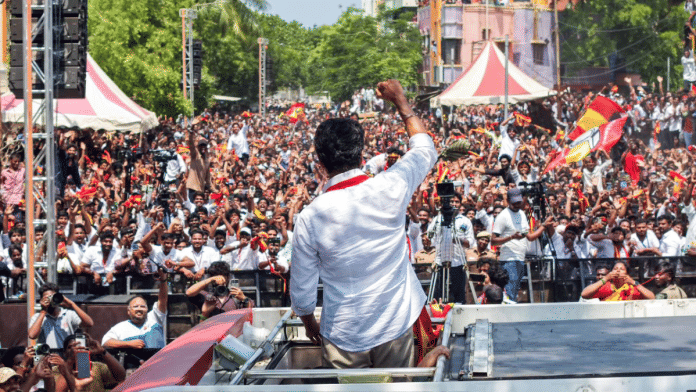
This is not an aberration. In many ways, it is the system working exactly as it has for decades. Take MG Ramachandran, for instance. MGR’s carefully curated on-screen persona — the messiah of the poor — bled seamlessly into his real-life political identity. Then, J Jayalalithaa inherited his party and mythos, crafting her own image of authority and grace and ‘Amma’ was soon the image of maternal benevolence, complete with her sarees and freebies. Both understood something fundamental: in Tamil Nadu, politics is performed, felt, and believed.
‘Thalapathy’ Vijay’s ascent fits squarely within this tradition. His films have always had a similar pattern: the righteous underdog, the defender of the poor and marginalised, the incorruptible everyman standing up to entrenched power. It is a narrative that resonates deeply in a state where the “common man” is a voter demographic as well as a cultural ideal.
Even as actors like Vijay command astronomical fees and live lives far removed from everyday struggles, their onscreen avatars allow audiences to see themselves reflected in them as the empowered, the avenged, and the redeemed. This emotional bridge collapses the gap between spectacle and reality.
The near-entry of Rajinikanth into politics years ago demonstrated the sheer pull of this phenomenon. His eventual withdrawal did little to diminish the anticipation he had generated. Conversely, Kamal Haasan and his party flopped. His intellectual heft and unconventional life choices make him a thinking man’s choice rather than the masses.
Vijay, unlike Haasan, has spent years cultivating a direct connection with the masses. His public interventions, fan club networks, and carefully calibrated messaging have reinforced his image as accessible and rooted. His political rise is less a sudden breakthrough — especially since 2012, with his constant and consciously chosen ‘saviour’ movies and political stances he has taken — and more the culmination of a long, deliberate process of the hero’s myth-making.
Vijay is so popular that VS Babu, a member of the actor-politician’s party Tamilaga Vettri Kazhagam (TVK), campaigned with his look-alike in Kolathur.
So what does this say about democracy?
Vijay’s victory can be seen as a reaffirmation of democratic vitality. Voters are not bound by legacy parties; they are willing to disrupt entrenched power structures and invest in new leadership. The decline of DMK and AIADMK dominance, if sustained, signals a churn that is essential for any healthy democracy.
Also read:
But it also raises concerns about the nature of political choice. When electoral success hinges heavily on cinematic persona, does governance risk becoming an extension of performance? Can the qualities that make a compelling screen hero — moral absolutism, dramatic resolution, individual triumph — translate into the complexities of policymaking?
Tamil Nadu has navigated this paradox before. MGR and Jayalalithaa wielded real administrative power and left lasting legacies. Their tenures show that the transition from reel to real, while fraught, is not inherently flawed.
As Vijay edges closer to what could be a historic mandate, the state stands at a familiar yet consequential crossroads. The electorate has once again chosen belief in a figure who has long occupied their imaginations. They don’t always choose a hero. This time, they have chosen a Jana Nayagan.
Views are personal.
(Edited by Ratan Priya)

