



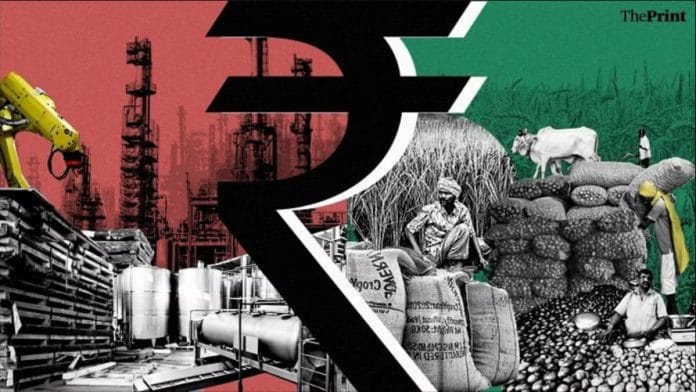
Even on the land, it is very clear that only private enterprise delivers the goods and that wherever the government tries to collectivise the land and farm it under State control, the yield drops. The smaller the farm, the more productivity per acre and the higher yield per acre, contrary to fashionable thinking in Delhi. I was very amused to see some time ago with a great sense of discovery the Delhi papers announced that the larger the farm the less the production, as if some new law of nature had been discovered. This was based on a study by a government official, who investigated on behalf of the Institute of Agricultural Research and the Ministry of Agriculture have now published a monograph which contradicts completely everything that the Prime Minister said in Parliament during our big debates on Co-operative Farming.
This is a historical and universal phenomenon. In the U.S.S.R., which has the system of highly mechanised collective farms, the weekly yield is 9.3 quintals per hectare; U.S.A., which has private enterprise on big farms, also mechanised, 12.2 quintals per hectare. In Britain, where the farms are very much smaller and private, it is 28.5 quintals. In Denmark, where the farms are even smaller and private, 34.4 quintals, and in Japan 22.6, where the farms are only 1/2 acres to 1 acre or 2 acres, much smaller than in India. In other words, Japan, with farms much smaller than ours, produces twice as much wheat per hectare as the USA and two and a half times as much as the U.S.S.R. In the case of rice, you will find the same story — U.S.S.R., 25 quintals per hectare, U.S.A., 28.3 quintals and Japan and Formosa, 48.5 quintals per hectare.
My other reason for saying that the continuance of free enterprise is essential or desirable is its political and social effects. Unless there is a large measure of free enterprise in economic life, we cannot maintain a free society; we cannot maintain a democratic constitution or Government. To start with, there is no known example in the world of a State owning everything—land, factories and business— and yet having a Parliamentary or any other kind of democracy with individual liberty. There is no known example yet. Maybe, thousands of years from now, such an example might evolve, but at present, human beings as they are, if there is no private enterprise there can be no political democracy and individual liberty.
Apart from the fact that it has not yet been done, which is pretty conclusive, logically also it must be so. Let us start by saying that unless we can have freedom of speech and expression and opposition in a society, we cannot have political democracy, democratic government and individual liberty. The need for an opposition, therefore, is at the core of a democratic system; if we cannot tolerate opposition, then obviously the Government becomes permanent, and it cannot be changed or replaced by the will of the people.
There cannot be a free opposition or effective opposition without free enterprise. Let us consider who will provide the opposition. In a system of society where everyone is either an officer or an employee of Government, as would be the case in Russia and China today–more or less everyone is an employee of government—where does the opposition come from? Obviously, a civil servant cannot start an opposition and get elected to Parliament in the face of a government that owns everything. So since one cannot go into opposition without losing one’s job and ration card, one does not go into opposition. Therefore, there is no opposition. Trotsky, who was a communist till he was murdered by Stalin, in his later years realised rather belatedly the nature of this truth when he said that in place of the old slogan “he who does not work neither shall he eat”, the new slogan in a communist society is “he who does not obey, neither shall he eat”. He came to the conclusion that this was the nature of State ownership. When the State became the universal employer, then obedience to the universal employer, the Government, was the test of whether one earned a living and could eat.
The only classes which can possibly provide opposition or the basis of opposition in society are what an Italian political thinker in the second half of the 19th century called “autonomous social forces”. The autonomous social forces are the businessmen, the factory owners, the shop keepers, the peasants who own the land, the artisans who create with their hands, the self-employed people, the professionals, (the lawyers, the doctors, the architects, the auditors etc.). These are “the autonomous social forces”, which means that they stand on their own legs.
They are not beholden to the government of the day for their bread and butter. The professional man, the businessman in a free economy, the landed peasant, the artisan and the self-employed man stand on their own legs and they can say to Government that they do not agree. They are the classes who can possibly go into opposition. They are the classes who can maintain a free press. They are the classes who can have any kind of voluntary society or organisation which is not dependent on Government patronage. Abolish these classes by nationalisation of private property and land and industry, and you will destroy every autonomous social force.
Then everyone is at the mercy of the State. That is why a command economy replaces not only the ballot box of the marketplace but a totalitarian Government replaces a democratic government provided by the Constitution.
These are two very basic reasons why everyone who believes in individual liberty and democratic government or the Constitution of Indian Republic cannot but come to the conclusion that the maintenance of free enterprise in agriculture and industry is a sine qua non of the maintenance of the free Constitution of India.
This essay is part of a series from the Indian Liberals , a project of the . This essay is an excerpt from a monograph published by the Forum of Free Enterprise titled “The Future of Free Enterprise in India” in June 1961. The original version can be accessed on this .

