



“Kyuki main na thoda sa nasamajh hoon, main thoda bewakoof hoon, main thoda paagal hoon yaar (Because I’m a little naive, I’m a little foolish, I’m a little crazy, my friend),”. As someone who, in all seriousness, told my friend, “Mera pehla pyaar adhura reh gaya Rifatbi, (My first love remained incomplete, Rifatbi)” the reel is my inner monologue.
And before you judge me, think about what you were up to when Rohan Rathore released Emptiness in 2010. It was viral before we had a word for it. How can we resist Instagram’s senti slop when the yearning and romantic doom were pumped into our veins by Alka Yagnik and Udit Narayan at a highly impressionable age?
It is impossible to map the entirety of desi brainrot. But some icons stand out.
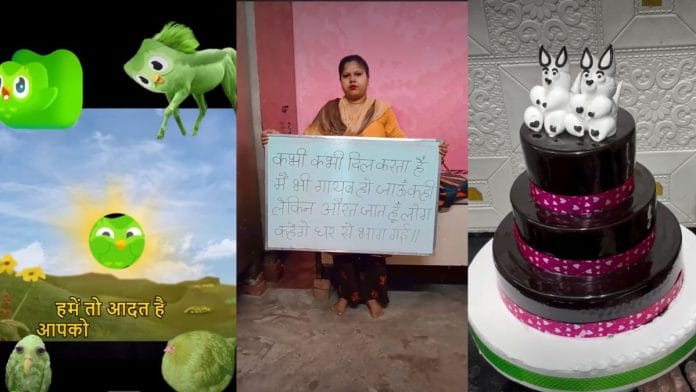
Renu Shakya is the self-designated ‘poster girl for all youth’, whose reels are just photos of her carrying a whiteboard with a Hindi message on it. The ‘thought of the day’ gang is ruling social media. Are the whiteboard writings often horribly misogynistic and full of slurs for ‘bad women’? Yes. Are there flashes of righteous man-hating, critique of patriarchy, and caste activism? Also yes. I enjoyed spotting a colleague’s like on one of her.
“Sometimes I feel like disappearing somewhere but I am a woman people will say she ran away from home,” reads the Hindi text. Shakya’s artistic choices—a radical refusal of punctuation and deadpan expression—have paid off well. The video has over 3.5 lakh views.
Then there are the cooking videos with family drama in voiceovers. Monika Raut’s passion is posting reverse Baghban reels.
“These elders show themselves as sad and wounded, but in their homes they spoil the marital lives of their children,” says an AI voice in Hindi in one of her. Lata didi is humming Kuchh Kuchh Hota Hai here, too.
But none of these videos scratches the surface of how mindless the scroll game can truly be. Because why am I watching someone connect drops of red and green water with a brush to form letters of the alphabet, while the voiceover ascribes personality traits to people whose names begin with them?
“People whose names begin with ‘R’ make very few friends. But when they make friends, they stay loyal to them,” goes one such. I pause the scroll for these videos every single time. Entertainment aside, they’re perfect pebbling material, too.
As with all great social media trends, companies move in sooner or later. Duolingo recently posted a ‘’ reel straight out of my mother’s Facebook feed.
Over visuals of the sun rising in a green landscape, a man can be heard saying:
“Jab fursat mile to hume bhi yaad karna
Humari kami ka bhi ehsaas rakhna
Hume to aadat hai aapko yaad karne ki
Agar disturb kiya ho to maaf karna
(When you find some leisure, miss me too
Retain the feeling of my absence too
I am used to missing you
If I’ve disturbed you, please forgive me)”
Plastered over the sun is the app’s grinning owl mascot. In one corner of the screen, the mascot is busy doing somersaults; in another, it appears as a weird green horse hybrid. In the third corner is a wet, green, miserable owl, while the fourth is just a green chicken. Over 3.6 lakh people have viewed the reel.
Whoever made the reel was clearly fusing Gen Z brainrot visuals with desi brainrot audio. If only the owl company had put that much thought into their language teaching modules. I’d be writing this in French, Japanese, or Korean.
(Edited by Theres Sudeep)

