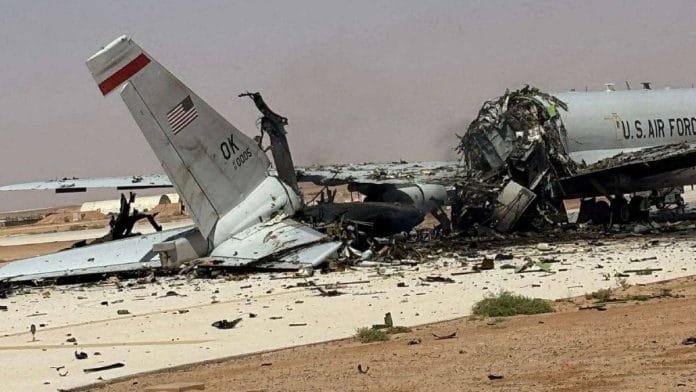
Thirdly, just as the Congress party in India has created a record for losing elections, the US has added one more loss of face to its list of losing wars, from Vietnam to Iran.
While we can’t know what lessons the US, Israel, and Iran will draw from this war — and whether they will at all — it is important that India doesn’t lose time in drawing lessons from this conflict and initiating suitable course correction in its domestic and foreign policies.
There is little doubt that the West Asia conflict appears to have taken New Delhi by surprise, as there are greater negatives for India. Our energy security continues to remain threatened, even as the parties to the conflict claim a ceasefire. The Strait of Hormuz has become a new bone of contention between the US and Iran, while Israel watches from the sidelines. The rest of the world is oscillating between heaving a sigh of relief one day and nail-biting moments as their ships cross the Strait of Hormuz. One drone attack, and their hopes go up in smoke.
After the Iranian Revolution of 1979, realising the need and urgency to replace the Shah’s Iranian army (Artesh), the new regime developed the Islamic Revolutionary Guard Corps (IRGC) as a parallel army and the main instrument of its defence and counter-offensive policy.
Tehran learned lessons from the Iran-Iraq War (1980–1988) and began developing the Ababil family of drones through the Iranian Aircraft Manufacturing Industrial Company (HESA), building on technology and expertise from the IRGC-affiliated Qods Aviation Industries. This led to variants such as the Ababil-2, Ababil-B, and Ababil-T, as well as the Qasef-1 and Qasef-2K loitering munitions, derived from the Ababil-2 airframe and equipped with 30 kg warheads. These systems have been used as low-cost loitering munitions and kamikaze-style drones against Saudi-led coalition forces in Yemen since 2016.
The indigenously developed drone technology helped Iran establish significant superiority in low-cost, asymmetrical drone warfare, primarily through mass-producing “kamikaze” drones like the Shahed-136 to take on much more expensive air defence systems like the US’ Patriot missile system and Israel’s Iron Dome.
The lesson India should draw is to speed up indigenisation of defence production through low-cost, high-technology, automated production processes, kept miles away from corrupt administration and the temptations of tax terrorism. Indian industry has the capability to arm the defence forces to the teeth, provided the government clears the road of speed breakers.
Another lesson that we have learned is the need to insulate Indian flagships and shipowners from the greedy insurers who fleeced them. The Union Cabinet has approved a Rs 129.8 billion sovereign-backed Bharat Maritime Insurance Pool (BMI Pool) to strengthen the country’s shipping sector and reduce reliance on foreign insurers. The BMI Pool will provide comprehensive coverage, including hull, cargo, protection and indemnity, and war risks, for Indian vessels operating domestically and internationally. It is for New Delhi to push this idea deeper into the Western world and the EU through effective economic diplomacy without stepping on the toes of insurance giants.
India has arguably gained ground in the realm of diplomacy, especially as the US–Iran conflict has forced New Delhi to walk a tightrope—deepening its partnership with Washington while preserving working ties with Tehran. Though India’s dependence on Iran for oil was not very large, its need to buy gas from Iran was significant. India did not choose to move away from Iran; it was forced to. The costs of this transition—logistical recalibration, exposure to price volatility, and dependence on geopolitically fraught suppliers—are real. The fact that India managed these costs efficiently does not convert them into gains.
The debate about improving and investing in alternate sources of energy has been going on for decades without any tangible result on the production and supply side. India should not wait for another crisis to perk up its transition to alternative energy sources. It is time for action on energy security as well.
While our resilience is evident, we have not added any advantage, as energy dependence persists, regional instability remains, and strategic projects like Chabahar Port face headwinds. We have survived the crisis so far; it is time to emerge as a victor, economically and diplomatically.
(Edited by Prashant Dixit)