



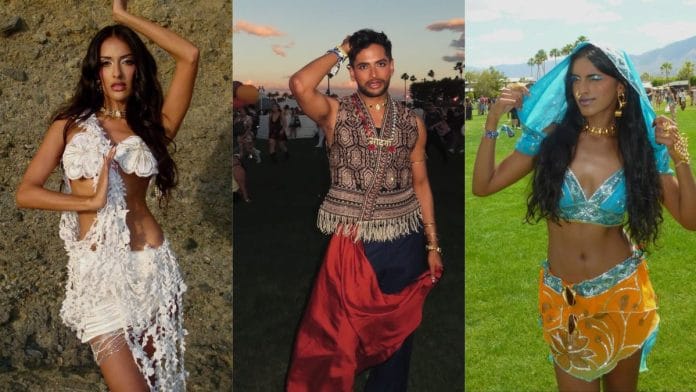
Now as the influencer Olympics enters its final leg, the fashion statement that remains in popular imagination isn’t the rise of the brat girl or even the Bieberchella fashion that emerged, but the “desicore” aesthetic that took over the desert runway.
The boho-chic look, made iconic as a Coachella staple by former Disney Channel star Vanessa Hudgens, has been reclaimed by Indian influencers, such as Kritika Khurana (better known as That Boho Girl), Seerat Saini, and even Katseye’s very own Lara Raj.
The fashion choices that once ignited fiery internet debates about cultural appropriation have been casually, calculatingly, and cautiously reclaimed. Influencers are quietly saying, “It is not boho, it is just being a ‘desi baddie’ or an Indian IT girl.”
Self-proclaimed “NYC princess” and budding fashion designer Sheel Yerneni’s “desichella” outfits have quickly gone viral across social media for incorporating jhumkas, dupattas, mirror work, and mehendi into some iconic looks. Even Aditya Madiraju’s carefully curated and chosen outfits by only Indian designers were a testament to intentional dressing. Whereas Saini, who does storytelling through fashion, Forbes that “she sees Coachella as a rare and powerful distribution channel for South Asian design.”
Credit where credit is due, these content creators have definitely earned the title “influencer.”
A butterfly-cut sari blouse paired with cut-off denim shorts, jhumkas (not Ralph Lauren) and cowboy boots — a new fashion aesthetic has emerged. By mixing Indian maximalism with Western minimalism, desi influencers are using the hippie Met Gala to bring about a quiet revolution in festival dressing.
Driven by NRI South Asian influencers, this desi-American aesthetic, which many Indians back home still consider “outdated” or “tacky”, has, in a short span of time, managed to break through the caucasity and demand acknowledgement of a stolen fashion statement.
Some content creators theorise that the discomfort many Indians feel about the rise of the desi-American aesthetic stems from a decades-long repression and suppression of Indian aesthetics. Others it is the result of the everlasting colonial mindset. Whatever the reason may be, this nostalgic, 2000s-friendly over-the-top Indian aesthetic has slowly made its way back into the mainstream. By using one of the largest and most profitable pop-culture events of the year, influencers have stated, rather than demanded, recognition of the boho chic aesthetic’s history and heritage.
Perhaps that is why there is no place like Coachella — here fashion speaks louder than words. Met Gala looks come and go, but “desichella” is here to stay.
(Edited by Aamaan Alam Khan)

