



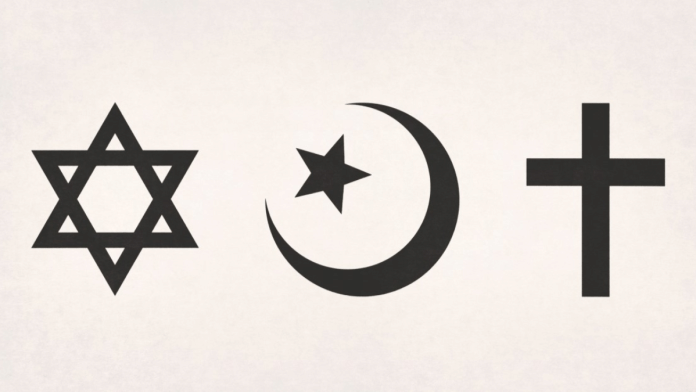
Worse, even God’s powers get limited here. If you believe in Allah, you must also believe that he has sent his last prophet, and that there will be no more prophets. If you believe in Christ as the Son of God, the possibility of other sons being sent to give mankind a new message is gone.
Monotheism thus comes with a computer binary: you are either one or zero. If My God is One, yours is Zero, Zilch, Nothing. This is a false binary, and excludes other more rational definitions of monotheism.
This idea of monotheism comes from the idea of the divine rights of kings, who needed to be granted solo powers in their domains. God did not create a single belief system for all of mankind, kings did.
Sigmund Freud, the world’s most famous psychologist, many of whose theories have now been discarded as too narrow (for they reduce almost everything to the sex drive), wrote an interesting book titled first published in 1939. This book, however, is not about psychoanalysis, but a speculative work on the origins of Moses in Egypt, which many scholars still argue about, and where he got his ideas of monotheism from.
The earliest votaries of monotheism date back to two eras: the era of Amenhotep IV, of the 18th Egyptian dynasty, who ruled from 1353-1336 BC, give or take a year or two. Then we had Zoroaster (or Zarathustra), who is dated anywhere from 1500 BC to 500 BC. He was the man who created a new monotheistic religion, whose practising descendants are now known as Parsis.
As Freud tells the story, when Amenhotep ascended the throne of Egypt, the state was becoming a world power. The people worshipped Amon but another god, the Sun God Aton, was in the ascendent. As the Egyptian empire started expanding to places in Syria, Nubia, Palestine and Mesopotamia, he needed a new and more abstract god who could be acceptable to the many peoples in the growing empire. Amenhotep changed his name to Akhenaten (with Aton, the Sun God, now added to his name), and chose to follow a rigid sort of monotheism. It was not popular, and the priesthood abandoned this monotheism once his dynasty ended.
Says Freud: the growth of the Egyptian empire led to a new imperialism, and “this imperialism was reflected in religion as universality and monotheism”. He adds: “Religious intolerance, which was foreign to antiquity before this and for long after, was inevitably born with the belief in one God.”
Akhenaten added “something new that turned into monotheism the doctrine of a universal god – the quality of exclusiveness.” One of the Pharoah’s hymns runs thus: “O thou only God, there is no other God than Thou.” This is eerily similar to what Islam preaches today. Freud says that to understand the core of this new Egyptian monotheism, it is important to not only know its positive content, but what it repudiates”. Freud’s book is, of course, on Moses and whether he was an Egyptian who crossed the seas to become the law-giver of the Jews. He surmises that Moses may have got his initial ideas on monotheism from Akhenaten’s brief experiments with monotheism, but we shall not get into that. Just Freud’s ideas on the underlying basis on which Abrahamic monotheism is built.
In Persia, Zoroaster was creating another monotheism, possibly in a reaction to the polytheistic peoples to the east in India, who believed in worshipping many gods. The new monotheism had a dualistic approach, separating good and evil, with Ahura Mazda representing the good and eternal, and Angra Mainyu the evil and destructive force. In the Zoroastrian world, Ahura (Asura to Hindus) represents important divinities, while Devas (Hindu divinities) are to be rejected. Clearly, the Indo-Iranian peoples split into two separate groups and theological disputes could have been one reason. The net result, though, is that when a stronger monotheism emerged from Arabia in the seventh century, the Zoroastrian one started losing ground and its last adherents had to flee to India to nurture what was left of their faith and heritage.
The point I would like to underscore is that the monotheism that has endured has two attributes: one good, and the other bad. The good part is that belief in the same God can enable people to work for a common goal even if they are from different cultures. The downside though is greater. Since Abrahamic monotheism creates a very negative “other” to emphasises its own exclusivity and greatness, ultimately all monotheisms may be destined to fight one another. We can see this even within Islam, where Shia fights Sunni, and both often fight to isolate the Ahmaddiyas or Bahais. Any religion that believes in one idea of God or Truth has, by definition, to negate other beliefs, other truths. The path to peace and coexistence lies in abandoning this narrow form of monotheism.
The war of the Abrahamics cannot end easily and well. They should be seeking a more universalised, diverse and tolerant definition of the One-God hypothesis. A God defined too precisely will inevitably add to conflicts.
To repeat: What we call monotheism is a limited and narrow monotheism that cannot bring peace.

