



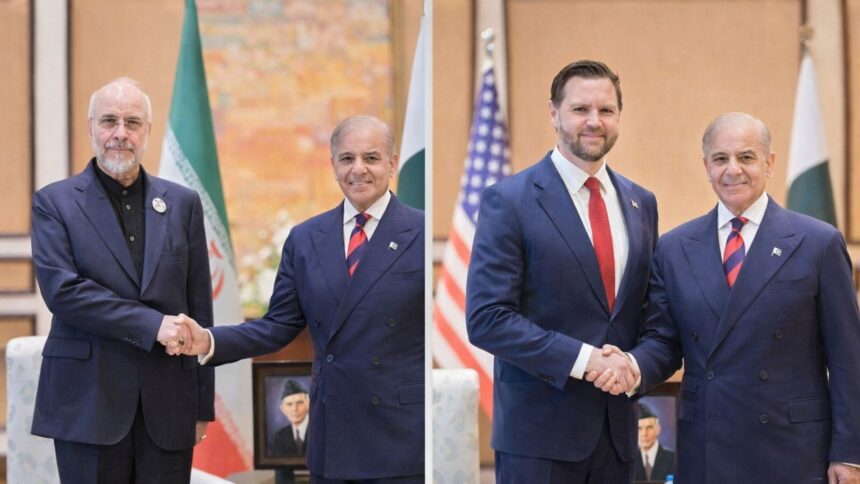
Vice-President JD Vance-led US and Iranian delegations on Saturday met with mediators in Pakistan ahead of talks aimed at shoring up a shaky ceasefire and paving the way for a permanent end to the fighting. It marks the first such meeting since the war began more than a month ago.
The weekend peace talks got off to a fractious start, dominated by a public dispute over frozen Iranian assets and a list of non-negotiable demands from Tehran, even as the two sides avoided meeting each other directly.
A senior Iranian source told news agency Reuters that Washington had agreed to unfreeze Iranian assets held in Qatar and other foreign banks, A second Iranian source put the figure at $6 billion, funds originally frozen in 2018 and refrozen by the Biden administration after the October 7, 2023, Hamas attack on Israel, Reuters reported. Qatar’s Foreign Ministry did not respond to a request for comment.
The Iranian delegation, led by Parliament Speaker Mohammad Baqer Qalibaf and Foreign Minister Abbas Araghchi, met Prime Minister and Army Chief General Asim Munir on Saturday morning, Iran’s state-run Press TV reported, according to PTI.
Iran’s Speaker of Parliament Mohammad Bagher Ghalibaf and the Iranian delegation met with Pakistani Prime Minister Shehbaz Sharif ahead of Iran-US peace talks in Islamabad.
Follow Press TV on Telegram:
— Press TV 🔻 (@PressTV)
Tehran used those meetings to present several elements of its 10-point proposal as red lines, the AP reported, citing Iranian state television. The demands include compensation for damage from US-Israeli strikes, release of frozen assets, a mechanism for and a “tangible and lasting ceasefire” covering Iran and allied theatres, an apparent reference to Hezbollah in Lebanon.
Iranian diplomats disclosed their RED LINES to Pakistani PM Shehbaz Sharif, which are:
1. The Strait of Hormuz under full Iranian control
2. Iran will get war reparations
3. Frozen Iranian assets will be released
4. Stable ceasefire in ALL areas relevant to Iran
— RT (@RT_com)
Araghchi warned that Iran was entering negotiations with “deep distrust” after being struck during previous rounds of talks, and said Tehran was prepared to retaliate if attacked again, the AP reported.
The US delegation – Vance, special envoy Steve Witkoff and Jared Kushner – arrived later Saturday and met Sharif, Pakistan’s Foreign Office confirmed.
Islamabad April 11 ,2026
As the Islamabad Talks commenced today, the Prime Minister of Pakistan, Muhammad Shehbaz Sharif held a meeting with His Excellency JD Vance, Vice President of the United States of America.
The U.S. Vice President was assisted by Special Envoy Steve…
— Prime Minister’s Office (@PakPMO)
“Commending the commitment of both delegations to engage constructively, the Prime Minister expressed the hope that these talks would serve as a stepping stone toward durable peace in the region,” the Foreign Office statement said, as reported by PTI.
President Trump posted repeatedly on social media ahead of the talks, saying Iranian officials “have no cards” to negotiate with. “The only reason they are alive today is to negotiate!” he wrote.
He said separately on Saturday that large numbers of empty oil tankers were heading to the US to load up with oil and gas.
The competing frameworks underscore the distance between the two sides, the AP reported. Iran’s plan demands a guaranteed end to the war, no future attacks, the lifting of economic sanctions, and control over the Strait of Hormuz. Washington’s 15-point counter focuses on restricting Iran’s nuclear programme and reopening the strait.
The strait remains Iran’s biggest strategic lever. Only 12 ships have been recorded passing through since the ceasefire was announced, against more than 100 a day before the war, AP reported. Brent crude stood at around $97 on Friday, up over 30% since the conflict began on February 28. Iran has floated charging ships for passage, an idea widely rejected, including by the US and Oman.
Israel pressed ahead with strikes in Lebanon on Saturday even as Iran conditioned the talks on a pause in fighting there. The strikes killed at least three people, AP reported, citing Lebanon’s state-run news agency.
, the office of Lebanese President Joseph Aoun said, AP reported. Israel wants Beirut to take responsibility for disarming Hezbollah, but it remains unclear whether Lebanon’s army can enforce such a demand.
Israel’s insistence that any Iran ceasefire does not cover its Hezbollah campaign has threatened to sink the deal. On the day the truce was announced, Israeli strikes on Beirut killed , according to the Lebanese Health Ministry.
The conflict, now in its seventh week, has killed at least 3,000 people in Iran, 1,953 in Lebanon, 23 in Israel and more than a dozen in Gulf Arab states, AP reported. It has largely severed the Persian Gulf from the global economy, sending energy prices surging and damaging infrastructure across half a dozen countries.
In Tehran, residents expressed cautious hope. “If we get concrete and final results, there is still a chance that the deal falls through,” Shahab Banitaba told the AP.
(With inputs from agencies)

