



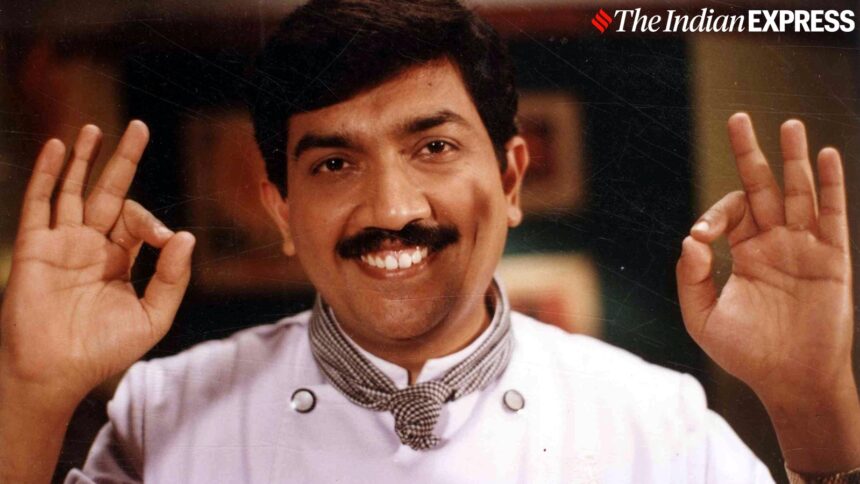
Celebrated chef Sanjeev Kapoor recently revisited a defining moment from his life in his video series , reflecting on what it meant to receive the Padma Shri in 2017—not just as an individual honour, but as a representation of his profession. While the award marked a proud milestone, what stood out was his insistence on wearing his chef’s uniform at the ceremony, despite being advised against it by protocol.
Speaking about his journey, he emphasised how . He said, “ (If you do not wish to give me the Padma Shri award, then please don’t give it.)”
He continues, “(For all the years I worked in a hotel as a chef, I wore my full uniform every single day at work. As I started working on TV, the chef’s cap was the first to disappear because it didn’t fit the frame. Gradually, I was asked to wear normal shirts to create a more casual look. I feel that the chef’s uniform carries pride and honour, and perhaps that is why chefs have reached where they are today.)
When it came to receiving the Padma Shri, he was initially told to follow a dress protocol. “ (When it was time for the Padma Shri, I was told there is no such precedent, and I would have to come in national dress. I said this is my profession, so please allow me this, but I was refused.)”
He revealed that he had asserted he would show up in his chef’s uniform and be okay with not receiving the award because of it. “ (I reached Rashtrapati Bhavan, and without any argument or problem, I received the Padma Shri in my uniform. Because I feel this Padma Shri was not just for me, but for the entire chef community.)”
His experience raises larger questions about how people view their professions, the symbols that represent their work, and the role of identity and pride in shaping personal and professional choices.
Dr Sakshi Mandhyan, psychologist and founder at Mandhyan Care, tells indianexpress.com, “Professional identity is not just about what we do. It becomes part of who we believe we are. I see this clearly when people speak about their work with pride or discomfort. Symbols like uniforms carry psychological meaning. They represent competence, belonging, social value, and identity reinforcement.”
From a psychological lens, she says, this connects to identity formation and self-concept. “When a role is visible and acknowledged, it strengthens internal validation. The brain begins to associate that identity with worth and capability. I have noticed that when people feel their roles are respected, they show greater ownership and engagement. When it is dismissed, the same individual may start to withdraw emotionally,” she states.
Pride in work is not only about achievement. It is about feeling seen in the role one holds.
Recognition meets a very basic psychological need. “It supports what we call esteem in motivational theory. I observe in my practice that when effort is acknowledged, confidence becomes more stable and less dependent on constant external validation,” concludes Dr Mandhyan.

