



Arzan Tarapore, in a 2020 for Carnegie, argued that the Indian military strategy since Independence has revolved around ground forces managing threats on the continental periphery. This was primarily based on the use of large ground formations with air power in an adjunct role and never projecting sea power. Six years hence, things have possibly changed. Operation Sindoor demonstrated the growing confidence among the political leaders and the public in the employment of air power. On 14 Jan 2026, , a stitched ship, completed its maiden voyage from Porbandar to Oman, demonstrating the government’s interest in reviving maritime affairs. Yet, all this can be reversed in the absence of an anti-goal.
In other countries, reforms aimed at increasing jointness often entailed deliberate efforts to reduce the number of land forces. For China, the aim was to bring it to less than 50 per cent of the . During the latest reforms in the PLA, the total strength of the armed forces was reduced by , with the ground forces slashed by 40 per cent, the Navy’s strength marginally increased, and the Air Force’s strength kept the same. As a result, both the and now have land forces that are numerically less than 50 per cent of the total active duty military personnel. The strength of the Indian armed forces personnel (active duty) is shown in a chart below:
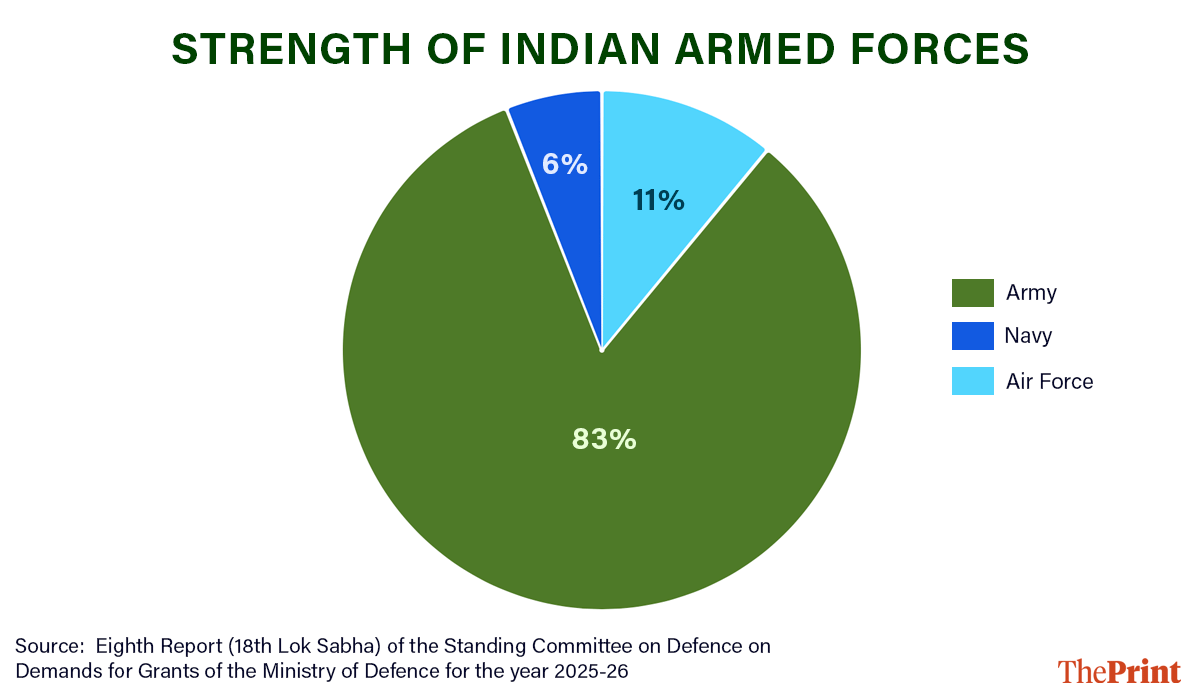
In the absence of proportional force restructuring, the representation of the Indian Armed Forces is skewed toward the land forces. Further, since the creation of the post of Chief of Defence Staff (CDS) in 2019, the appointees have always been from the Army. This has historic precedence. All Commanders-in-Chief (C-in-Cs) of India were from the Army, despite the post being open to the Navy and Air Force as well.
Although it is a that the Great Wall of China is visible from space, the modern-day equivalent of the Great Wall, the Indo-Pak border fence, is actually visible from . With the Army constituting 83 per cent of the total strength and the CDS always from the Army, like 15th-century China, it is possible that a continental approach emerges once again, exactly at a time when air, sea, and space are gaining prominence.
In the 1991 Gulf War, the communication networks on the US Navy ships and the theatre command HQ (CENTCOM) were not interoperable. Therefore, to transfer the classified data of Air Tasking Orders, data was burned on CDs (compact discs) and flown by helicopters between the places. This caused communication delays and affected operations. In 2026, this example of a CD might appear archaic, as some young readers must have never used one in their lives. However, this example illustrates that capabilities such as additional features, message transfer speeds, and encryption standards are often degraded to the lowest common denominator to ensure compatibility.
All three services have followed different technical paths. For example, the IAF took logistics online through the Integrated Material Management Online System (IMMOLS) as early as , whereas a similar project was implemented in the Army in . Likewise, there would be examples where the Navy or the Army would have been the pioneers. A quick way to achieve interoperability is by scaling down other users to the lowest specifications. This results in an overall capability downgrade and must be avoided.
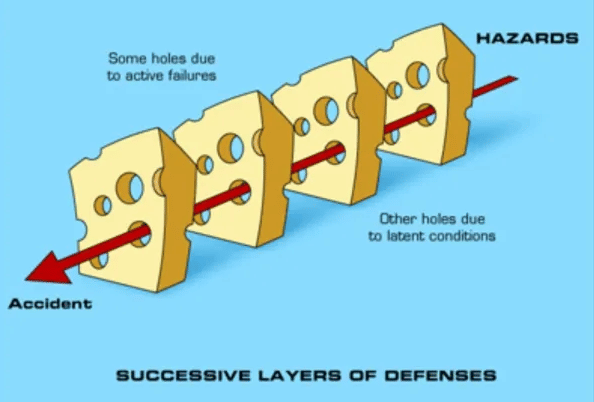
In aviation, a framework called the Swiss-Cheese model is often referred to to explain aircraft accidents. When the holes in all levels align on a particular occasion, an accident occurs. Why specifically ‘Swiss-Cheese’ is chosen is because the holes are not perfect circles. They are irregular shapes that grow/contract randomly as the cheese melts, depicting real-life features of unpredictability.
The Indian Armed Forces are currently undergoing concurrent reforms at multiple levels. At the tactical level, the recruitment and training have moved to the Agnipath scheme. The first batch of Agniveers will be completing their engagement in the current year. It is difficult to predict how smooth their exit would be and what impact it would have on the Armed Forces. At the operational level, the Indian Army started the process of converting to Integrated Battle Groups in . The first Rudra Brigade rolled out in . It would need significant time to exercise, iterate and refine its operations to achieve combat readiness of all the groups.
At the military-strategic Level, there is the implementation of theatre commands, which the CDS stated could happen by May this year. Significant challenges could emerge during the practical implementation, which would not have been forecast during planning despite best efforts. Thus, over the next few years, there will be several unknown unknowns at all levels, which could cause a high degree of churn in the Indian Armed Forces. The entropy is going to be at an unprecedented level in history — all holes possibly aligned at some time, a potential recipe for disaster.
Structural reforms in the Indian military are rare. Even things that are as inconsequential as were shut down only as late as 2021. Therefore, the organisational culture and structures are not tuned to the flood of reforms that are scheduled to flow in the next few months or years. Setting some anti-goals like the three above can help mitigate unintended outcomes.
(Edited by Aamaan Alam Khan)

