



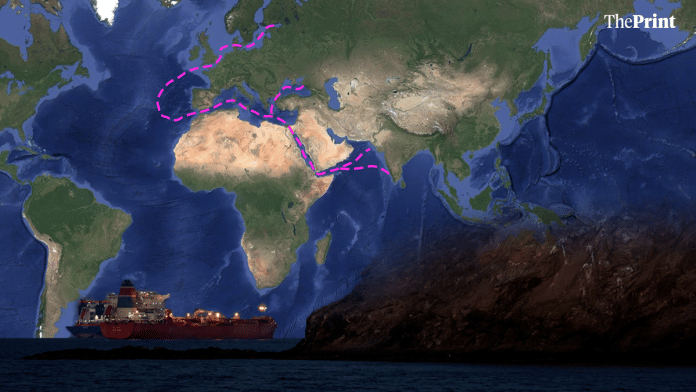
The March waiver, issued amidst an escalating conflict between US-Israel and Iran that has disrupted fuel supplies from the Gulf, is now expected to reverse that decline of Russian crude to India, at least temporarily.
On paper, an oil shipment looks simple: load onto tankers at port, set sail, discharge. The reality of Russian crude reaching India is considerably more complex—shaped by sanctions, and a complicated logistics architecture.
Maritime experts identify two main corridors through which Russian oil reaches Indian shores.
The dominant one runs from the Baltic Sea—specifically from the ports of Primorsk and Ust-Luga—and typically carries 60 to 70 percent of all Russian crude shipped to India. A secondary but significant route originates at the Novorossiysk terminal on the Black Sea.
Smaller volumes also arrive from Russia’s northern and eastern ports, Murmansk and Nakhodka.
Primorsk and Ust-Luga are Russia’s principal Baltic export terminals, serving the country’s most productive oil-producing regions. In February, approximately 20 million barrels left these terminals bound for India—about 67 percent of Russia’s total crude exports to India that month, according to data from Kpler, a global trade intelligence firm.
“These are the highest oil producing fields in Russia,” said Navin Thakur, Director at Drewry Maritime Research.
A typical cargo from the Baltic takes 25 to 30 days to reach India, according to Nikhil Dubey, senior research analyst for oil markets at Kpler.
The route threads through the North Sea, the Strait of Gibraltar, the Mediterranean Sea, the Suez Canal and the Red Sea before the vessel reaches Indian waters. This comes to an approximate distance of 7,00 nautical miles, or 13,890 kilometres, according to Kpler and Drewry Maritime Research.
On arrival at Indian ports, crude is discharged either through Single Point Moorings (SPMs)—submerged offshore pipelines connected to the coast—or through lighterage, a process in which smaller vessels ferry oil from a large tanker anchored offshore to refineries.
Key receiving points in India include Sikka in Gujarat, which serves Reliance Industries’ Jamnagar refinery and Vadinar refinery which serves Nayara Energy, IOCL and BPCL, along with Mangalore on the west coast and Paradip in Odisha on the east.
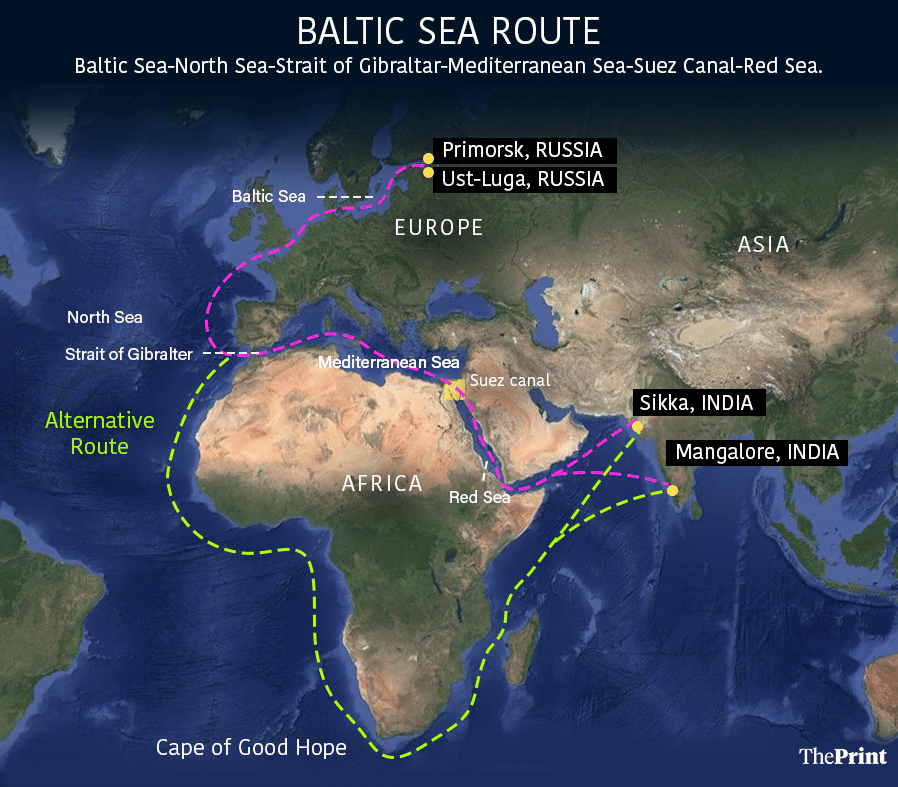
When the Red Sea becomes unsafe—as it did during Houthi rebel attacks on commercial shipping from Yemen—vessels divert around Africa’s Cape of Good Hope. This alternative route is longer by around 5,000 nautical miles, adding 15-20 days to the journey, and consequently, more expensive. It is used only when the primary corridor is unsafe.
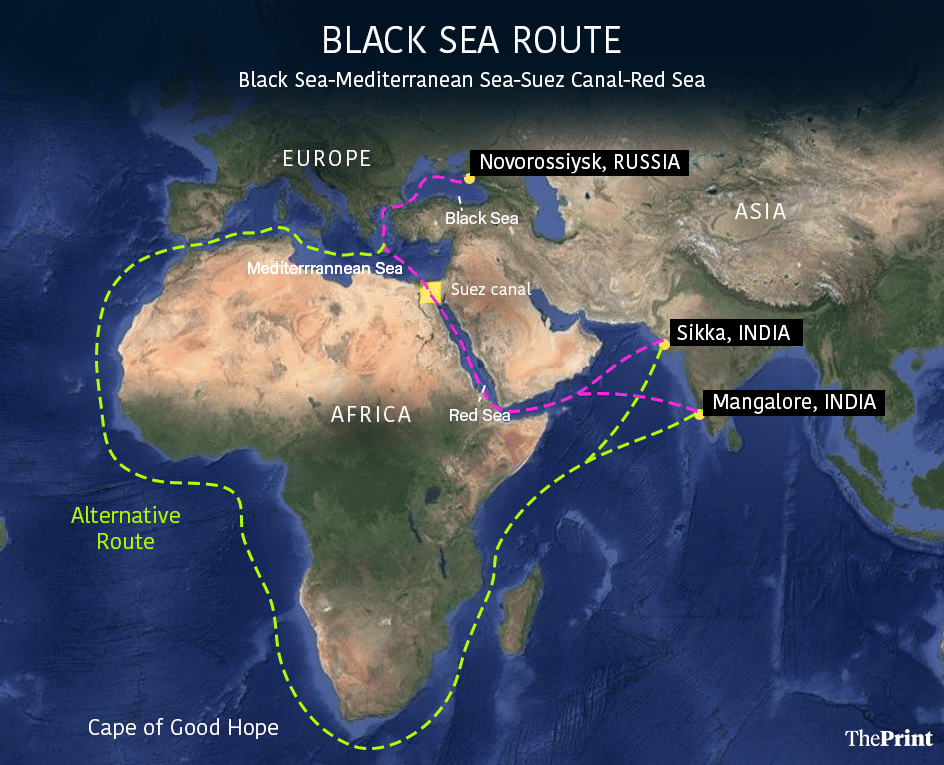
The second major corridor begins at Russia’s Novorossiysk terminal and runs through the Mediterranean Sea, the Suez Canal and the Red Sea before reaching India—a 4,200-nautical mile voyage of 15 to 20 days, considerably shorter than the Baltic route.
In February, approximately 8.7 million barrels arrived in India via this route, accounting for roughly 30 percent of Russian supplies that month, according to Kpler.
Due to scrutiny on Russian oil, some of which has been sanctioned by the US and its allies, vessels from the country make their way to India mainly through the two maritime routes, but their journeys are rarely direct.
Thakur explained that from Russia, oil is first loaded onto smaller tankers—known as Aframax or Suezmax vessels, which are often under sanction-linked conditions. Midway through the voyage, in unmonitored offshore waters, the cargo is quietly moved to a different ship.
“These transfers happen at unknown locations, often off the coast. By the time the oil reaches Indian waters, it is on a non-sanctioned ship,” Thakur said.
These ship-to-ship (STS) transfers are not only a sanctions workaround—they serve a practical purpose, too. “The STS serves two purposes: blending of crude from the Urals (Russia) with the crude from the Middle East, making it suitable for consumption in Indian refineries, and to optimise the transportation cost,” Thakur added.
The vessel on the receiving end of the transfer is typically a Very Large Crude Carrier (VLCC)—a mammoth tanker that aggregates multiple cargoes and sits outside the sanctions net. This is the ship that completes the final run to India.
Ship-to-ship transfers feature on both the Baltic and Black Sea routes.
“The US and European Union are trying to curb this shadow fleet’s operations by imposing sanctions. This has made it difficult to obtain insurance. But these vessels continue to trade and carry sanctioned oil, as some Russian companies still offer insurance. Over 70 percent of targeted vessels change flags and often reflag to Russia, which is often the only registry willing to accept them, restoring legal protection under international maritime law,” Thakur said.
Not all Russian oil is sanctioned. According to Thakur, under existing rules, Russian crude sold at or below $47.6 per barrel can be traded legally, with full access to international insurance and financial systems.
But Russia’s profit margin at that price is thin. “At this price, Russia cannot survive comfortably,” Thakur said.
This has given rise to what traders call the “dark trade”—oil sold above the price cap and transported by vessels that operate outside conventional regulatory frameworks, beyond the reach of Western banks and insurers. The premium for this opacity is steep. “Transportation costs are 50 to 100 percent higher than normal but it’s a risk that the operators may absorb,” Thakur said.
Despite the legal complexity, elevated costs and the scrutiny, Russian crude continues to reach India—and global markets broadly—because the alternative carries its own risks, experts said.
“If Russian crude is taken out of the equation, global supply will suffer,” Thakur said.
(Edited by Prerna Madan)

