



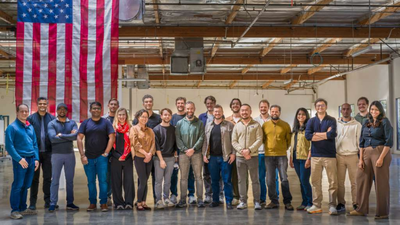
Adi Prasad grew up watching molten metal become machines in a small Indian city. Now he wants to remove the human hand from manufacturing entirely, and he thinks that’s the most human thing he can do.It is a Sunday morning in February, and Adi Prasad is heading into office. This is not remarkable in Silicon Valley, where weekends are more of a philosophical concept than a scheduling constraint, but what’s striking is the way he mentions it, in the way you might mention walking to a park you love. The background on his screen is the Stanford foothills. He is cheerful. He is already thinking about the factory.The factory doesn’t exist yet. Or rather, it exists in the way that really important things exist before they’ve been built, as a specific gravity of conviction, pulling people and money and talent toward it. Matter, the company Prasad co-founded with three others in late 2024, is setting up its first facility in Sunnyvale this month.
Israel Iran War
Within it, he intends to demonstrate something that a lot of very smart people have been theorizing about and very few have actually done: a factory floor that runs without a human workforce converting raw components into finished electromechanical products.“Matter is changing the paradigm,” he says, with the confidence of someone who has worked through the argument so many times it has become load-bearing. “Manufacturing has always been a human-dependent activity.
We are decoupling the human from that process.”Prasad grew up in Ranchi, then a heavily industrialized city in what is now Jharkhand, where his neighbors were largely the children of factory workers at state-owned heavy engineering enterprises built through Soviet-era collaboration. His father was a doctor: brilliant, voraciously curious, the kind of man who answered a child’s questions about trains with engineering diagrams and trips to the library. As a small boy, Prasad would wander through the nearby plants and watch raw material transform into finished product. “It was like a big toy,” he says. He was five or six years old when he first hacked a circuit board at home. His parents were delighted. The direction of his life was already legible.He went to MIT, not IIT, which surprised people, though Prasad had done the probability math himself in his head at seventeen. The IAS civil service exam, which most of his uncles had pursued, had sub-one-percent selection rates. Engineering at the world’s best institution had rates perhaps a factor higher, and crucially, the outcome was something he could actually shape. Prasad is, at his core, a man who is allergic to outcomes determined by luck. The preference for high-agency bets, made thoughtfully, runs like a thread through every decision in his life.At MIT he discovered what he’d been missing: an education system built around application rather than memorization, one that treated engineering as inherently interdisciplinary. He took economics classes, humanities seminars. He learned what most Indian engineering programs did not teach, that, to build things that matter at scale, you need to understand how people make decisions, how markets work, how institutions accumulate and spend trust. “In order to become a great entrepreneur,” he says, “apart from engineering problem skills, you need to understand the world as a whole.”His first job out of MIT was at Tesla, in 2014, which at that moment was not yet obviously the company it would become. Elon Musk was publicly struggling with the Falcon Wing doors on the Model X, calling manufacturing “insanely difficult.” On his first day, Prasad’s manager Charly Mwangi, who would later become his co-founder, handed him the Falcon Wing problem and told him it was his. Prasad was a new graduate. He was, by any reasonable assessment, unprepared. He solved it.What happened next would reshape how he understood ambition. Musk convened a small team (fifteen engineers out of four hundred) and gave them an unusual assignment: think from first principles. What would the factory of the future actually look like? Prasad was in the room. What emerged from that exercise became, in various forms, manufacturing innovations now considered industry standard. “Once you go through that experience,” he says, “smaller problems become less exciting.” He means this literally. Proximity to genuine scale shifts your internal calibration.After Tesla came stints at Apple, then at Rivian, where he was among the first members of the battery manufacturing team during the company’s wildly ambitious attempt to launch three electric vehicles in three years during COVID, in a state with no manufacturing infrastructure, partially decoupled from their Chinese supply chain. His colleague at Rivian was Aish Varadhan, now Matter’s CTO. Their other co-founder, Aditya Ranjan, he has known since MIT. The fourth is Charlie, who told Prasad on his first week at Tesla, back when Prasad was still a new graduate, still figuring out what he wanted, that, whenever he started his company, he’d write the first check.He did.The company Matter is building does not look like what most people imagine when they hear “autonomous factory.” There are no humanoid robots stomping around doing human jobs, which Prasad finds mildly frustrating as a framing. Boston Dynamics-style humanoids, he points out, are still years from the precision and speed required for real production work. What Matter is building is subtler and, in some ways, radical: flexible, reconfigurable production lines with distributed robotic systems: conveyor robots, arm robots, laser welding stations, adhesive dispensers, all governed by a proprietary operating system, Matter OS, that coordinates them into a unified intelligence. The product is manufacturing capacity itself. You send them an engineering drawing; they send back a finished product.The business logic follows from there. If you can decouple manufacturing from human labor, you decouple it from geography. You no longer need to chase cheap labor to China or Mexico. You can build anywhere, in the US, in Europe, eventually in India. “80% of world GDP is manufacturing,” Prasad says. “The way to increase GDP per capita is to increase goods and services. And till today, that has always been tied to human labor.” He draws the thread back to pyramids to shipping containers and Foxconn. The whole history of industry, he argues, is a series of attempts to get around the problem that humans are expensive, inconsistent, and need to go home. Matter is, in his framing, simply the latest and most complete attempt.Twenty-five people are now working at the company. They have a defense company as a customer. A robotics partner. A hyperscaler. A new hire from Google. The seed round closed last September, with angels including Tesla’s former head of autonomous driving and Google’s head of AI infrastructure.When I asked about what he learned from the three extraordinary entrepreneurs he has worked with closely (Musk, , and Rivian’s RJ Scaringe), Prasad gives answers that are less about management style than about epistemology. What he absorbed from Musk was an intolerance for explanations that begin with “that’s how it’s been done.” From Kalanick, a respect for the sheer difficulty of changing entrenched industries, the kind of difficulty that people minimize until they try it. From Scaringe, an understanding that product and brand and attention to detail are not separate from engineering but continuous with it.What he carries from all three is something harder to name: a belief that the only bets worth making are the ones where the stakes match the moment. Prasad talks about building a successful company the way people talk about obligations. His ancestors, he says, never had access to what he has access to. The schools, the mentors, the proximity to genius-level entrepreneurs, the chance to sit in a room with Elon Musk and think from first principles about what the future of making things should look like. To use all of that to build something incremental would be, in his precise word, regretful.The factory in Sunnyvale will be finished soon. Prasad will be there, most likely on a Sunday, working in the space between what has been built and what he believes can be built. The distance between those two things is enormous. He is aware of this. He is also, somehow, not particularly troubled by it.“I knew I had an acumen for engineering,” he says, thinking back to Ranchi, to the factories he walked through as a child, to the circuits he was wiring before he started school. “And I loved every moment of being an engineer. I still do. I don’t think I can be in any other profession.”He smiles. He is going into the office now.
.

