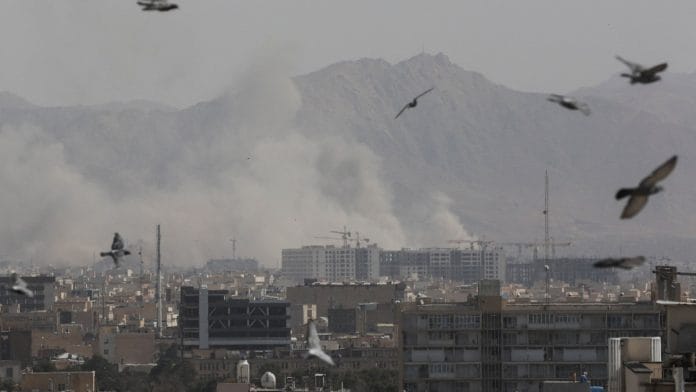
The paradox of this war is becoming increasingly clear: The United States and Israel dominate the tactical battlefield, but despite facing devastation, a weakened Iran is asymmetrically shaping the strategic environment in which that battlefield exists. Both sides would have carried out a strategic review to modify or redefine their political and military aims. What are the likely future political and military aims of the adversaries, and what is the likely future course of the war?
US-Israel, in their opening gambit, succeeded in the top political and military leadership, including the Supreme Leader Ali Khamenei. Since then, they have severely degraded the retaliatory military capacity and capability of Iran, as set out in the . Iran’s air defence systems have been destroyed, and has been achieved. Political and military command and control, defence industry and internal security infrastructure have been destroyed or severely degraded.
US-Israel claimed that Iran’s primary retaliatory capability—missiles and drones—in terms of the number of strikes had by 90 per cent since 28 February. However, in the last three days, there has been a surge, but the average as compared to the peak period of the first three days is 20 per cent for missiles and 45 per cent for drones. The Israel Defence Forces assessed that of Iran’s approximate 450-500 missile launchers have been destroyed or rendered combat ineffective. Iran’s conventional navy has been largely destroyed. This leaves a residual capability of 135-150 missile launchers with adequate missiles. Similarly, it is assessed that only 30 per cent of its drone arsenal remains intact.
The resilience of the Iranian regime in managing continuity and its hold on power has led to ambiguity with respect to the political aim of regime change. The degradation of military infrastructure and capability to declare victory and impose peace on one’s own terms through negotiations with the same or a more acceptable avatar of the same regime became the modified aim.
However, Iran laid down impossible conditions—withdrawal of all US bases and war reparations—and has refused to negotiate. The closure of the Strait of Hormuz has virtually foreclosed the option of a quick exit.
Hormuz cannot be kept open for cargo and tanker traffic by naval power alone. Iran’s residual drone and missile capability and asymmetric maritime capability in the form of undersea drones, midget submarines and suicide boats will cause unacceptable damage. Militarily, the security of the Strait of Hormuz requires physically securing the islands in the strait, effective air defence, sustained naval operations to destroy unconventional maritime threat and continuous naval presence thereafter.
In view of the above, the revised politico-military aim would be to destroy Iran’s residual retaliatory military potential with a focus on missile and drone capability, particularly in the coastal region and islands in the strait. Secure the Strait of Hormuz for maritime traffic through sustained naval and marine operations to destroy unconventional maritime threats. Limited ground operations are likely to be undertaken to capture the islands for the physical security of the Strait.
The original political aim of regime change will still lurk in the background, and strikes are likely to continue.
In my view, the US is unlikely to undertake any major ground operations on mainland Iran. The temptation of capturing Kharg Island or targeting the oil terminal will also be avoided due to the threat of retaliatory action on all oil terminals in the Gulf by Iran. However, in case of uncontrolled escalation of the energy war and as a symbolic action to declare victory, it may be captured.
Special forces operations may be launched to secure the 440-450 kg of 60 per cent enriched Uranium in case its exact location is known.
To achieve the revised objectives, sustained military operations will continue for another three weeks before another review is undertaken.
Iran’s politico-military was to ensure regime survival and bring about the strategic defeat of US-Israel, through exhaustion by horizontal escalation of the war to the entire Persian Gulf region and closure of the Strait of Hormuz to create a global economic crisis.
At the end of three weeks, I have no hesitation in concluding that Iran has been eminently successful in executing its strategy. The theocratic regime has not only survived the decapitation of its leadership, it has also displayed continuity by electing Mojtaba Khamenei, the son of the slain Supreme Leader Ali Khamenei, as the new Supreme Leader with the IRGC firmly in the saddle. It continues to maintain its firm control over the state and has even managed to generate some nationalistic fervour against the external enemy.
Iran has made very effective use of its primary retaliatory capability—missiles and drones. It used them successfully to target Israel, US bases and all the Gulf countries. It did achieve some major successes in US air defence support systems in the form of radars and communication hubs. It has also successfully targeted maritime shipping by closing the Strait of Hormuz. Missiles and drones have also been used for calibrated attacks on oil infrastructure to signal its intent and capability for a quid pro quo if its own infrastructure is targeted.
The overall damage caused by drone and missile strikes was relatively insignificant, as 90 per cent of missiles and drones were intercepted. However, the war has spread to the entire region and created a global economic crisis by denying the world 20 per cent of oil. Interestingly, Iran has continued to export its own oil and also allowed safe passage to the tankers of friendly countries.
Iran has all offers of a ceasefire and negotiations by laying down non-negotiable conditions. Inspired by the Shia ideology of martyrdom, it will persist with its strategy despite all odds. As a last resort, it would be prepared to directly target the oil infrastructure of the region in case its own is threatened. The present regime is prepared to go down fighting. Should its retaliatory capability be completely decimated, it will resort to a prolonged asymmetrical war to deny a strategic victory to the US.
The key to continuing to pursue its strategy is its residual missile and drone capability and unconventional maritime resources to sustain the closure of the Strait of Hormuz. This is an unknown factor as uncertainty prevails with respect to its residual missile and drone arsenal and production infrastructure. This residual capability will now be the focus of sustained US-Israel air campaigns. The drop in missile and drone strikes may have been done deliberately by Iran to maintain a reserve. In the last eight months after Israel’s Operation Rising Lion, Iran had almost rebuilt its missile and drone capability to its original levels.
Iran still has 440-500 kg of Uranium enriched up to 60 per cent. While the Uranium enrichment infrastructure has been destroyed, the apprehension of 8-10 crude nuclear bombs being made in future will remain.
The next three weeks are likely to see the world’s most intense air campaign by the US and Israel to destroy Iran’s residual missile and drone capability and production facilities. Sustained naval and limited land operations will also be launched to open the Strait of Hormuz. US-Israel will continue with leadership decapitation to make a last-ditch effort at regime change.
Due to its Shia traditions, the present regime in Iran is likely to fight to the finish, hoping to rise like a Phoenix from the ashes. It is sanguine that the US will not launch a ground invasion. It is only a matter of time before a more formidable missile and drone arsenal is created. In the interim, asymmetrical war by other means will continue.
The US and Israel stand alone in this war. In the next few weeks, they may achieve their military objectives by destroying or further degrading Iran’s residual retaliatory military capability and opening the Strait of Hormuz. A permanent US deployment in the region on a much larger scale is inescapable. Victory may be declared. However, since Iran is unlikely to capitulate, a strategic defeat of the US is ordained.
(Edited by Theres Sudeep)