



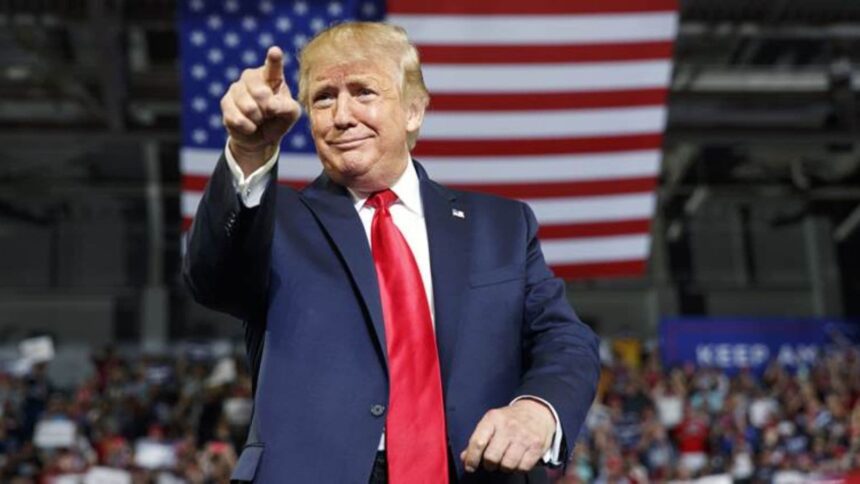
Repeatedly over the past two days, President Donald Trump returned to his central argument for his , and to do it at this moment in history. Tehran was on the verge of getting a nuclear weapon, the president insists, and would use it first on Israel, then on the United States.
“They would use it within one hour or one day,” Trump said Monday.
In fact, listening to Trump in recent days is to hear a president debating whether to order the biggest Iran mission of all: to seize or destroy the near-bomb-grade nuclear material believed to be largely stored deep under a mountain in Isfahan.
It would, by any measure, be one of the boldest and riskiest military operations in modern American history, far more complex and dangerous than the effort to kill Osama bin Laden in 2011, or seize Nicolás Maduro from his bed in early January. No one is certain where all the fuel is. If the canisters holding it are pierced, the escaping gas would be both toxic and radioactive. If the canisters come too close together, there is the risk of an accelerating nuclear reaction.
As his own secretary of state, Marco Rubio, put it a few weeks ago to Congress, this is an operation that could only be accomplished if a commando force were ordered to “go in and get it.” Trump told reporters Tuesday that ground operations didn’t worry him.
“I’m really not afraid of that,” he told reporters. “I’m really not afraid of anything.”
Trump is clearly considering the operation, which a few weeks ago he said he would only try if Iran’s military was “so decimated that they wouldn’t be able to fight on the ground level.” On Monday, he snapped at a reporter who asked if he was now ready, saying “if any president answered those questions they shouldn’t be president.”
But it is Trump himself who keeps musing about the problem of ending the war before the problem is solved. Matthew Bunn, a nuclear specialist at Harvard, noted that if Trump stopped now he “would leave a weakened but embittered regime, possibly more determined than ever to make a nuclear bomb — and still with the material and much of the knowledge and equipment needed to do so.”
So now a president who did little to prepare the American public for the attack on Iran sounds like he is issuing daily warnings in case he decides to seize Iran’s mother lode of nuclear fuel.
As he returns time and again to the nuclear threat, Trump is overstating how quickly the material stored underground can be turned into a weapon, telling reporters in the Oval Office on Tuesday that Iran had been “within one month” of being able to make a nuclear weapon before he bombed three nuclear sites in June 2025. (Experts note that while Iran could have enriched that fuel to bomb grade within a month, it would have taken months, maybe a year, to make a crude weapon.)
In fact, before the war broke out Feb. 28 with the combined American and Israeli attack, most intelligence officials said they saw little imminent risk that Iran could race for a bomb. That was underscored Tuesday with the resignation of Joe Kent, the director of the National Counterterrorism Center, who argued in a letter explaining his decision to step down that “Iran posed no imminent threat to our nation.”
U.S. satellites and other intelligence-collecting gear were monitoring the country’s main nuclear storage sites, and said they were confident they would pick up telltale signs if the Iranians tried to recover the fuel from the deep underground tunnels and race for a bomb.
Now, though, the situation has changed. After 18 days of bombing by the United States and Israel, wiping out much of its conventional missile capability, the nuclear material is one of Iran’s last lines of defense.
“In their view, they need it more than ever,” George Perkovich, a senior fellow at the Carnegie Endowment for International Peace, said Tuesday. “And they were probably ready to protect it.”
Perkovich, the author of “How to Assess Nuclear Threats in the 21st Century,” said that based on how well the Iranians appear to have planned out their reaction to the American and Israeli attack, the United States should assume they have done the same for the storage sites holding their nuclear fuel.
“The Iranians understand Israel and the United States want to destroy this material or take it out,” he said. “So presumably there are lots of decoy canisters, so when the Special Forces get down there, instead of 20 or so containers there are hundreds or thousands. They are going to do many things to bedevil anyone trying to get it.”
The United States has been planning for such operations for years, ever since it created units of nuclear-trained special operations forces who practice deactivating weapons, blowing up centrifuges and dealing with nuclear material.
The operations are shrouded in secrecy, so even basic questions — including whether the United States would blow up the canisters of nuclear material or try to spirit them out of the country — get blank stares and no comments.
Similarly, it is unclear whether the United States would try a stealthy and minimalist operation, like the one to get bin Laden, or whether Trump would order a major influx of protective troops and air cover. And most likely the United States would have to check out several different sites for the material.
“While a bunch of it is at Isfahan, we have to assume not all of it is,” said Bunn. Some may be in tunnels at a location informally called “Pickaxe Mountain.” And some may be at the destroyed enrichment facilities at Fordo and Natanz.
The complications are so great that it may lead the Trump administration to revisit a proposal that Abbas Araghchi, Iran’s foreign minister, put on the table last month, in the days just ahead of the attack. Iran, he said, was willing to blend all of the nuclear material in its possession down to the level used in nuclear reactors, under inspection by the International Atomic Energy Agency. But it would not let the material leave the country; it had to remain in Iran, under inspection.
The two U.S. negotiators, Jared Kushner, the president’s son-in-law, and Steve Witkoff, his special envoy, rejected the concept, saying that under no circumstance could Iran be left with stockpiles of nuclear fuel. They offered an alternative: The United States would supply Iran with low-enriched uranium, good for power reactors, forever and for free, according to two people familiar with the negotiations.
Araghchi rejected the notion. There was talk of another meeting, but that was preempted by the early-morning American-Israeli attack Feb. 28.
All wars end sometime, and in any future ceasefire negotiation, there could be another chance to negotiate over the fate of the nuclear material. American access to get at the fuel and perhaps to remove it or blend it down could be part of the deal. But for now there is no evidence any off-ramp is under active negotiation.
This article originally appeared in The New York Times.

