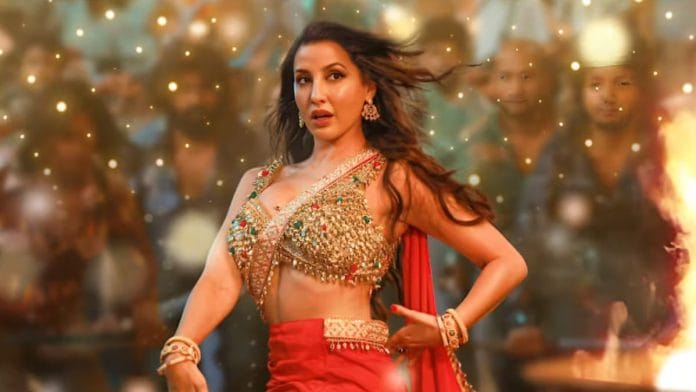
Outrage followed. Some tweets, Instagram stories, and a few “what is this?” reactions. The song was taken off YouTube today, a day after release, but not before several other channels had re-uploaded it. These videos already have millions of views. But where was this energy when songs like Choli Ke Peeche Kya Hai and Fevicol Se were released? Those songs walked so this one could run.
They normalised a certain gaze, a certain language, a certain reduction of women into punchlines. And, we danced along. We ourselves, knowingly or unknowingly, lowered the bar, inch by inch. But now there is barely space left to lower a bar.
Now, this abomination of a song will be played in clubs, with neon lights masking the awkwardness of what is actually being said. It will become Instagram reel material within days, hook steps, remixes, transitions. Influencers will lip-sync without a second thought. Comments will flood in with fire emojis. And just like that, another problematic song will be normalised.
Armaan Malik’s comment that “commercial songwriting has reached a new low” hits the nail on the head, but even that feels like an understatement.
We quickly need to find out what CBFC officials are smoking because their ‘yardstick’ is beyond me. They clear Sarke Chunar Teri Sarke after cutting a 33-second mid-air kiss between Superman and Lois Lane in James Gunn’s Superman (2025).
Then there is Nora Fatehi. Her involvement raises its own set of questions.
Even though she has previously said that she is “not a feminist,” she should be questioned this time.
Not because she owes a specific ideological stance but because this goes beyond the usual ‘item number’ territory. The song is in no sense sensuous. It’s outright crass.
It’s unfortunate that in the end, it’s women who are promoting this content by singing and featuring in it.
Have we killed our conscience for money and virality?
Here, I would like to applaud Shreya Ghoshal for at least admitting her mistake.
Speaking on the podcast with Raj Shamani, Ghoshal said that after the success of Chikni Chameli, she was offered several songs that she felt were objectifying, and she turned them down.
Shreya explained that she is not ashamed of having recorded Chikni Chameli, but is now more selective about the songs she chooses. And, even rejecting Fevicol Se, for “too much objectification”
The real question isn’t why songs like this are being made. That’s easy to answer, because they sell. The real question is why we keep buying.
Why do we keep streaming, sharing, dancing, and then acting surprised? Why do we give these songs the exact attention they are designed to extract? Until that changes, nothing else will.
So yes, Sarke Chunar Teri Sarke is vulgar. It’s very problematic. Yes, it’s a new low. But it’s also exactly where we were headed all along.
And now, here we are, shocked and offended.
(Edited by Theres Sudeep)